Showing posts with label Theophilus Holmes. Show all posts

Thursday, November 30, 2023

Confederate Memphis

   Memphis was both an old city and a new city when the war began. Native Americans, like the Chickasaw and their ancestors, had inhabited the area for centuries. Settlers had built some homes on Fourth Bluff prior to October 1818, when the Chickasaw elders sold more than six million acres of land to the United States. Shelby County, named for Revolutionary War hero and Kentucky governor Col. Isaac Shelby, was established by the Tennessee General Assembly in November 1819. By the time Tennessee left the Union in 1861, Memphis was major port on the Mississippi River. Shelby County had a population of 48,092 people, which included 276 free people of color and 16,953 slaves. This included “bankers and manufacturers, cotton buyers and factors, wholesale grocers and slave traders, doctors and lawyers, editors and railroad presidents.” 22,623 people lived in Memphis alone, making it the thirty-eighth largest city in the United States. Memphis had a fire department, hospital, and city streets paved with cobblestones.[1] 

Memphis, ca.1862, LOC

   When the vote for United States president came in 1860, the men of Memphis cast 2,319 votes for Stephen Douglas, 2,250 votes for John Bell, and a mere 572 ballots for Vice President John C. Breckinridge. The men of Memphis were more inclined at this stage to conditionally support the Union. With the secession of South Carolina in December 1860, the tone of the people in Memphis slowly began to change. Both pro-Union and Secession meetings were held across the city. With the Federal resupply and subsequent Confederate attack on Fort Sumter, followed by Lincoln’s call for volunteers to suppress the rebellion, more and more Memphis citizens supported secession. Tennessee Governor Isham G. Harris called for a meeting of the legislature in Nashville. On May 6, the General Assembly passed a Declaration of Independence. The following day, Harris agreed to a military allegiance between Tennessee and the Confederate government. These actions were ratified by a public vote on June 8.

   Memphis, its port, the most important port in Tennessee, and even more importantly, the railroads, quickly entered the discussion. In August 1861, Confederate Rep. David M. Currin requested $160,000 “for the construction, equipment, and armament of two ironclad gunboats for the defense of the Mississippi River and the city of Memphis.” The bill was signed into law the next day.[2] Prior to the war, from 1844 to 1854, Memphis had a US Naval dock. Several private shipyards still existed along the Mississippi River. Two twin-screw vessels, the Arkansas and the Tennessee, were contracted to John T. Shirley, a local Memphis businessman. He was to deliver the two vessels by December 1861, at a cost of $76,920 each. The ships were to be 165 feet in length, and a draft of no more than 8 feet when loaded. Shirley struggled to find skilled carpenters and shipwrights, and both he and Secretary of the Navy Stephen Mallory implored district commander Maj. Gen. Leonidas Polk for details of men to help with building the ships. Not having enough experienced hands, Shirley concentrated on building the Arkansas. Lieutenant Henry Kennedy Stevens arrived from Charleston, assigned as the executive officer of the Arkansas, and took charge of the operations.[3]

   Memphis appeared in the campaign plans of several Federal commanders, including George B. McClellan, David G. Farragut, and Abraham Lincoln. McClellan’s tenure as general-in-chief was short lived, although he did approve of a plan of taking New Orleans first, followed by Baton Rouge, the railroad hub at Jackson, Mississippi, and then Mobile, before setting his sights on Memphis. Farragut, a  “firm advocate of combined operations,” submitted a plan to force the Confederates out of their defenses around New Orleans, then proceed up the Mississippi River, taking Baton Rouge, Vicksburg, and then Memphis. After firing McClellan, Lincoln’s strategy was “a joint movement from Cairo to Memphis; and from Cincinnati to East Tennessee.”[4]

   Fort Henry, Fort Donelson, and Nashville fell in February. Governor Harris ordered the General Assembly to convene in Memphis on February 20. Island No. 10 fell in April 1862. Only Fort Pillow remained to protect Memphis. Mallory ordered the Arkansas to New Orleans if she was in danger of capture. To the west, the Confederates lost the battle of Shiloh on April 7, and to the south, the bombardment of New Orleans began on April 18. Four of the Southern flotilla from Fort Pillow made their way to Memphis after the fort was abandoned on May 10, 1862. The Federals knew of the construction of the ironclads at Memphis, and Farragut worried that just one of them could destroy most of his ships and maybe even retake New Orleans. Farragut would not get a crack at Memphis.[5]

   Braxton Bragg ordered the evacuation of Memphis, and by June 4, the earthworks constructed on the river were empty. Only the small naval flotilla remained. On June 6, Federal Commander Charles Davis, with five ironclads and four rams, headed toward Memphis. The Confederate fleet, eight vessels mounting twenty-eight guns, under Capt. Joseph E. Montgomery, was the only force between the Federals and city. In the two-hour-long fight, only one of the Confederate gunboats escaped: the General Van Dorn. Three Confederate vessels were destroyed, and four others fell into Union hands. The Arkansas had been towed up the Yazoo River a month before the battle of Memphis. Historian William N. Still, Jr., believes that had the Arkansas been left in Memphis, she might have been finished in time to take part in the battle. The Tennessee was destroyed the night before the battle of Memphis.[6]

   Mayor Parks surrendered Memphis, and the city was occupied by Col. G.N. Fitch and a brigade of Indiana Infantry. The civic leaders had to swear an oath of allegiance to the Union, and martial law was declared on June 13. Maj. Gen. U.S. Grant was in Memphis by June 23, finding the city in “bad order” and “secessionists governing much in their own way.”  Elections were held, and voters were required to swear the Oath of Allegiance before they could vote; property of pro-Confederate sympathizers was seized to pay for acts of destruction caused by partisans; partisans were “not entitled to the treatment of prisoners of war when caught”; it became a crime to display Confederate symbols; and, men between the ages of eighteen and forty-five had to take the oath or leave the city. Because Memphis was firmly under Federal control, Lincoln’s Emancipation Proclamation did not apply to the city.[7]

  With local businesses refusing to open, hundreds of merchants from Cincinnati and Louisville arrived with goods, opening new stores. With open roads, this allowed goods to flow into Confederate hands. One observer believed that more than $20 million worth of supplies left Memphis, bound for the Confederate army, during the war. Confederate forces skirmished with their Federal counterparts in Shelby County frequently.  Memphis became a major supply depot for the Federals operating in western Tennessee, northern Mississippi and Alabama. Numerous raids and large-scale operations, both on the Mississippi River and overland, set out from Memphis. The Federals often retreated to the defenses of the city after confrontations with Confederate commander Nathan Bedford Forrest.[8]

   There was some discussion by the Confederate high command of recapturing the city. In October 1862, Jefferson Davis wrote to Maj. Gen. Theophilus H. Holmes with plans to unite Southern forces in the west and drive the Federals out of the area, recapturing Helena, Memphis, and then Nashville.[9] Nothing came of the idea, but on August 21, 1864, Nathan Bedford Forrest rode into Memphis with 1,500 men and two cannons. “I attacked Memphis at four o’clock this morning, driving the enemy to his fortifications,” Forrest wrote later that day. “We killed and captured four hundred, taking their entire camp, with about three hundred horses and mules. Washburn and staff escaped in the darkness of the early morning, Washburn leaving his clothes behind.”[10] “Memphis Captured by Forrest” ran several Northern newspaper headlines. While Forrest failed to capture the three Federal generals in the city and only held the city for a few hours, he did divert the attention and draw resources away from other theaters of the war.[11]

General Washburn leaving his clothes behind. 

   While Memphis was spared the fate of other Southern cities like Atlanta, Columbia, and Richmond, it had one final role to play for history. On April 27, 1865, the boilers on the S.S. Sultana, carrying over 2,200 former Federal prisoners from Andersonville and Cahaba, exploded in the Mississippi River just north of Memphis. It is believed that 1,195 of the 2,200 passengers and crew perished in the explosion and subsequent fire. The loss of the Sultana was the deadliest maritime disaster in United States history. Many of the victims are buried in the Memphis National Cemetery.

    While every other Southern city with a population of over 20,000 people has a history of its wartime years(and in some case, multiple published histories), Memphis apparently does not.


[1] Dowdy, A Brief History of Memphis, 13-24.

[2] Still, Iron Afloat, 16.

[3] Luraghi, A History of the Confederate Navy, 107, 119, 129.

[4] Reed, Combined Operations in the Civil War, 61-62, 66.

[5] Reed, Combined Operations in the Civil War, 198.

[6] Luraghi, A History of the Confederate Navy, 169; Still, Iron Afloat, 62.

[7] Dowdy, A Brief History of Memphis, 13-24.

[8] Dowdy, A Brief History of Memphis, 13-24; Long, Civil War Day-by-Day.

[9] Papers of Jefferson Davis,  8:454-56.

[10] Wyeth, That Devil Forrest, 417.

[11] Daily Ohio Statesman, August 25, 1864; The Times-Democrat, August 28, 1864; New York Daily Herald, August 29, 1864.

Thursday, May 18, 2023

Camp Holmes

   There was more than one Camp Holmes during the war. In September 1861, there was Camp Holmes  in the Fredericksburg area.[1] Another was located near the mouth of the Little River in Indian Territory.[2] And there was also a Camp Holmes in Raleigh, North Carolina. It is unclear just who was the source of the name for the one in the Indian Territory. The ones near Fredericksburg and in Raleigh were both named for Confederate Lieutenant General Theophilus H. Holmes (1804-1880).

   A North Carolina native and son of former North Carolina governor Gabriel Holmes, T.H. Holmes was a graduate of West Point and a career army officer prior to the war. Holmes bounced around in different commands, including eastern North Carolina. After a lack-luster showing during the Seven Days campaign, Holmes was shuffled off to the Trans-Mississippi theater, commanding the district from October 1862 to March 1863. The new commander, E. Kirby Smith, appointed Holmes to command the Department of Arkansas. Holmes resigned that appointment and was appointed commander of the reserve forces in North Carolina.

   At the start of the war, there were many different camps of instruction in the greater Raleigh area : Camps Badger, Boylan, Vance, Winslow, Wyatt, Ellis, Mangum and Crabtree. Many of the camps were short lived, opened to handle the influx of new volunteers as the state began recruitment efforts in 1861. The Conscription Law mandated that most of these camps be closed. Camp Holmes, opened in 1862, became the primary camp of instruction not only for the Raleigh area, but for the state.[3]

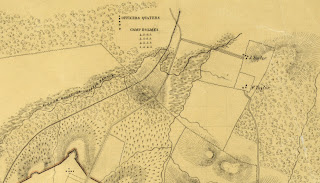
Camp Holmes (National Archives)

  Camp Holmes contained barracks for soldiers, but also a hospital, quartermaster and ordnance depots, offices, and a guardhouse. In charge was Major (later colonel) Peter Mallett. Mallett was able to report by June 10 that he had selected a location to the north of Raleigh for the camp.[4] The camp was opened by July 15, 1862.[5] The primary function of Camp Holmes was to process new soldiers coming in due to the Conscription Law. It was also a place to hold those new recruits and to hold deserters who had been captured, until they could be forwarded to regiments in the field.

   Camp Holmes would assume a new responsibility in March 1863. The previous October, the Confederate Congress had passed regulations stipulating what was to become of recaptured slaves. Section 2 stipulated that the depots for recaptured slaves were to be established by the Secretary of War  “at convenient places, not more than five in number, in each State, and all slaves captured in such State shall be kept in such depots.” According to section 3, physical descriptions of each slave, where they were arrested, and the name of their owners were to be recorded and published in one or more newspapers. Section 4 stated that “While such slaves are in the depot they may be employed under proper guard on public works…”[6] While other states had more than one camp (Virginia had three) North Carolina had only one – the Camp of Instruction in Raleigh.

   The late Walter C. Hilderman III wrote a good book on Confederate Conscription in North Carolina – They Went into the Fight Cheering (2005) that makes frequent mention of Camp Holmes, Colonel Mallett, and the role of Mallott’s Battalion in the enforcement of the Conscription Act. There is not, however, anything on just Camp Holmes or the role of the camp as a depot for recaptured slaves.

The other Camps of Instruction that Cooper designated were  Alabama – Notasulga (Camp Watts) and Talladega (Camp Buckner); Arkansas – Little Rock; Florida – Tallahassee; Georgia – Macon and Decatur; Louisiana – Monroe, Camp Moore, and New Iberia; North Carolina – Raleigh (Camp Holmes); Mississippi – Brookhaven and Enterprise; South Carolina – Columbia (Camp Johnson); Tennessee – Knoxville and McMinn; Texas – Houston; Virginia – Richmond (Camp Lee), Petersburg, and Dublin.[7]


[1] OR Ser. 1, Vol. 5, 884.

[2] OR Ser. 1, Vol. 13, 892, 893.

[3] Hilderman, They Went into the Fight Cheering, 25.

[4] OR, Ser. 4, Vol. 1, 1148.

[5] Camp Holes Letterbook, Vol. 6, Peter Mallett Papers, SHC.

[6] OR, Ser, 2, vol. 5, 844.

[7] OR, Ser, 2, vol. 5, 844.

Thursday, July 25, 2019

Purging the Army of Northern Virginia


   A couple of weeks ago, while filming a short interview with Chris Mackowski of Emerging Civil War (we were at the American Battlefield Trust's Teacher's Institute), I made a comment about the purging of officers from the Army of Northern Virginia after Robert E. Lee was assigned command in June 1862. I had never really counted until today, but fifteen men who were brigade or division commanders during the Seven Days battles were not with the Army of Northern Virginia when it surrendered at Appomattox Court House in April 1865 (this excludes those who died or were killed in action). Did Lee have these officers transferred on purpose? A good question.

Here are the fifteen and what became of them:

John B. Magruder - sent to Trans-Mississippi Department after the Seven Days.

William H. C. Whiting - reassigned to the Military District of Wilmington. Died as a prisoner of war in New York on March 10, 1865.

Richard Taylor - transferred to the Trans-Mississippi Department July 1862.

Bradley Johnson - with the Army of Northern Virginia until 1864, when consolidation removed him from command. Finished the war as commander at Salisbury Prison.

D. H. Hill - shuffled back to North Carolina in February 1863. Commanded a corps in the Army of Tennessee during the Chickamauga-Chattanooga Campaign. Had further run-ins with high command, but finished the war commanding a corps at Bentonville.

Boswell Ripley - bounced around between South Carolina and the Army of Northern Virginia. Commanded a division in the Army of Tennessee during the battle of Bentonville.

Robert Toombs - resigned March 4, 1863, after not getting the promotion he thought he deserved. Later served in the Georgia militia.

Howell Cobb - in November 1862, transferred in November 1862 to the District of Middle Florida. Later in the Georgia Militia.

Stephen D. Lee - November-December of 1862 transferred to Department of Mississippi and East Louisiana. In mid-1864 was a corps commander in the Army of Tennessee.

Roger Pryor - brigade was broken apart in the spring of 1863 and Pryor resigned.

William S. Featherston - transferred to Vicksburg in early 1863, and later commanded a brigade in the Army of Tennessee

Ambrose R. Wright - wounded in 1864, and transferred to Department of South Carolina, Georgia, and Florida.

John G. Walker - transferred to the Trans-Mississippi department after the Maryland campaign.

Benjamin Hunger - relieved of field duty July 12, 1862, and spent most of the war as an inspector of artillery in the Trans-Mississippi department.

Theophilus Holmes - transferred to Trans-Mississippi department July 30, 1862.

Did Lee have some of these men transferred to get them out of his hair? All four most senior major generals in the army when Lee took command were soon elsewhere. While Margruder did an outstanding job fooling McClellan at Yorktown, there were numerous complaints leveled at him following the Seven Days battles, mostly for being drunk. He was very quickly assigned to the Trans-Mississippi Department, but on returning to Richmond to answer the rumors against him, he leveled charges against Lt. Col. R.H. Chilton of Robert E. Lee's staff. That surely did not help his cause.

William Whiting's feud was with Jefferson Davis They had butted heads in late 1861, declining command of a Mississippi brigade. Whiting was gone on sick leave, and when he returned, found his division under the command of John B. Hood.

Benjamin Huger feuded with Joseph E. Johnston over the Seven Pines battle. Johnston claimed that Huger was not ready to attack when ordered. Huger wanted charges preferred. Richard Taylor wrote that "Magruder is charged with incompetency and loss of head, and much blame attached to both his and Huger's slowness." (Davis, The Confederate General, vol. 3, 129)

Lee might have been trying to get rid of Theophilus Holmes prior to the Seven Days battles. There is a letter from Lee to the Secretary of War, dated June 19, 1862, stating that Lee "recommended General Huger's orders to be issued from the Adjutant and Inspector General's Office." (OR 1, vol. 11, pt. 3, 609.)

Lee, of course, was remaking the Army of Northern Virginia. He wanted younger,  more aggressive commanders to take charge of his divisions.

Tuesday, January 17, 2017

Books on North Carolina's Confederate Generals

You've probably figured out that I like lists of books. For several years, I've kept a list of North Carolina counties and their published histories of the War. Well, below is a new list, a list of North Carolina-born general officers of the Confederacy (with one exception). There are several names not on this list, like James H. Lane or William Henry Chase Whiting. They were associated with North Carolina, but came from other states. There are also a couple who are buried in the Tar Heel state but who are not on this list, like William R. Boggs. He came after the war. The only exception that I have made is for Collett Leventhorpe. He was born in England, but when he moved to North Carolina (prior to the war), he never really lived any other place, and is buried in Caldwell County. I have also not included state-appointed generals, like John W. McElroy. These men are only Confederate-appointed generals.

Of the 46 men on this list, 26 have no material published on them, save brief pieces in Warner's Generals in Gray, Powell's Dictionary of North Carolina Biography, or Davis's The Confederate General (6 volumes). Of the 18 who do have biographies, three of those are just sketches, usually presented at a monument dedication or a memorial service. For me, that leaves 16 who have bios. Of that number, six have multiple biographies. Braxton Bragg has eight, William Dorsey Pender, Leonidas Polk, and Stephen Dodson Ramseur have four each, and James Johnston Pettigrew has three. Bryan Grimes had two, and the rest, one each.  

As always, this is a work in progress. If I missed someone, or some book, please let me know. At some point, I will probably update this list to include theses and dissertations, and then maybe articles.

Anderson, George Burgwyn, Brig. Gen.  (1831-1862)
            "A Private" Brigadier-General George Burgwyn Anderson (19--?)
Armistead, Louis Addision, Brig. Gen., (1817-1863)
Baker, Laurence Simmons, Brig. Gen. (1830-1907)
Barringer, Rufus, Brig. Gen. (1821-1895)
            Barringer, Fighting for General Lee (2016)
Barry, John D., Brig. Gen. (1838-1867)
Bragg, Braxton, General (1817-1876)
            Bragg, Braxton Bragg: Military Strategist (1998)
            Hallock, Braxton Bragg and Confederate Defeat, Vol. 2 (1991)
            Hay, Braxton Bragg and the Southern Confederacy (1925)
            Hess, Braxton Bragg: the Most Hated Man of the Confederacy (2016)
            Martin, General Braxton Bragg (2011)
            McWhiney, Braxton Bragg and Confederate Defeat Vol. 1 (1969)
            Seitz, Braxton Bragg, general of the Confederacy (1924)
            Stout, Reminiscences of General Braxton Bragg (1942)
Branch, Lawrence O'B., Brig. Ben. (1820-1862)
Bullock, Robert, Brig. Gen. (1828-1905)
Clingman, Thomas L., Brig. Gen. (1812-1897)
            Jeffrey, Thomas Lanier Clingman: Fire Eater from the Carolina Mountains (1998)
Cox, William R., Brig. Gen. (1832-1919)
            Spruill, A Sketch of the Life and Service of General William Ruffin Cox (1921)
Daniel Junius, Brig. Gen. (1828-1864)
Dockery, Thomas P., Brig. Gen. (1833-1898)
Forney, John H. Maj. Gen. (1829-1902)
            Daugette, The Life of Major General John H. Forney (1925?)
Forney, William H., Brig. Gen. (1823-1894)
Garrott, Isham W., Brig. Gen. (1816-1863)
Gatlin, Richard C., Brig. Gen. (1809-1896)
            Daddis,  Richard C. Gatlin and the Confederate Defense of Eastern North Carolina (2015)
Gilmer, Jeremy F., Maj. Gen. (1818-1883)
Gordon, James B. Brig. Gen. (1822-1864)
            Hartley, Stuart's Tar Heels (1996)
Govan, Daniel C., Brig. Gen. (1829-1911)
Grimes, Bryan, Maj. Gen. (1828-1880)
            Allen, Lee's Last Major General: Bryan Grimes of North Carolina
            Cowper, Extracts of Letters of Maj. Gen Bryan Grimes to his Wife (2014)
Hill, Daniel H., Lt. Gen. (1821-1889)
            Bridges, Lee's Maverick General: Daniel Harvey Hill (1991)
Hoke, Robert F., Maj. Gen. (1837-1912)
            Barefoot, General Robert F. Hoke: Lee's Modest Warrior (1996)
Holmes, Theophilus H., Lt. Gen. (1804-1880)
            Hilderman, Theophilus Hunter Holmes: A North Carolina General in the Civil War (2013)
Johnston, George D. Brig. Gen. (1832-1910)
Johnston, Robert D., Brig. Gen. (1837-1919)
Kirkland, William W., Brig. Gen. (1833-1915)
Leventhorpe, Collett, Brig. Gen. (18815-1889)
            Foley and Cole, Collett Leventhorpe, the English Confederate (2006)
Lewis, William G., Brig. Gen. (1835-1901)
MacRae, William, Brig. Gen. (1834-1882)
Martin, James G., Brig. Gen. (1819-1878)
McNair, Evander, Brig. Gen. (1820-1902)
Pender, William D., Maj. Gen. (1834-1863)
            Hassler, One of Lee's Best Men: The Civil War Letters of Gen. William D. Pender (1999)
            ----The General to His Lady: The Civil War Letters of W. D. Pender to Fanny Pender (1965)
            Longacre, General William Dorsey Pender: A Military Biography (2001)
            Willis, Confederate General William Dorsey Pender: The Hope of Glory (2013)
Pettigrew, James J., Brig. Gen. (1828-1963)
            Bauer, The Long Lost Journal of Confederate General James Johnston Pettigrew (2001)
            Wilson, Carolina Cavalier: Life and Mind of James Johnston Pettigrew (1990)
            Wilson, The Most Promising Man of the South... (1998)
Polk, Leonidas, Lt. Gen. (1806-1864)
            Parks, General Leonidas Polk, CSA (1992)
            Polk, Leonidas Polk; Bishop and General 2 volumes (1915)
            Robbins, The Bishop of the Old South: (2006)
            White, Confederate General Leonidas Polk: Louisiana's Fighting Bishop (2013)
Polk, Lucius E., Brig. Gen. (1833-1892)
Rains, Gabriel J. Brig. Gen. (1803-1881)
Ramseur, Stephen D., Maj. Gen. (1837-1864)
            Cox, Address on the Life and Character of.... Ramseur (1891)
            Gallagher, Stephen Dodson Ramseur: Lee's Gallant General (1995)
            Kundahl, The Bravest of the Brave: The Correspondence of Stephen D. Ramseur (2014)
            Schenck, Sketches of Maj. Gen. Stephen Dodson Ramseur (2015)
Ransom, Matt W., Brig. Gen. (1826-1904)
            Marlow, Matt W. Ransom, Confederate General from North Carolina (1996)
Ransom, Robert, Jr., Maj. Gen. (1828-1892)
Richardson, Robert V., Brig. Gen. (1820-1870)
Roberts, William P., Brig. Gen. (1841-1910)
Scales, Alfred M., Brig. Gen. (1827-1892)
            Conner, Address on Alfred Moore Scales (1907)
Toon, Thomas F., Brig. Gen. (1840-1902)
Ticker, William, Brig. Gen. (1827-1881)
Vance, Robert B., Brig. Gen. (1828-1899)
Wilcox, Cadmus M., Maj. Gen. (1824-1890)

            Patterson, From Blue to Gray (2001) 

Tuesday, January 22, 2013

New North Carolina Civil War books


I was rooting around this evening, and noticed that McFarland has several upcoming books relating to North Carolina and the War, scheduled for release in the near future. Some folks do not like McFarland, but they are leading the way in publishing books about North Carolina and the Civil War. You can check out McFarland's web page here. These include:

North Carolina Civil War Monuments
by Douglas J. Butler
from the publisher:


Through much of recorded history, monuments of stone and metal have honored victorious armies and successful leaders. Following the American Civil War this commemorative tradition expanded to include soldiers of the defeated Confederacy. By the early twentieth century, memorials to the Southern dead and surviving veterans were regional icons, and men of the Confederate army ranked among history’s most commemorated troops. This illustrated history details one state’s commemorative response to a war in which more than 30,000 of its soldiers died in military service: 101 Confederate monuments--and eight Union memorials, including one honoring African American troops--were dedicated across the Tarheel State between 1865 and the Civil War centennial in 1961. The location, design, funding and dedication of these memorials reveal a society’s evolving grief and the forging of public memory. Committee minutes, financial records, legal documents, and contemporaneous accounts are quoted, highlighting the challenging and often contentious process through which these monuments were realized. Manufacturers’ catalogs and advertisements, as well as spirited editorial exchanges in newspapers and magazines, provide further insight into the sculptural, technological and cultural milieu in which these North Carolina monuments were raised.


The Confederate Surrender at Greensboro
by Robert M. Dunkerly

from the publisher:

Drawing upon more than 200 eyewitness accounts, this work chronicles the largest troop surrender of the Civil War, at Greensboro--one of the most confusing, frustrating and tension-filled events of the war. Long overshadowed by Appomattox, this event was equally important in ending the war, and is much more representative of how most Americans in 1865 experienced the conflict’s end. The book includes a timeline, organizational charts, an order of battle, maps, and illustrations. It also uses many unpublished accounts and provides information on Confederate campsites that have been lost to development and neglect.


Theophilus Hunter Holmes
by Walter C. Hilderman III
from the publisher:

The son of a North Carolina governor, Holmes graduated from the United States Military Academy in 1829 and served on the frontier during the "Trail of Tears." He fought in the Second Seminole War and the War with Mexico and, in 1859 , became the U.S. Army’s chief recruiting officer and was assigned to Governors Island at New York City. Only days before resigning from the U.S. Army, he helped organize the naval expedition sent to relieve Fort Sumter from the Confederacy’s blockade.

But then casting his lot with his native state, Holmes led a Confederate brigade at First Manassas and a division during the Peninsular Campaign, commanded armies in the Trans-Mississippi, and organized North Carolina’s young boys and old men into the Confederate Reserves. Holmes served with some of America’s most notable historic figures: Zachary Taylor, Winfield Scott, Robert E. Lee, and Jefferson Davis. In modern times, however, he is virtually unknown. The man and the soldier possessed traits of both triumph and tragedy.