Showing posts with label 37th NCT. Show all posts

Sunday, July 19, 2026

More Confederate diversity – the Bunker brothers

    Several years ago, I wrote a post about the way the Confederate army was racially integrated. Actually, I’ve written on that subject a couple of times, talking about the lives of free men of color like the Townsend brothers in the 26th North Carolina and the Cozzens brothers in the 37th North Carolina. These men volunteered to serve, and, according to the 1860s, they were not white. You can check out those posts here and here.

   Along those same lines is the service of Christopher Wren Bunker. However, Bunker’s father was not Black, but was born in Thailand, as was his uncle. The two brothers are better known as Chang and Eng Bunker, the famous Siamese Twins.

   The brothers were born in the fishing village of Mekong, Siam, now Thailand, in 1811. They were conjoined at birth, and in August 1829, came to the United States. Due to their being conjoined, they were seen as oddities and picked up jobs with Hunter and Coffin and later with P.T. Barnum, traveling around the United States. They decided to settle in the states, became naturalized citizens, broke with Barnum, adopted “Bunker” as a surname, and set out on their own. For a time in the late 1830’s, they quit touring and settled in the Traphill section of Wilkes County, North Carolina.  Eng and Chang met two sisters, Adelaide and Sarah Yates, whom they married in 1843. Eng and Sarah had ten children, while Chang and Adelaide had twelve children. They relocated to Surry County, North Carolina.[1]

   One of those sons was Christopher Wren Bunker, born to Chang and Adelaide in 1845. On April 1, 1863, in Wythe County, Virginia, Bunker enlisted in Company I, 37th Battalion Virginia Cavalry. He was mustered in as a private. Bunker was captured at Moorefield, Virginia, on August 7, 1864, and sent to Camp Chase, Ohio, arriving on August 24, 1864. A descriptive list described Bunker as having a dark complexion, brown eyes, and black hair, five foot eight, and twenty years of age. On March 4, 1865, Bunker was transferred to City Point, Virginia, where he was paroled.[2] 

Christopher W. Bunker (findagrave)

   But wait, there is another Bunker in the 37th Battalion Virginia Cavalry. Stephen D. Bunker, son of Eng and Laura Bunker, also served. According to his widow’s pension record, Stephen D. Bunker enlisted in July 1864. There is no clear record in the 37th Battalion for Stephen, but there are a couple of pages for a D.C. Bunker who was absent wounded in 1864.[3]

   What about the 37th Battalion Virginia Infantry? They were originally known as Dunn’s Partisan Rangers, organized in August 1862. Lt. Col. Ambrose C. Dunn was the first commander. The battalion saw duty during the Jones-Imboden Raid, the battle of White Sulphur Springs, the Siege of Knoxville, and the Valley Campaigns of 1864, including the battle of Moorefield and third battle of Winchester. The battalion disbanded in mid-1865.

   Chang and Eng Bunker passed away in 1874 and are buried at White Plains Baptist Church Cemetery in Surry County, North Carolina. Christopher Wren Bunker passed in 1932 and is buried at the Antioch Baptist Church Cemetery in Surry County.  Stephen D. Bunker passed in 1920 and is also buried at White Plains Baptist Church in Surry County.

   While there is probably not another story quite like that of Chang and Eng Bunker and their sons Christoper and Stephen, there are undoubtedly many other documented cases of diversity in the ranks of Confederate regiments.


[1] Daniel Traywick, “Eng and Change Bunker,” Dictionary of North Carolina Biography, 1: 269-70.

[2] CMSR, RG109, M324.

[3] CMSR, RG109, M324.

Wednesday, July 16, 2025

Saving Pamplin Historical Park: Its Story, My Story, How You Can Help


   On July 16, 2025, my friend Chris Mackowski hit the airwaves for Emerging Civil War News with a fantastic announcement: the American Battlefield Trust is purchasing Pamplin Historical Park. When Pamplin Park opened in 1994, it was hailed as a “major player in that conflict.” (Richmond Times-Dispatch, June 22, 1994.)  The park, separate from the Petersburg National Battlefield, would “refocus attention on the dramatic events that led to the fall of the Confederacy.” (Richmond Times-Dispatch, April 27, 1994) 

   So what was the battle of Pamplin? Well, there was not a battle by that name. The Pamplin part is the name of the family that preserved the property. Located just below Petersburg, the property was purchased in 1810 by William E. Boisseau. Boisseau built Tudor Hall, and the family lived in the structure until 1864. That fall, McGowan’s South Carolina brigade arrived. The Boisseau family went elsewhere (probably Petersburg) and Brig. Gen. Samuel McGowan used the home as his headquarters. McGowan’s brigade left the entrenchments that ran through the farm on March 29, 1865, replaced by Brig. Gen. James H. Lane’s North Carolina brigade. Lane was minus one regiment, but the other four spread themselves throughout the works. One Tar Heel wrote that they were about ten paces apart. In the early morning hours, the massed VI Corps struck the position, breaking through the thinly held lines. Robert E. Lee was forced to evacuate the Petersburg and Richmond lines, moving west. The Boisseaus were forced to sell the property after the war. It was purchased by Asahel Gerow of New York. In the mid-20th century, the property was purchased by Robert Pamplin and his son, direct descendants of the Boisseaus. They are the ones who created Pamplin Historical Park, which not only includes the best preserved earthworks in the nation, but also the restored Tudor Hall, the Breakthrough Museum, and the National Museum of the Civil War Soldier.

   My connection? In the late 1990s, I was working on my first book, a history of the 37th North Carolina Troops. That regiment was stationed in those very works on the morning of April 2, 1865. Pamplin Park had just received the battleflag of the 37th North Carolina on loan from the Museum of the Confederacy. I stood gazing at the flag for some time, counting the bullet holes that had been repaired during the war. Just a few dozen steps away were the breastworks where the 37th North Carolina was located, and where that very flag was captured.

   That history of the 37th North Carolina was published in 2003. In 2005, I wrote an article about the breakthrough for America’s Civil War.  And in 2018, Savas Beatie published General Lee’s Immortals, my history of the Branch-Lane brigade. (You can order the books here)

   I’ve visited Pamplin Park many times over the years. Sometimes, I am a tourist, just walking among the trenches where the breakthrough took place so many years ago. Several times, I have been invited to speak about the events and the Branch-Lane Brigade (twice in 2024). In 2016, a monument to Lane’s Brigade was dedicated at the park. I was not the speaker – Edd Bearss was. But I had a chance to join with a great group of re-enactors, and spend a couple of days doing interpretive programs at the park.

   The American Battlefield Trust needs to raise $600,000 by November to finish the purchase of the Confederate defenses at Pamplin Historical Park (total cost is over $21,000,000). Like most other historic sites, not just those dedicated to the Civil War, Pamplin has struggled since 2020. This is a win-win situation for everyone. The American battlefield Trust already owns 200 acres of land adjacent to this 400+-acre tract. It is the location from which the VI Crops launched its attack. The American Battlefield Trust will continue the excellent stewardship of the Pamplin family and will allow this site to be preserved to teach the future about this important story of the past.

If you would like to help support this important effort to help preserve this unique site, you can find more information here

Tuesday, April 19, 2022

Killing Confederate Prisoners at Fort Gregg

   Any time someone mentions the killing of prisoners during the war, names like Fort Pillow, Saltville, Plymouth, and Champ Ferguson come to mind. In these events, it is always the Confederates killing their prisoners. It is rare to hear about similar atrocities being committed by Federal forces. Yet it apparently happened at the battle of Fort Gregg on April 2, 1865.

"Shoot and be Damned!"

   Following the debacle at Five Forks, southwest of Peterburg, Virginia, on April 1, 1865, U.S. Grant ordered the Federal forces to launch an assault on Confederate lines. Grant believed that given the amount of Confederates his forces faced at Five Forks, Confederate lines had to be weak some place. That assault, early on the morning of April 2, resulted in the breakthrough, most notably along Arthur’s Swamp, held by four regiments of Brig. Gen. James H. Lane’s North Carolina brigade. (There were, of course, other breakthroughs of the line.) Many of Lane’s men not gobbled up in the ensuing early morning breakthrough, or the ensuing counterattack, drifted back towards Battery 45 and the inner Confederate lines. A portion of Lane’s men, along with some men from Harris’s Mississippi brigade and Thomas’s Georgia brigade, were assigned to the defense of Fort Gregg.

   Fort Gregg, and its sister fort, Fort Whitworth, were the idea of Wade Hampton. Hampton proposed the idea of a series of fortifications between the main Confederate line and the inner Confederate line in a letter to Lee in September 1864.[1] Fort Gregg was a crescent-shaped earthen fort. The fort had four cannon emplacements and a palisade fence across the back. Fort Whitworth was an enclosed earthen fortification. Fort Whitworth is sometimes referred to as Fort Baldwin. Both forts were named for local families and both situated in between the two Confederate lines, designed to slow down a Federal advance if the first line of fortifications were breached. As a permanent garrison Fort Gregg had a detachment of 100 artillerymen, mostly drivers, from several different batteries, along with two guns belonging to Chew’s 4th Maryland Artillery. Fort Whitworth had a contingent of the Washington Artillery from Louisiana, along with the 18th and 48th Mississippi from Harris’s brigade. 

   Crowding into Fort Gregg were members of the 12th and 16th Mississippi, 18th, 28th, 33rd, and 37th North Carolina, and the 14th, 35th, 45th, and 49th Georgia Infantry regiments, plus the artillerymen, and an estimated 334 Confederate soldiers.[2] The Federal attack commenced about noon, and there were at least three different waves of Federal attackers. The final wave was able to break through the back entrance to Fort Gregg, while at the same time, use the embankment created by an unfinished line of breastworks connecting the two forts. Confederates inside Fort Gregg were running low on ammunition, some resorting to hurling rocks and bricks at the attackers. On the third attempt, the Federals were able to break through. Some Confederates continued to fight on. Lawrence Barry, 3rd Company, Washington Artillery, had the lanyard of his cannon in his hand as Federals came over the works. An officer told him to drop the lanyard or they would fire. “Shoot and be damned!” he told the Federal, pulling the lanyard and obliterating several Federal soldiers. Those remaining opened fire, killing Barry.[3]

   Many Confederates surrendered. Yet there were several stories that emerged that the surrender of some were not accepted. In 1867, Lt. Dallas Rigler, 37th North Carolina, wrote to James H. Lane about the attack. He mentioned running low on ammunition, using “bats and rocks,” and then the Federals scaling the wall. They entered Fort Gregg’s “walls and after a short struggle they took the fort and some few did fire on after they got possession but their officers tried to stop them.”[4] Captain A. K. Jones, 12th Mississippi, believed that the Federals “were under the influence of whiskey,” and because of the stiff resistance offered by the Confederate defenders, which had produced “a bloody massacre” on Federal attackers, were planning to kill everyone within the Fort. It was the Federal officers “who with cocked pistols made the men desist. . . We lost about forty men killed in the fort after its capture. . . It was ten minutes before the shooting could be suppressed.”[5] George W. Richards, a surgeon attached to Fort Gregg, wrote that as the Federals swarmed into the fort, they “showed us no quarter.” Richards disagreed with Rigler and Jones as to why the Federals stopped killing the Confederates who had surrendered. “It was not so much their officers who caused them to desist from shooting us,” he wrote. Instead, it was when General Lee ordered Poague’s artillery to open fire on the Fort. “one shot after another in rapid succession drove all the enemy on the opposite side of the fort for shelter. Had it not been for Colonel Poague’s guns I believe they would have killed every one of us.”[6]

   Maj. Gen. John Gibbon, commanding the attacking force – the XXIV Corps, agreed that the defenders of the fort held on to the very last, writing that the assault was “one of the most desperate of the war” and that fort was only taken “by the last of several determined dashes with the bayonet.”[7] Brig Gen. Robert S. Foster agreed with Gibbon: “The fighting on both sides at this point was the most desperate I ever witnessed, being a hand to hand struggle for twenty-five minutes” after the Federals gained the parapet.[8]

   Some of the rank-and-file Federals echoed the Confederates. In an 1889 history of the 39th Illinois can be found a letter about the assault, a Federal officer wrote that he was one of the first over the walls, witnessing the carnage inside. It “was with the greatest difficulty that we could prevent our infuriated soldiers from shooting down and braining all who survived of the stubborn foe.”[9] A member of the 12th West Virginia recalled that on the order to charge, “in they went, with an irresistible rush, maddened at the slaughter of their late comrades, and determined to avenge their deaths. That onslaught could not be checked…”[10]

   In the end, the assault cost the Federals, according to John Gibbon’s report, 122 men killed, and 592 wounded. Confederate losses are placed at 57 killed, 243 wounded and captured, with 33 more unwounded captured. All of this to capture two forts that would have abandoned overnight regardless of any other Federal advances. The killing of Confederate soldiers after they had surrendered was quietly chalked up to “maddened” or “infuriated soldiers,” and quietly forgotten. The war in Virginia would all be over in about a week’s time.[11]


[1] Fox, The Confederate Alamo, 15.

[2] Fox, The Confederate Alamo, 234.

[3] Fox, The Confederate Alamo, 182.

[4] Dallas Rigler to James H. Lane, June 17, 1867, Lane Papers, AU.

[5] Jones, “The Battle of Fort Gregg,” SHSP, Vol. 31, 56-60.

[6] “Fort Gregg Again,” SHSP, Vol. 31, 370-372. More accounts can be found in Fox, The Confederate Alamo, 183-188.

[7] ORs., Vol. 46, 1:1174.

[8] ORs., Vol. 46, 1:1177.

[9] Clark, The History of the Thirty-Ninth Regiment Illinois Volunteer Veteran Infantry, 255.

[10] Egan, The Flying, Gray-haired Yank, 391.

[11] ORs, Vol. 46, 1:1174; Fox, The Confederate Alamo, 229.

Friday, November 27, 2020

McClung’s Tennessee Battery

 Many times, people ask where I get ideas. And to be honest, many of my ideas are connected. That first book on the 37th North Carolina led to my books on the battle of Hanover Court House, Watauga County and the Civil War, Charlotte and the Civil War, the book on the Branch-Lane brigade, Feeding the Army of Northern Virginia, and in an indirect way, my history of the 58th North Carolina Troops.

 But at other times, I come across little tidbits that make me just wonder what people or regiments or events get left out of the historical narrative. A few days ago, I acquired the two-volume Broadfoot reprint of Lindsley’s Military Annals of Tennessee. These two volumes provide brief glimpses of Confederate regiments from Tennessee. When finally tracking down McClung’s Battery, listed as Company A, First Tennessee Light Artillery, we simply get that Company A was under Capt. H. L. W. McClung. (870) A few pages over is a list of officers (877). But unlike other infantry and cavalry regiments and artillery batteries, there is no history of McClung’s command.

Crute, in his Units of the Confederate States Army, goes into a little more detail. The battery was organized in the fall of 1861 in Knoxville, Tennessee. It was involved in the battles of Fishing Creek and Shiloh, and then in the summer of 1862, was stationed at Vicksburg, then Port Hudson, then East Tennessee. In April 1864, it was sent with no guns to Saltville, Virginia (I’m not sure why they didn’t have guns). In August 1864, it was re-armed, only to lose its guns at the battle of Morristown, Tennessee, on October 28, 1864. The seventeen men who were left were transferred to Captain Lynch’s Battery and disbanded in April 1865. (317)

McClung's Battery, Shiloh (NPS)
The rangers at Shiloh NMP wrote a facebook post about the battery, and on another site on Barr’s Battery, the editors wrote a piece on McClung’s Battery. This is the most extensive piece written so far, about four pages. The battery was known as the Caswell Artillery. In December 1861, they were reported to have two-six pounders and two 12-pounder cannons. They were not really involved in the battle of Mill Springs, Kentucky, in January 1862, but were forced to abandon their cannon on the retreat. By the time of the battle of Shiloh, they were re-armed, and two pieces were in action on April 7th. In May, the battery was attached to Statham’s brigade, Breckinridge’s corps. The battery was soon in Vicksburg, and in August, was ordered to Port Hudson. By this time, they apparently had rifled cannons. A month later, the command was in Holly Springs, Mississippi. 

By December 1862, the battery was in East Tennessee – David’s brigade, Heth’s Division. For the rest of the war, they bounced around between various posts – Loudon, Carter’s Depot, Zollicoffer. They were engaged at the battle of Carter’s Depot in September 1863, where they lost the carriages to their guns. In November, they were reported as having no cannons. They were sent to Saltville, Virginia, shortly thereafter. It does not appear that they were re-armed until August 1864, when it was reported they had four pieces of artillery. In an engagement at Morristown, Tennessee, in October 1864, most of the battery was captured. The seventeen who escaped were assigned to Lynch’s Battery. The battery was disbanded in April 1865 at Christiansburg, Virginia.

Several months ago, I was exploring Captain Hugh McClung’s service record. He was court martialed in 1863. Many courts martial records were lost at the end of the war, but parts of McClung’s survive. There were six charges against him – violating the 14th, 36th, 39th (twice), 45th articles of war, and  “Conduct to the prejudice of good order and military discipline.” Many of these charges concerned falsifying muster rolls, “misapplying an artillery horse,” drunkenness while on duty, and permitting his men to break into a train car. McClung pled not guilty. The court found him not guilt on most of the charges, but he was guilty of trading artillery horses at Corinth in May 1862;  “Habitually failing to restrain his men from trespassing and depredating private property”; and, “Habitually drawing and appropriating to his own use, rations belonging to his men…” The court found him guilty. His punishment was to “forfeit all pay due him from the Confederate States, and that he be dismissed from the service.” However, when Major General Simon B. Buckner reviewed the case, he disagreed, finding that the charges were “utterly unfounded… the offences of the accused were rather those of omission than commission.” Buckner recommended mercy. The general added that during the attack on Knoxville, McClung, there under arrest, “offered to serve in any capacity.” Buckner believed that “Such conduct was worthy of a good soldier, and merits leniency.” Buckner remitted the findings of the court and ordered McClung to report to his battery. McClung would go on to be captured at the battle of Morristown and spent the rest of the war as a prisoner at Johnson’s Island.

Can I say that this will be my next regimental history? No, I can’t. But I find the story intriguing and the credible information in the greater realms of Confederate histography lacking. Now you know how projects come to me.

Thursday, January 10, 2019

Peas!


   One of my favorite stories I have uncovered over the past 25 years of researching and writing has to do with the lowly pea. I used the story in both my first book, a history of the 37th North Carolina Troops, and in General Lee's Immortals, my history of the Branch-Lane brigade. The person who told the story was Pvt. David Dugger, Company E. He was from the mountains of western North Carolina. Being shelled by the Federals was a new experience for the Confederate soldiers below New Bern, where in March 1862, this story takes place. Dugger and another private had been sent to the rear to cook food for the men manning the front lines.

   On the return [to the company] we had about a half dozen camp kettles full of peas.  The kettles were strung on a pole, with George [Lawrance] at one end and I at the other.  We had to go through a pine grove, and while going through there, we heard our first bomb shells, and we did not know what they were, and there we stood looking and wondering what on earth they could be as they went whizzing through the air.  Presently one cut the top out of a pine, and then we found out what they were and forthwith proceeded to hug the earth without getting our arms around it.  As soon as the sound of the shell died away we gathered our pole and started to the Fort.  When we got there we had peas all over us, so that we could hardly be told from the peas. (Watauga Democrat June 18, 1891)

   Recently, I re-read Berry Benson's Civil War Book. This is one of those volumes I read decades ago, and I had forgotten that Benson had his own pea story. Benson's story comes at the end of the war. He's experienced "bomb shells" a plenty, but was captured, held prisoner, escaped, and just seen a good deal of the war. Benson and his comrades have evacuated the entrenchments around Petersburg, and are on their way to Appomattox Court House.

Cow peas
   As I ran up the low hill, the shells bursting all around, I came upon a camp fire abandoned by its maker, and upon it sat boiling a pot full of peas. The fear of getting killed was strong, I admit, but hunger was a match for it. I saw Lieut. Hasell running by and called to him to come quick. Running the barrel of my gun through the handle of the pot, I gave him the butt, took the muzzle myself, and off we went amidst the crackling of the shells, bearing to a place of safety our pot of peas. But alas for human endeavor! When we finally reached a place where we could stop, we found the peas but half done, so turned the pot over to Owens to cook while we went on to the picket line with the Sharpshooters. When i next saw the pot... there was not a pea left to tell the tale." (197)

   We here at Confederate History Headquarters had a discussion about what type of pea this might be. Several soldiers mention cow peas in their correspondence. These differ from the garden pea in that the cow pea could be dried more readily.  According to seed catalogs, a cow pea is also known as black-eyed pea, southern pea, yardlong bean, catjang, and crowder peas. There are several varieties of this staple food, which is more like a bean than a pea. The cow pea grows in "sandy soil" with low rainfall. Soldiers seemed to eat them by the bucket full any occasion they could get. Looking at Francis P. Porcher's Resources of the Southern Fields and Forest (1863), Porcher writes that "Great use is made of the varieties of the pea on the plantations... as articles of food for men and animals. The species called the cow-pea is most in use." (194) As I work on the Feeding the Army of Northern Virginia project, peas and cow peas are mentioned frequently. Only once, in the reminisces of Col. William Poague, has someone mentioned black-eyed peas. (150). It could be that different areas had different names for the same pea. Certainly, none of the black-eyed pea-eaters I know (myself included) use the name cow peas.
   

So the next time you set down to a meal with cow peas (or black-eyed peas), remember for a moment David Dugger and Barry Benson, and all the other Confederate soldiers who ate these peas! Happy New Year!

Thursday, October 25, 2018

Examining new recruits.


Once a young man (or sometimes an older man) joined the army, he was supposed to be examined by a surgeon or doctor.

Turning back to the Confederate regulations and the recruiting service, new recruits were required to be examined. Article #1453 states: "The superintendent or commanding officer will cause a minute and critical inspection to be made of every recruit received at a depot, two days after his arrival; and should any recruit be found unfit for service, or to have been enlisted contrary to law or regulations, he shall assemble a Board of Inspectors, to examine into the case. A board may also be assembled in a special case, when a concealed defect may become manifest in a recruit, at any time during his detention at the depot." (Regulations of the Confederate Army, 1863, 394)

William M. Whisler, Asst. Surg. 1st SC (Orr's)
Article #1455 reads: "Recruits received at a military post or station shall be carefully inspected by the commanding officer and surgeon, on the third day after their arrival; and if, on such inspection, any recruit, in their opinion, be unsound or otherwise defective, in such a degree as to disqualify him for the duties of a soldier, then a Board of Inspectors will be assembled to examine into and report on the case." (Regulations of the Confederate Army, 1863, 394)

The latter requirement is reiterated elsewhere. Article #1194 states "As soon as a recruit joins any regiment or station, he shall be examined by the medical officer, and vaccinated when it is required, vaccine virus being kept on hand by timely requisition on the Surgeon General." (Regulations of the Confederate Army, 1863, 238)

Chisolm's A Manual of Military Surgery stated that new a recruit "before he is received undergoes a critical examination by the recruiting medical officer, who rejects all blemishes as well as those conditions showing a predisposition to disease..." (16)

Just what did that critical examination look like? Turning again to the Confederate Army Regulations, article #1192: "In passing a recruit, the medical officer is to examine him stripped; to see that he has free use of limbs; that his chest is ample; that his hearing, vision, and speech are perfect; that he has no tumors or ulcerated or extensively cicatrized legs; no rupture, or chronic cutaneous affection; that he has not received any contusion, or wound of the head, which may impair his faculties; that he is not a drunkard; is not subject to convulsions, and has no infectious disorder, nor any other that may unfit him for military service." (238)

Obviously, some surgeons faithfully did their jobs. There were 27 men rejected from the 37th North Carolina Troops. Not once do the compiled service records list why these men were rejected. Usually, it has their enlistment date, and simply that they were rejected. It is unclear if they were examined by a local doctor, or if they were rejected once they arrived at camp and were examined by a post surgeon. Many of these men later joined other regiments. Soldiers seldom wrote home about the process of being inspected by a surgeon.

Surg. Walter T. Adair 2nd Cherokee Mnt. Vol.
But there were obviously lapses in the inspection process. Sarah Malinda Blalock joined the 26th North Carolina Troops in March 1862, under the name of "Sam Blalock." She posed under the guise of her husband's younger brother. She was in the army for a month, apparently never examined by a surgeon. It was only her disclosure, after her husband's discharge, which led to her dismissal from the army.

As time went on, reason for being rejected decreased. In February 1863, orders informed examining officers that defects such as "general debility," "slight deformity," partial deafness, speech impediment "unless of a very aggravated character," functional heart trouble, muscular rheumatism, epilepsy-unless clearly proven, varicocele-"unless excessive," myopia, hemorrhoids-"unless excessive," "opacity of one cornea, or the loss of one eye," "loss of one or two finger," and "single reducible hernia" were "not deemed sufficient and satisfactory for exemption." (Cunningham, Doctors in Gray, 164)

It would be interesting to note (or track) any upticks in a regiment's members on a sick list, before and then after February 1863. Of course, new regiments suffered from measles, mumps, and a host of other calamities that ran rampant through the camps. Was there an uptick of new recruits (post February 1863) hospitalized for one of the ailments listed above? A more serious question would be: how did the revised regulations strain the Confederate hospital system?


I'll be watching for mentions of new recruits being examined as I continue my read through Confederate letters and diaries.

Monday, February 19, 2018

Who shot Jackson?

Ok. That one is pretty easy. Almost everyone agrees it was the 18th North Carolina Troops who shot Jackson. It was not their fault: it was dark; Jackson should not have been out in front of his men that close to the front lines, etc., etc. Scott Ellis recently asked me a much harder question: what company of the 18th North Carolina shot Jackson? We don't actually know, which leads to a much harder, technical question: how were companies deployed in a line within a regiment?

Image result for illustration from Hardee's Light infantry
from Hardee's Light Infantry Tactics (1861). 

Some basics: A standard infantry regiment during the war was composed of ten companies. Each company was composed of 100 men, at least early in the war. By mid-1863, it was probably half that. Each company, once a regiment was created, was given a letter designation - A through K, skipping the letter J because it looked too much like the letter I. Traditionally, when ten independent companies were gathered at a training camp, they were given permission to form a regiment and elect their colonel, lieutenant colonel, and major. Then the independent companies were given letter designations. It would be nice to assume that Company A was the oldest company in the regiment, Company B the second oldest, etc., but that does not appear to be true. In looking at three regiments, the 16th North Carolina, 26th North Carolina, and 37th North Carolina, the companies are not lettered chronologically. It is possible that the Company lettering was based upon when they received permission to organize from the governor. (That would take more research to prove.)

We could then assume that Company A would be the first company in line, followed by Company B, Company C, etc. But that's not the way the period manuals laid out the regiment. The very first paragraph in the 1861 edition of Rifle and Light Infantry Tactics... by W. J. Hardee reads: "A regiment is composed of ten companies, which will habitually be posted from right to left, in the following order: first, sixth, fourth, ninth, third, eighth, fifth, tenth, seventh, second, according to the rank of captains." (5) The last little phrase "according to the rank of captains" is what makes this confusing.

Going back to the 37th NC, the regimental line, based upon the seniority of the captains, should look like this on November 20, 1861 (this is from the right): A, E, C, G, K, H, D, I, F, B. That changes on November 21. Capt. William M. Barber (Company F) is promoted to lieutenant colonel and Capt. John G. Bryan (Company G) is elected major. Their successors are now the junior captains in the regiment. 1st Lt. James Reed replaces Captain Bryan, and Pvt. Charles N. Hickerson replaces Captain Barber. Since Hickerson is elected from the ranks, he is the junior captain of all the company commanders in the 37th NC. Now the companies are in line, from the right: A, E, C, G, K, I, D, F, H, B. Usually, the companies on the far right and far left are designated flank companies, or skirmish companies. At times, they are armed with rifles, while the rest of the companies are armed with smoothbore muskets.

Now, this raises a serious question that I have never been able to answer. During the war, when captain turnover was frequent, did the companies change position in the line? I could see this in the old US Army, prior to war. Companies were rarely together to begin with, often stationed at various posts some distance away. Looking at the 37th NC on May 1, 1863, right before the battle of Chancellorsville, the companies should be, from the right, A, E, H, I, D, G, F, K, B, C. And even this may not be right. Captain John Hartzog of Company A was originally elected as captain on August 27, 1861. He resigned and went home on July 15, 1862, but was re-appointed as captain of Company A on February 9, 1863. Does his previous rank come into play?

The reason I use the 37th NC for an example is this: I actually have a listing of companies in line. Noah Collins, in his post-war writings, lays out the company line in late 1861 (from the left): D, B, E, C, K, I, H, G, A, F. As you can see this is nothing like how it should be, according to the rank of the captains.

Along those lines, has anyone ever seen another account of a Confederate regiment where the companies were designated in line? I've been reading letters, diaries, and regimental histories, and I don't recall seeing this any other place.

So, to go back to Scott Ellis's question, no, I don't know which company of the 18th NC shot Jackson. I'm not sure we will ever know the answer to that question. 

Monday, January 29, 2018

The Most Recognizable Flags in the Confederacy?


18th NC flag, NC Museum of History 
Did the Branch-Lane brigade have the most recognizable flags in the Confederacy? Quite possibly. On the front cover of my new book is the "Branch pattern" flag of the 18th North Carolina Infantry. It is a standard 3rd pattern Army of Northern Virginia flag, with battle honors painted in a distinct white scalloped style. As far as I can tell, no other ANV infantry regiment ever had such a distinctive style flag. The flags of the 3rd, 13th and 15th South Carolina are similar, but not enough to attribute it to the same painter. The battle honors are not as bold.

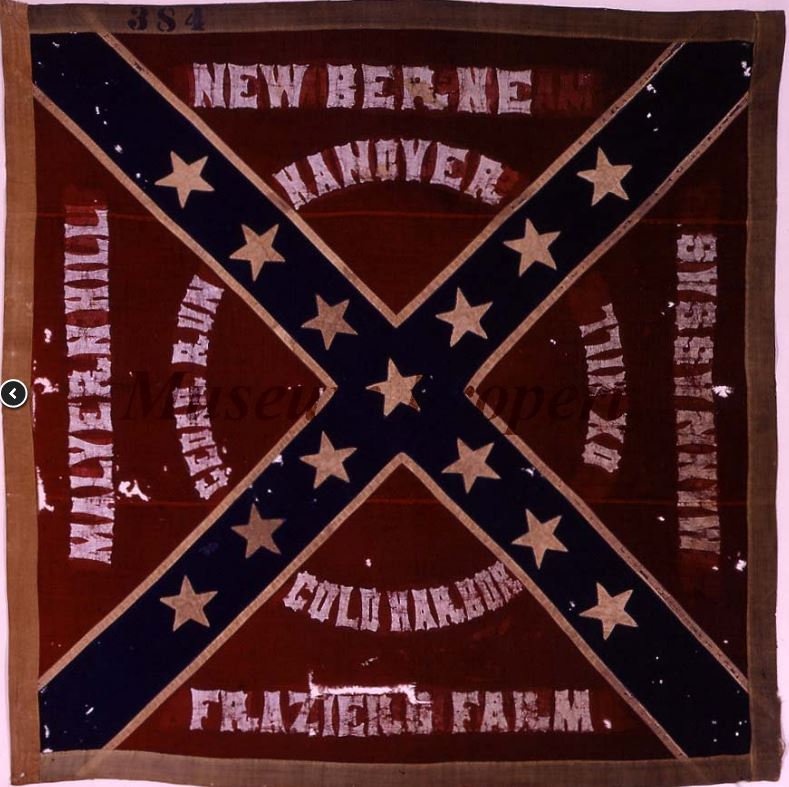
Following the Seven Days battles, Brig. Gen. Lawrence O'Bryan Branch was authorized to have new battle flags inscribed with the regiments' battle honors. The quartermaster was responsible for furnishing flags to the brigade. The flags of the 7th, 33rd, and 37th regiments were authorized to be emblazoned "New Berne, Slash Church, Mechanicsville, Gaines Mill, Fraziers Farm, [and] Malvern Hill." The flags of the 18th and 28th regiments were embellished with "Slash Church, Mechanicsville, Gaines Mill, Fraziers Farm, [and] Malvern Hill."

37th NC flag, Museum of the Confederacy
When the flags of the regiment were issued to the brigade in December 1862, the battle honors had undergone some changes. Instead of "Slash Church," the flags now had Hanover. Gaines Mill was now Cold Harbor. Other honors were listed as well, including Cedar Run, Manassas, Manassas Junction, Ox Hill, Shaprsburg, and Harper's Ferry.

According to the compiled service records, the flags arrived in camp in early December 1862. Captain George S. Thompson, quartermaster for the 28th Regiment, signed for his regiment's flag on December 4, 1862. The statement reads "One Battle Flag with inscription." That's an important little fact. I would take it to mean that the flags arrived in camp, from Richmond, already painted with their battle honors. Obviously, there was some discussion from the time that Branch requested the flags, until when they were actually painted (after September 1862) with someone at the Quartermaster's Department.

28th NC flag, Museum of the Confederacy 
The brigade, now belonging to James H. Lane, carried these flags through the battles of Fredericksburg and Chancellorsville. The 18th NC lost its flag at Chancellorsville. Glen Dedmondt writes in his book, The Flags of Civil War North Carolina, that A. P. Hill's division was issued new flags in June 1863. The 7th NC obviously stuck their "Branch" flag back in a wagon. Their new flag was captured on July 3, on the slopes of Cemetery Ridge by a member of the 1st Delaware Infantry. The 28th North Carolina also lost a flag, but not the new one. Their Branch flag was captured on July 3. Dedmondt believes the 33rd NC carried its new flag through the Gettysburg campaign, until it was captured at the Wilderness on May 6, 1864.

33rd NC flag, Museum of the Confederacy
So the Branch pattern flag of the 18th was captured at Chancellorsville, and that of the 28th at Gettysburg. The 37th North Carolina's Branch flag was captured on April 2, 1865, as the Federals overran the breastworks below Petersburg. The 33rd North Carolina's Branch Pattern flag was supposedly in Battery Gregg as the fighting took place. It was captured at some point after April. So what became of the 7th's Branch pattern flag? The 7th NC had been ordered back to North Carolina in February 1865, to try and help round up deserters. Instead of surrendering their flag, the men cut it up, each taking a piece of it home with him. This seems to be a common practice with Army of Tennessee regiments.

Pieces of all three flags survive. A fragment of the 7th NC's Branch pattern flag is at the North Carolina Museum of History, along with the 18th NC's Branch pattern flag. The Branch pattern flags of the 28th, 33rd, and 37th Regiments are at the Museum of the Confederacy.

7th NC flag fragment, NC Museum of History 
Back to my original argument. I would say that the Branch pattern flags of the Branch-Lane brigade are the most distinctive depot-issued flags of the Army of Northern Virginia.


Thanks to Charlie Knight of the North Carolina Museum of History for help with this post. 

Friday, September 02, 2016

Hard times after the war.

Recently, I was looking through the records of the African-American Freedmen's Bureau, attempting to flesh out my knowledge of a local family who were Unionists, and slave owners. While that quest was unfruitful, I did find an interesting piece.

Like most of the South, North Carolina was in a state of flux after the war. People were trying to figure out and adjust to whatever the new normal was. I often tell the story of Harvey Bingham, former member of the 37th NCT, and after mid-1863 major in the 11th Battalion, North Carolina Home Guard. Bingham did such a good job after the war, rounding up deserters and conscription-dodgers, that he was forced to move from the area. He relocated to Statesville and opened a law school. While looking through the Freemen's Bureau records, I found another case, albeit from a different angle.

On May 19, 1866, Lt. P. E. Murphy, the Freemen's bureau agent in Asheville, wrote to Col. Clinton Cilley in Salisbury. His main question concerned with what to do with children who were under 14 and were orphans, or had been abandoned by their parents. But he had another problem. Murphy writes: "There is a colored woman here with four small children who is very destitute and the people about will not give her work for the reason that her husband gave some information to our troops when they came in here. The husband was obliged to leave this place and is now in Chattanooga, Tennessee, and she wants to get to him. Is there any means by which she could be helped[?] Her name is Adelaide Walker."

Next, I looked in the 1870 census for Buncombe County, but no Adelaide Walker. Maybe she finally made it to Chattanooga. Maybe she remarried, or, maybe she died.


It is not possible to know how many times the story above was repeated in North Carolina in the years right after the war: Confederate soldiers returning home to discover loved ones dead or farms burned; Union soldiers unable to deal with the strife the war generated with their pro-Confederate neighbors and family; or people simply wanting to put the past behind them. They all left, taking their stories with them. 

Monday, February 15, 2016

The Charge of General Lee (or did he?).

It is a familiar scene for those of us who study the War. General Lee, concerned about repairing the breach, twice appeared at the head of Confederate troops, prepared to lead them into the heat of the battle. At the Wilderness, it was at the head of the Texas brigade. During the morning fight at Spotsyvlvania Court House, almost a week later, it was Gordon's brigade of Georgians.

Yet, is there a third account that has gone unreported in the annuals of history.

Spotsylvania Court House marker
On the afternoon of May 12, Lee appeared along the line near Heth's Salient. He sent some of the Sharpshooters from Lane's North Carolina brigade forward to ascertain if a Federal battery was supported by infantry. Based upon the intelligence gathered, Lee chose to attack and capture the battery, and roll up Burnside's flank, if possible, relieving the pressure on the Mule Shoe. Lane's brigade, supported by Weisiger's brigade, moved out into the woods , capturing the battery and striking the flank of a new division of Burnside's men being launched towards the Confederate lines. Lane's attack was successful to a degree: the Federal guns were captured, although there was no way to bring them off the field, and Burnside's attack crumbled. Lane might have accomplished more if Weisiger had not become lost in the woods, firing into the rear of the North Carolinians.

Did Robert E. Lee, commander of the Army of Northern Virginia, lead Lane's attack?

Two post-war accounts lean in that direction.


Brig. Gen. James H. Lane wrote about his near capture on June 30, 1983: "That afternoon [May 12, 1864], in obedience to orders from General Lee and under his eye, we crossed the works and entered the oak woods, from which we drove the enemy's skirmishers, and attacked Burnside's corps in flank as it advanced to assault the salient. The General and staff and all of the regimental foot officers were on foot."

Two points about this account. One: Lane writes that they were under the "eye" of General Lee. That simply could mean that Lee watched the brigade advance over the works and into the woods, or that Lee had accompanied them further. Two: All throughout the article, Lane refers to himself in first person. "I was with that part of the line which swept over the Federal battery," he writes. Yet Lane tells us that "The General and staff and all of the regimental officers were on foot." He does not write "[I] and [my] staff and all of the regimental officers."

The second account comes from Octavious Wiggins, a lieutenant in the 37th North Carolina, and was written in 1903. Wiggins chronicles that the men were under artillery fire as they move over the works and into the woods. He then writes: "General Lee was riding very close to us at the time" that the attack started. (Clark, North Carolina Regiments, Vol. 2, 666.)

A third account, written by William W. Chamberlaine, a staff office under Lee, seems to dissuade me of the idea. He writes that as the attack was going forward (totally leaving out Lane, who did the lion's share of the work), Confederate artillery opened fire on Burnside's men, and Lane's brigade got caught up in it. Chamberlaine writes that "soon we saw General Lee galloping on the road towards us. Shells were dropping in the road, but he reached us in safety. He directed General Early to have the Batteries cease firing." Chamberlaine's account was published in 1912.


Three accounts: two that lend support to the idea that Lee was close by Lane's brigade during the attack, and third stating he was not. Sure wish I could find something from 1864 to confirm either account. 

Monday, January 18, 2016

Was Colonel Barber Present at Gettysburg?

Pick up any order of battle for Confederate forces commanding at Gettysburg, and Col. William Barber, of the 37th North Carolina Troops, is not listed as being in command of the regiment during the battle. He was wounded at Chancellorsville, and, according to the North Carolina Troop  books, he did not return until "prior to September 1, 1863." Instead, many believe that the regiment was commanded by Lt. Col. William G. Morris, who was captured on July 3, 1863.

But I'm still not convinced. And here is why.

General Lane drafted his official report on August 13, 1863. Concerning the attack of Lane's brigade on the afternoon of July 1, the General writes, "We then moved forward about a mile, and as the Seventh Regiment had been detained a short time, Colonel Barbour threw out 40 men, under Captain [D. L.] Hudson, to keep back some of the enemy's cavalry....." Lane mentions Baber one other time, toward the close of the report, writing that "Colonel Barbour, of the Thirty-seventh, refers to his heavy loss as sufficient evidence of the gallantry of his command." Lane  never mentions Lieutenant Colonel Morris. These sources all come from the Official Records, Volume 27, pat. 2, page 664-668.

My second piece of evidence comes from the letter of Capt. Thomas L. Norwood of Company A, 37th North Carolina. Norwood was wounded and captured on July 3, and a couple of days later, escaped. Norwood arrived back within Confederate lines on July 12, and even had breakfast with Robert E. Lee. The general quizzed him about what he had seen on his sojourn through Federal lines. Norwood was in a hospital in Richmond when he wrote his father a letter about his adventures. In this letter, dated July 16, 1863, Norwood writes that after his breakfast with Lee, he "reported to Col. Barber who sent me to the hospital here at Richmond."

One final piece of evidence to consider: Lieutenant Morris was held as a prisoner of war until March 22, 1865, and never rejoined the regiment. On October 1, 1877, he wrote a letter to the Raleigh Observer about his Gettysburg experiences. At no point in the letter does Morris mention Barber, but at the same time, Morris never mentions being in command of the regiment. He does write: "I was Lieut. Colonel of my regiment." I would think that had he been in command, he would have noted it.
So there you have it, why I feel that Barber was in command of the 37th North Carolina at Gettysburg. Do you agree or disagree?

PS: Is it Barber or Barbour? The family spells it Barber. About half way through the war, it is clear that Barber started signing his correspondence Barbour. However, when it came time to erect a tombstone, the family went with Barber.

PSS - I found another piece. Barber endorsed the resignation letter of Lt. Thomas Kerns on May 17, 1863. Yet another piece, in my opinion, that points that Barber was present in this time frame. 

Monday, December 28, 2015

The Landscape of War and brigade history.

   Lately, I've been doing some reading in the Landscape of War, and thinking about how I can incorporate this idea into a brigade history. How did the men in the Branch-Lane brigade "perceive their natural environment and their place in it"? (quoting Lisa M. Brady, author of War Upon the Land: Military Strategy and the Transformation of Southern Landscapes during the American Civil War). I am not at this time, however, so much interested in how a brigade transformed the landscape (which they did), but instead, how they perceived the changing landscape around them.

   In an essay on the subject, Megan Kate Nelson (The Journal of the Civil War Era, Vol. 3, No. 3, September 2013) writes that soldiers, in writing home, "sought to exert control over their lives by explaining the world around them to themselves and their loved ones."

  A great place to see a soldier explaining the landscape around him can be found in the letters of Bennett Smith, a member of the 37th North Carolina Troops. Smith was 25 years old and living in Watauga County when he enlisted on September 8, 1861. He wrote his wife Jane several times throughout his service in the Confederate army. It is unlikely that Smith had ever ventured far from his mountain home prior to the start of the war.

   Smith's February 24, 1862, letter is full of landscapes. "I hav sean a hep of curyous things," he writes. "this is a pore contry down hear it is a white sandy lan and jast as full of grean briars as it can bee[.] Smith added that "The water is bad hear I had rather drink out of them mud holes thare on Brushy fork[.]" Smith also mentioned the forts in the area and the Neuse River.

   Writing on March 6, 1862, Smith gives us a glimpse of another aspect of his changing landscape. "There is so mutch nois here Some eavnings here That I cant here them fire the canons at the forts[.]"

   Following the loss at the battle of New Bern, Confederate forces retreated to Kinston. "We hav a house to stay in now wher we are it is rite smrt toun" he wrote of Kinston on March 15, 1862.

   Water seemed to be a recurring theme for Smith - more so than in most letters that I have read. On April 13, 1862, at Camp Holmes, he wrote that "The water runs sloe down here & looks of a redish color[.]"  Smith goes on to add "As to this being A helthey place I dont think it will it i to low and swampy[.]"

   In early May 1862, the 37th NCT was transferred to Virginia, and Smith found himself passing
through Virginia. "The part of Virginia that I come threw is a butiful contry Some of the pretiest farms I evry saw I think it will be helthy here their is mountains here the timber is gitting green[.]"  Undoubtedly the Confederate capital was the biggest city Smith had even been in. "[Richmond] is a big place & Just any thing you want to sea you can sea nearly  I saw the Statute of Washington  he was siting on a horse Jest looked like man drest in milatery close... the nigurs was drest finer than the white people in Watauga...”   Once again, Smith also mentioned water in this May 8, 1862 letter: "The water dont taist good it is cold a nuf it is Slait Stone water[.]"

   Smith was captured during the battle of Hanover Court House on May 27, 1862. He was taken to Fort Monroe and paroled at Aiken's Landing, on August 5, 1862. Smith was absent without leave from October 20, 1862, through mid-January, 1863. He probably made his way back home, and was able to tell Jane about seeing the Atlantic Ocean, Fort Monroe, and other sites.

    By January 27, Smith was back with the army, writing home and describing the breastworks at Fredericksburg. The plain in front of the breastworks was "2 miles" wide and "Just as level as a house flore..."

   Smith wrote that he was ill starting in February 1863. His descriptions of his surroundings became fewer. For a while, he did nothing but "lay a bout my hut[.]" Of course, since Smith's part of the Army of Northern Virginia was stationary from mid-December until early May, Smith would not have had much news in regards to a change of scenery to commit to his letters. On April 7, Smith commented on the wind and mud, "the stickeyes mud I ever saw[.]" He goes on to comment about the health of the regiment not being good, partially due to the filthiness of the area and that "the water is not very good[.]"

   Smith set out with the 37th NCT when they headed to Chancellorsville, but was sent to the rear because of the problems with his feet.

   Bennett Smith's last letter home was written on June 18, 1863. Smith, suffering from "hydroxthrus" and/or "dropsy" was sent to a hospital in Lynchburg, Virginia. He thought Lynchburg "a very good place hear[.]" He had a clean bed and plenty of food. Smith died in Lynchburg on June 30, 1863.


   Smith left a dozen or letters, kept by his family, and thankfully, shared with me while I was working on the book on the 37th North Carolina Troops. He has provided us with some insight on how a mountain soldier viewed the new world opened up to him by the war. Nelson finishes her article by reminding us that "By seeing landscapes clearly, we gain new insights into the Civil War's many and varied histories." In my opinion, Smith's is one of the best. I just wish he had survived the war. 

Wednesday, August 19, 2015

Looking for John Polk

   In Volume 8 the North Carolina Troops books series, on page 148, we find this:
Polk, John -----
Negro. Served as "body guard to Colonel Samuel Lowe" of this regiment.

Who was John Polk? Was he a slave owned by Colonel Lowe? A freeman? Inquiring minds want to know more.

I've been writing today about free persons of color and slaves attached to the Branch-Lane brigade. Talk about an area in which there is a total lack of research. There are, I believe, a couple of reasons for this gap. First, people seem more interested in adopting positions than actually doing the research to confirm or refute their ideas. The positions run the gambit from "There were no blacks in the Confederate army," to "There were no blacks willingly serving in the Confederate army," to "There were tens of thousands of blacks willingly serving in the Confederate army." Second - it's not easy to find good sources, especially when the "National Narrative" is already against you. Why is this? I believe the reason why we don't find more mention of black men serving right alongside white men in the ranks is this: it was not an uncommon practice prior to the war. They worked in the fields together, in towns together, often attended church together, and, given that the majority of slave owners only owned one or two slaves, often lived in the same house together.

On a couple of occasions here on this blog, I've talked about the Cozzens/Cossens/Cousins brothers. They were free people of color who voluntarily served in Company B, 37th North Carolina Troops. In one letter from another member of the 37th NCT, I have a list of men messing together. The Cozzens are included in that list. This clearly was no big deal to the writer of the letter.  While this is scant evidence of the theory that I proposed above, it is a start.

So just how many free men of color, or slaves, served in or simply served Confederate regiments? That is impossible to say. But I did a little sample. There were 139 men who served in the officers corps of the 37th NCT. Officers were, historically, better educated and wealthier and could afford slaves. I took the officers of two companies from Watauga, B and E. Out of the twelve officers in Company B, nine were from Watauga. In Company E, seven out of eleven were from Watauga. According to the slave census, only one officer in Company B owned slaves - Jonathan Horton. He owned five, and could possibly have brought one from home. Likewise, in Company E, only one man, William F. Shull, owned slaves. He owned three, and could have brought one from home. If that tally is true for every company, then there might have been one slave brought from home for each company. Of course, that slave would be attached to his master, and possibly his master's mess mates.  It is possible that this number would be greater in a regiment recruited earlier in the war. I've not written about a regiment recruited early in the war (yet), so I'm not sure. You might easily add three or four more for the field and staff. I also have some records of soldiers renting servants. But, they often do not specify whether they were renting slaves or freemen. So, maybe fifteen slaves or servants tending to their masters in a regiment?

In the Branch-Lane brigade, I have identified twenty-three men who served as teamsters during the war, a position traditionally occupied by black men. But so far, I have not been able to identify any of them as either free men of color or as enslaved. The research continues.

Back to John Polk. The scant amount of information we have simply says he was a "Negro" and that he was Samuel Lowe's "body guard." The record does not tell us if he was a cook, or teamster, or  if he was slave or free, or even how long he served.

I went and looked in the US Census. Samuel Lowe was from Lincoln County. I found a John Polk, age 35, in the 1860 Gaston County census. He is a freeman, and lists his post office in the King's Mountain area.

There is a John Polk in the 1870 US census for Cleveland County, North Carolina. He is listed as a black man, age 49, living in the home of Abe Polk, age 59. He was from North Carolina, and could read and write.

Of course, I have no idea if these are the same men, or even if this is the right John Polk. I also searched for Samuel Lowe as a slave owner on Heritage Quest. I could not find him listed.

People often mention the plethora of books about the war. Save for a literal handful, like Bell Wiley's Southern Negroes, 1861-1865; Durden's The Gray and the Black: The Confederate Debate on Emancipation; Blackerby's Blacks in Blue and Gray: Afro-American Service in the Civil War; and Barrow, Segar, and Rosenburg's Black Confederates, it appears that everyone is willing to just adopt some position, dig in, and hurl "bum shells" at those who disagree. That is a terrible shame, as men like John Polk deserve to have their stories told.