Showing posts with label 7th NCT. Show all posts

Saturday, January 16, 2021

Site Visit Saturday: Fort Macon

 
  Located on Bogue Banks on the North Carolina coast, Fort Fisher was the second fort constructed on this spot. The first was known as Fort Hamilton. Fort Macon was named in honor of Nathaniel Macon, a North Carolina politician who served in both the US House and Senate. The fort was seen as a way to protect the towns of Beaufort and Morehead City. (Blackbeard was known to sail in and out of Beaufort Inlet; Beaufort was captured by the Spanish in 1747 and the British in 1782.)

   Fort Macon was a part of the Third System of US fortifications and designed by Brig. Gen. Simon Bernard, US Army Corps of Engineers. Construction began in 1826 and was finished in 1834, costing $463,790. Because of poor management, the fort was in a sad state of affairs in 1861.

   The fort was under the command of Ordinance Sergeant William Alexander. He and his family were the only ones present on April 14, 1861, when the Beaufort Harbor Guards arrived to seize Fort Macon. By the next day, two other companies of North Carolina volunteers had arrived at the fort. On April 17, a force of sixty-one free and twenty-one slaves, all African-Americans, had arrived at the fort to begin maintenance work. Over the next few weeks, a railroad was laid to the wharf, and thirteen 24-pounder cannons were shipped, and in some way, mounted at the Fort. Various volunteer companies from the eastern portions of the state garrisoned Fort Macon, with Col. Charles C. Tew appointed commander. Then, that summer, Tew was replaced by Maj. William L. DeRossett, then Lt. Col. John L. Bridgers, followed by Col. Moses J. White. Later, the independent companies were mustered into traditional regiments or were designated as members of the 1st North Carolina Artillery.

   Due to the threat of attack, the newly mustered 26th North Carolina Troops was assigned to the fort in September 1861, along with the 7th North Carolina State Troops, the latter staying for a month. This was followed by a company of the 3rd North Carolina Artillery. In early 1862, Federal forces began a campaign that resulted in the capture of Roanoke Island and New Bern. The Federals turned their attention to Fort Macon next. Although hopelessly surrounded, the garrison at Fort Macon refused to surrender. On April 25, 1862, Federals began to bombard the fort, which was hit an estimated 560 times. The fort surrendered the next day.  

   Fort Macon was repaired and garrisoned by Federal soldiers for the rest of the war, including Company G, 2nd Massachusetts Heavy Artillery, the last company to leave the fort in June 1865. Following the war, the fort was used as a civil and military prison. It was deactivated in 1877 but garrisoned by state troops during the summer of 1898. In 1903, it was abandoned and sold as surplus military property in 1923. It was acquired by the state of North Carolina in June 1924 for $1, and in 1936, became one of the state’s first state parks. The fort was leased to the US Army in World War II, maned by Coast Artillery troops.

   Fort Macon is still a state park, in an excellent state of preservation, with a fantastic museum and education center. For more information, see Paul Branch’s Fort Macon: A History (1999).

   I last visited the fort in June 2018.

Wednesday, November 07, 2018

Revision: 1,500 Confederate regiments


I recently found the late Arthur Bergeron's Guide to Louisiana Confederate Military Units, 1861-1865, on my own shelf. Not sure why I did not look at it when I made my initial post a few weeks back. Crute's Units of the Confederate States Army lists 77 infantry, cavalry, and artillery organizations from Louisiana. Bergeron lists 111. So, the new number of Confederate regiments, battalions, and batteries raised during the war stands at 1,500. I image this number will continue to rise.
A couple of days ago, I received this question through my contact form, from Edgar: "I found many union regimental histories/biographies on the Hathi Digital website when I was researching Sherman's march campsites (Goldsboro-Raleigh) last winter, but I can't find much about Confed. regiments there." So, why not more Confederate regimentals? That's a question. The reason that a person cannot find more Confederate regimentals on online databases like HathiTrust is probably because they were not written.

Using North Carolina as a guide, we find in Stewart Sifakis's Compendium 233 Confederate regiments, battalions, and batteries. Of those 233 organizations, only seven had histories written and published by the veterans themselves. Those seven are:

Harris, Historical Sketches of the Seventh Regiment North Carolina Troops, 1861-1865 (1893)
Smith, The Anson Guards: Company C, Fourteenth Regiment North Carolina Volunteers 1861-1865 (1914)
Mills, History of the 16th North Carolina Regiment in the Civil War (1901)
Carr, History of Company E, 20th N. C. Regiment 1861-1865: Confederate Grays. (1905)
Underwood, The 26th Regiment N.C. Troops, Pettigrew's Brigade, Heth's Division, Hill's Corps, A. N. V. 1861-1865 (1901)
Sloan, Reminiscences of the Guilford Grays, Co. B 27th N. C. Regiment (1883)
Day, A True History of Company I, 49th Regiment North Carolina Troops (1893)

If my math is right, that is only 3 percent of North Carolina regiments, battalions, and batteries that had a book written about their service prior to the 1960s. To take this a step further, of the seven, only three are actually regimental histories. The others deal with companies. Now, to North Carolina's credit, the North Carolina Confederate Veterans Association, under the direction of Walter Clark, began to collect essays by veterans about their regiments at the turn of the 20th century. This was later published in 1901 in a five-volume set. To my knowledge, no other state has anything equal to this: a short history of almost every regiment, written by a veteran of that regiment. (By the way, all five of these volumes have been digitized and are online.)


   So to answer the question posed, the reason there is not more information on these regiments is because the veterans did not write down their histories. Union regimentals are plentiful. Confederates, not so much.

Monday, January 29, 2018

The Most Recognizable Flags in the Confederacy?


18th NC flag, NC Museum of History 
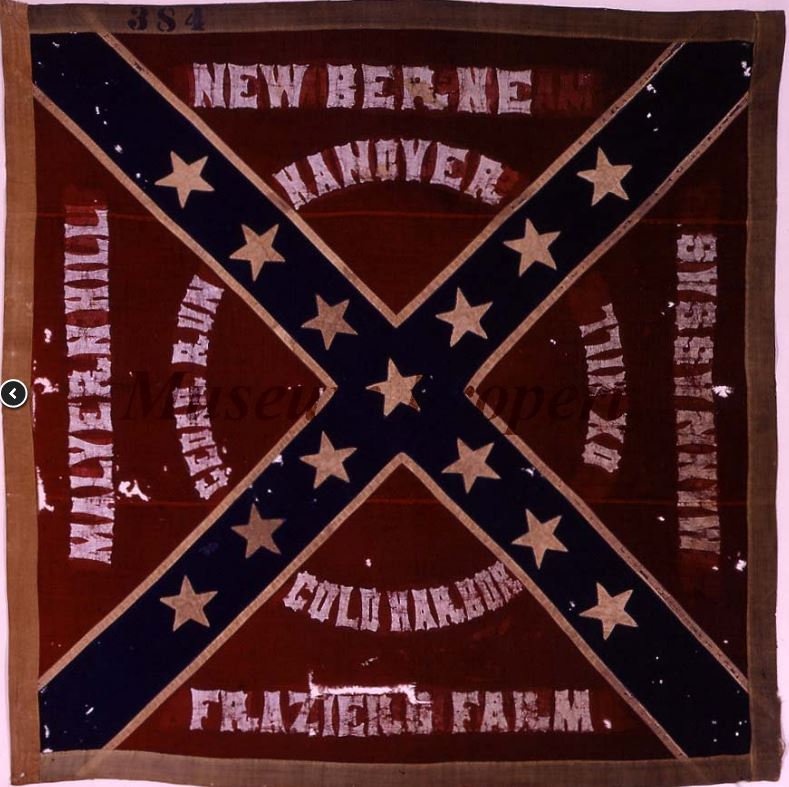
Did the Branch-Lane brigade have the most recognizable flags in the Confederacy? Quite possibly. On the front cover of my new book is the "Branch pattern" flag of the 18th North Carolina Infantry. It is a standard 3rd pattern Army of Northern Virginia flag, with battle honors painted in a distinct white scalloped style. As far as I can tell, no other ANV infantry regiment ever had such a distinctive style flag. The flags of the 3rd, 13th and 15th South Carolina are similar, but not enough to attribute it to the same painter. The battle honors are not as bold.

Following the Seven Days battles, Brig. Gen. Lawrence O'Bryan Branch was authorized to have new battle flags inscribed with the regiments' battle honors. The quartermaster was responsible for furnishing flags to the brigade. The flags of the 7th, 33rd, and 37th regiments were authorized to be emblazoned "New Berne, Slash Church, Mechanicsville, Gaines Mill, Fraziers Farm, [and] Malvern Hill." The flags of the 18th and 28th regiments were embellished with "Slash Church, Mechanicsville, Gaines Mill, Fraziers Farm, [and] Malvern Hill."

37th NC flag, Museum of the Confederacy
When the flags of the regiment were issued to the brigade in December 1862, the battle honors had undergone some changes. Instead of "Slash Church," the flags now had Hanover. Gaines Mill was now Cold Harbor. Other honors were listed as well, including Cedar Run, Manassas, Manassas Junction, Ox Hill, Shaprsburg, and Harper's Ferry.

According to the compiled service records, the flags arrived in camp in early December 1862. Captain George S. Thompson, quartermaster for the 28th Regiment, signed for his regiment's flag on December 4, 1862. The statement reads "One Battle Flag with inscription." That's an important little fact. I would take it to mean that the flags arrived in camp, from Richmond, already painted with their battle honors. Obviously, there was some discussion from the time that Branch requested the flags, until when they were actually painted (after September 1862) with someone at the Quartermaster's Department.

28th NC flag, Museum of the Confederacy 
The brigade, now belonging to James H. Lane, carried these flags through the battles of Fredericksburg and Chancellorsville. The 18th NC lost its flag at Chancellorsville. Glen Dedmondt writes in his book, The Flags of Civil War North Carolina, that A. P. Hill's division was issued new flags in June 1863. The 7th NC obviously stuck their "Branch" flag back in a wagon. Their new flag was captured on July 3, on the slopes of Cemetery Ridge by a member of the 1st Delaware Infantry. The 28th North Carolina also lost a flag, but not the new one. Their Branch flag was captured on July 3. Dedmondt believes the 33rd NC carried its new flag through the Gettysburg campaign, until it was captured at the Wilderness on May 6, 1864.

33rd NC flag, Museum of the Confederacy
So the Branch pattern flag of the 18th was captured at Chancellorsville, and that of the 28th at Gettysburg. The 37th North Carolina's Branch flag was captured on April 2, 1865, as the Federals overran the breastworks below Petersburg. The 33rd North Carolina's Branch Pattern flag was supposedly in Battery Gregg as the fighting took place. It was captured at some point after April. So what became of the 7th's Branch pattern flag? The 7th NC had been ordered back to North Carolina in February 1865, to try and help round up deserters. Instead of surrendering their flag, the men cut it up, each taking a piece of it home with him. This seems to be a common practice with Army of Tennessee regiments.

Pieces of all three flags survive. A fragment of the 7th NC's Branch pattern flag is at the North Carolina Museum of History, along with the 18th NC's Branch pattern flag. The Branch pattern flags of the 28th, 33rd, and 37th Regiments are at the Museum of the Confederacy.

7th NC flag fragment, NC Museum of History 
Back to my original argument. I would say that the Branch pattern flags of the Branch-Lane brigade are the most distinctive depot-issued flags of the Army of Northern Virginia.


Thanks to Charlie Knight of the North Carolina Museum of History for help with this post. 

Monday, December 18, 2017

Frazier's Farm or Frasier's Farm?

While working on my images for General Lee's Immortals, I made an interesting discovery. There is inconsistency on the spelling of Frazier's farm. Ok. There are a lot of inconsistencies on spellings in that time period. But this inconsistency happens to be on battle flags.

In December 1862, Branch's brigade received new Army of Northern Virginia battle flags.  These flags had their battle honors painted in white paint, in a very distinctive pattern. Of the five flags issued, four survive. The fifth flag, belonging to the 7th North Carolina State Troops, was cut up at the end of the war near Lexington, North Carolina. A scrap of this flag survives at the North Carolina Museum of History in Raleigh. On this particular issue of flags, the June 30, 1862, battle (a part of the Seven Days Campaign), is spelled "Fraziers Farm."


However, in a later issue of Army of Northern Virginia flags to the 28th North Carolina Troops (May 1864), it is no longer" Fraziers Farm," but it is now "Frasiers Farm." This flag was captured on July 28, 1864, near Malvern Hill, Virginia. A replacement was issued shortly thereafter. This 28th North Carolina flag has been further modified. Now, the battle honor reads "Frasers Farm." This flag was surrendered on April 9, 1865, at Appomattox Court House.

 Being the inquisitive soul that I am, I pulled out my copy of Glenn Dedmondt's The Flags of Civil War North Carolina, and started to look at just the spelling of Frazier's Farm. It would appear that the odd spelling on the flag of the 28th North Carolina was an odd occurrence. Eight other flags bear the name "Frazier's Farm." (I also checked Dedmondt's books on Alabama and South Carolina, and once again the spelling is consistent.)

So our next question is why? Why did the lettering on two different flags issued to the 28th North Carolina, get misspelled, once with "Frasier's Farm," and the next time with "Frazier's Farm." Just who was painting these flags on these two different days?

Of course, these are questions I cannot answer. There is not even a consistent spelling of the family who lived on the farm during the 1862 battle. Is it Frayser's Farm? Frazier's Farm? Or, Frasier's Farm? (Or, maybe Glendale...)

Thursday, February 04, 2016

Two points of view - 7th NCT vs. 66th NYV in the Wilderness

So many times, in writing about battles, the sources with which I have to work are very vague. We attacked here, or charged, or were fired upon, etc. We get the skeleton version or outline of what happened. While working on the role of Lane's brigade during the battle of the Wilderness, I came upon two accounts that give us a little more.

To lay our scene:

Wilderness battlefield
May 5, 1864 - It's dark and smoke hangs in the air. Lane's brigade has been ordered forward to try and stabilize the Confederate line near the Orange Plank Road. The 7th North Carolina, on Lane's left, has been cautioned that there are Confederate troops in their front. Capt. James G. Harris, writing on September 8, 1864, fills us in on the details of what happens next: "At this time owing to the darkness, smoke and density of the swamp, it was impossible to distinguish friend from foe. After remaining here for some time, it was discovered that a column was moving towards the plank road on our left, but supposing it to be McGowan's brigade little attention was paid it until our left wing having arrived within a few paces of it was ordered to surrender, and almost at the same instant, a destructive volley was poured into the regiment, which created some confusion." Harris goes on, in his 1893 account, to tell us that it was the 66th New York Volunteers that fired into the 7th North Carolina.

Lt. Simon Pincus wrote the official report of the 66th New York on September 10, 1864, two days after Harris drafted his. Pincus tells us that his regiment was "deployed in line of battle in the woods on the right of the Third brigade. The line was scarcely formed when the rebels came marching by the flank in front of my regiment, distant about 10 paces. It being dark, they were at first mistaken for friends, but the illusion was soon dispelled, and Lieutenant-Colonel Hammell gave the order to fire, which was promptly executed with fatal effect. It proved to be the Seventh North Carolina, commanded by Lieutenant-Colonel Davidson, who was captured..."

Two points of view, one Confederate and the other Federal, of the same dark moments in the Wilderness.


Thursday, November 12, 2015

Writing about Chancellorsville

For the past two months, I've been writing about Lane's brigade and the battle of Chancellorsville for two different destinations. The first treatment was the chapter for the Branch-Lane book. The second was an article, possibly for inclusion in a new issue of Civil War Regiments, about how James H. Lane wrote about the battle.

 The chapter in the Branch-Lane book is about 10,000 words. It is my belief that this will be the most widely read and scrutinized chapter of the book. Why? Well, it was Lane's brigade that shot Jackson. This episode of the war is one upon which a lot of ink has been spilt, possibly only second to the battle of Gettysburg.

Even after such an exhaustive study, I still have a few questions. Both the 7th and 37th Regiments voted to bestow upon a member of each company the "Badge of Honor." Would it not be great to know why their comrades picked each of these men? Just what did they do during the battle to earn this honor?

There were a couple of men who were promoted to a high rank on the field, men such as William Lee of the 7th NC. He was promoted to lieutenant colonel. Did this really happen on the field, or, did his promotion date to May 3, 1863?

And lastly, John Crayton , 28th NC, was killed in action. According to the Troops book series, "a medal was presented to his friends for his bravery." I wonder what it looked like, how many were struck, who were his friends?

The article I sent to Civil War Regiment takes a little different tack. Instead of looking at the role of Lane's brigade at the battle, I examined the way Lane wrote about the battle, starting with his official report, and then moving into the post-war years. He wrote a couple of newspaper articles about the role of his brigade, and corresponded with Henry B. McClellan, biographer of JEB Stuart, and with Augustus C. Hamlin, a Federal veteran who wrote a history of the battle of Chancellorsville. Lane's timeline of events never really strayed from his official report. He did, though, as time went on, add little details, like his conversation with Jackson on the Orange Plank Road, about the topography surrounding him, and about how dark it was.

A small example would be Lane to Hamlin about May 3, 1863. After being driven out of the captured Union lines, Lane pulled his men back, resupplied them with ammunition, and was then ordered to the far Confederate left.  Lane wrote that:
" The woods were on fire, shells, dropped loaded muskets & cartridges were exploding in every direction. The dead, Confederates as well as Federals, were on fire, & helpless wounded Federals-officers & men-begged to be removed from the approaching devouring flames but we could render no assistance.  On reaching Colquitt, we had to wait until the woods on his left was burnt over, before we could prolong his line. There we remained until the next day in the ashes & the charred scrubby oaks, & it was hard to tell whether we white or black, Federal or Confederate so far as the color of our clothes were concerned.  When we were ordered back, the troops in rear received us with boisterous laughter & cheer.  My brigade was in nearly every great battle fought by the Army of Northern Virginia, but in none did I ever witness so many harrowing scenes as I did at Chancellorsville."


No matter how many times I get to explore some of these topics, there is always some new angle to study, some new direction to consider, and big pile of questions I would love to have answered.

Monday, February 02, 2015

The lifespan of a Confederate colonel.

There are many different ways to examine the men who served as colonels of Confederate infantry regiments: age, education, pre-war occupations, social standing, etc. How about looking at how long they maintained their position during the War? Since I'm living the life and times of Branch-Lane brigade, I've chosen to look at the 15 men who served as colonels of the five regiments that made up the brigade. Now the fine print: there were brigades and regiments who fought less, or saw less of the War than the five regiments in this Tar Heel brigade. John B. Palmer was the only colonel of the 58th North Carolina Troops. He was elected in July 1862, and on paper, still commanded his regiment in May 1865 when he was captured. While Palmer served as commander of the Department of Western North Carolina starting in late 1863, he was never promoted to brigade general, and the 58th North Carolina never got a new colonel.


There were five regiments in the Branch-Lane brigade.
The 7th North Carolina Infantry had three colonels.
Reuben Campbell was elected in May 1861 and was killed at Gaines Mill on June 27, 1862.
Edward Haywood was promoted to colonel on June 27, 1862, was wounded at Second Manassas and Chancellorsville, and resigned on July 22, 1864.
William Davidson assumed the position on November 28, 1864, and commanded until the end.
Col. John D. Barry


 The 18th North Carolina Infantry had the most, with four men serving as colonel.
James Radcliffe was elected on July 18, 1861, and defeated for re-elction on April 24, 1862.
Robert Cowan defeated Radcliffe, and served as colonel until resigning on November 11, 1862.
Thomas Purdie assumed command next, and was killed at Chancellorsville.
John Barry was promoted colonel to rank on May 3, 1863, was absent due to a wound from July 1864 until January-February 1865, and surrendered with the regiment.
Col. James H. Lane


The 28th North Carolina had three men to serve as colonel.
James H. Lane had the post from September 21, 1861, until promoted to brigadier general on November 1, 1862.
Samuel Lowe assumed the position next, while a prisoner of war, not assuming command until January 1, 1863. After his wounding at Gettysburg, he apparently never resumed command, and was retired to the invalid corps on July 8, 1864.
William Speer was next, and served the shortest amount of time as colonel, occupying the post for only two months until he was mortally wounded at Reams Station on August 25, 1864.


Col. Robert Cowan
The 33rd North Carolina had three men who were colonels.
Lawrence Branch was elected on September 20, 1861, and promoted to brigadier general on January 17, 1862.
Clark Avery replaced Branch, serving from January 1862 until he died of wounds on June 18, 1864. Yet Clark was a prisoner of war from March 14, 1862, until sometime in November 1862. Avery was wounded at Chancellorsville and was out until November 1, 1863. He missed 14 months of service (at least) .
Robert Cowan replaced Avery on June 18, 1864, and rode out of camp on April 10, 1865, without surrendering.


The 37th North Carolina Troops had only two men to attain the rank of colonel.
Charles C. Lee was appointed colonel on November 20, 1861, and was killed at Frayser's Farm on June 30, 1862.
William Barber was elected colonel on June 30, 1862, and died of wounds on October 3, 1864. Yet Barber was wounded at Chancellorsville, captured at Spotsylvania Court House, and wounded in August and again in September 1864. He missed eight months.


Looking at the time we know the men missed due to being wounded, or as prisoners of war, the average length of service was about 11 months. A man appointed colonel in a regiment in the Branch-Lane brigade would only hold the position for about 11 months. 

Wednesday, January 15, 2014

What's so special about the 7th Regiment?


I recently sat down and looked through the rosters of the regiments in the Branch-Lane Brigade during the months (February - April 1862) that they were re-organizing, transitioning from twelve-month regiments to three-years-or-the-war regiments. Part of the Conscription Act was the provision that regiments could re-organize, electing new officers.

In the 33rd NCT, there was a small amount of movement, none of which I can say for certain was a part of the re-organization of that regiment.

In the 37th NCT, seven officers were defeated during the re-election process. The highest ranked was Maj. W. R. Rankin. Once again, this would not be any large-scale disruption.

Not so with the 28th and 18th Regiments: fifteen (15) officers of the 28th NCT were defeated, one resigned at election time, one resigned to go into medical service, and one other was court-martialed. The highest-ranked officer to loss his re-election bid was Maj. R. E. Reeves.

The 18th NCT wins the highest turnover award. Twenty-six (26) officers were defeated, while two resigned. Two others were transferred. Defeated were Col. J. D. Radcliffe, Lt. Col. O. P. Meares, and the adjutant C. D. Myers. Seven (7) of the ten (10) company captains lost their positions.

But, what has me stumped, is the 7th NCST. Not one of the regiment's field grade or company grade officers lost his position in that time frame due to being defeated during the re-election campaign. Did the 7th Regiment not re-elect new officers? Were they not eligible? Were they all totally amazing officers that the men adored? Time to go do some more reading and digging!

Monday, September 13, 2010

Mecklenburg County

In the county studies that I have written in the past, I’ve shied away from the large cities and their respective counties in the state. I just struggled with a way to both find the information that I wanted to include, and to find ways to write that information. I think I have figured it out. We are going to look at Mecklenburg County today, and probably for the rest of the week in a series of related posts.


Mecklenburg County was created in 1762 and named for the home of King George III’s wife, Charlotte Sophia’s home – Mecklenburg-Strelitz. The county seat, originally called Charlotte Town, was incorporated in 1768. Charlotte earned the name “The Hornet’s Nest” during the American Revolution because of the citizens’ patriotic fervor. It was also the site of the signing of the Mecklenburg Declaration of Independence, a document that was supposedly signed a year before the far more well-known Declaration of Independence.

In 1860, there were 17,374 people who lived in Mecklenburg County, including 6,541 slaves and 290 free persons of color. Today, Mecklenburg is the most populous county in North Carolina. In 1860, Buncombe, Granville, Guilford, Halifax, New Hanover, and Wake Counties were larger. In the 1860 presidential election, eligible voters cast 1,101 votes for Breckenridge, 826 votes for Bell, and 135 for Douglas.

During the February 1861 call for a convention, eligible voters cast 1,448 votes in favor of calling the convention, and 252 against. They were allowed two candidates for the convention: William Johnson and James W. Osborne. Johnson was born in present-day Gaston County in 1817. He was a graduate of UNC (1840) and then studied law. He settled in Charlotte soon thereafter. In 1856 Johnston was a railroad president. Johnson resigned his seat in the convention when appointed Commissary General by Governor Ellis. Osborne was born in Salisbury in 1811, and graduated from UNC in 1830. He also studied law and settled in Charlotte. In 1859 Governor Ellis appointed Osborne to a judgeship, and the legislature later approved the governor’s actions. Both Johnston and Osborne died in 1896.

Numerous companies came from Mecklenburg County and joined the Confederate cause. They include Company K, 1st North Carolina Cavalry; Company E, 4th North Carolina Cavalry; Company F, 5th North Carolina Cavalry; Company B, 2nd North Carolina Junior Reserves; Company C, 1st North Carolina Artillery; Companies B and C, 1st North Carolina Volunteers; Company A, 6th North Carolina State Troops; Company D, 7th North Carolina State Troops; Companies A, E, and H, 11th North Carolina State Troops; Company B, 13th North Carolina Troops; Company K, 30th North Carolina Troops; Company G, 34th North Carolina Troops; Company H, 35th North Carolina Troops; Companies C and I, 37th North Carolina Troops; Company K, 42nd North Carolina Troops; Company B, 43rd North Carolina Troops; Company F, 49th North Carolina Troops; Company B, 53rd North Carolina Troops; and, Company K, 56th North Carolina Troops. After the war, Dr. John B. Alexander, himself a former member of the 37th North Carolina Troops, believed that 2,713 men from Mecklenburg County served in the Confederate army.

There are numerous important people (to the Confederacy) who lived in Charlotte at the time of the war. Included in this list is Daniel Harvey Hill, who was teaching at the North Carolina Military Institute at the start of the war, along with Brig. Gen. James H. Lane and Col. Charles C. Lee.

There are numerous issues we could discuss about Charlotte and Mecklenburg County and its role during the war. I would argue that Charlotte and Mecklenburg County was the second most important area of North Carolina during the war (behind Wilmington and New Hanover County). Charlotte was the site of the North Carolina Military Institute, which provided numerous officers to the Confederate army. (Check out a post about the school here.) Also located in Charlotte was the Confederate Naval Ordnance Works, a hospital, the Confederate Acid Works, a Confederate gunpowder manufacturing facility in the Moore’s Chapel/Tuckaseegee Ford area, and a prison camp – Camp Exchange. The area was the site of the last cabinet meeting of the Confederate government in late April 1865. It was in Charlotte that Jefferson Davis heard of the assassination of Abraham Lincoln. Charlotte was later garrisoned by Federal soldiers after the war. We’ll talk more about these in the days to come.

After the war was over, Charlotte and Mecklenburg County was home to a large United Confederate Veterans camp, the Stonewall Jackson Chapter of the United Daughters of the Confederacy, and the James H. Lane Chapter of the United Daughters of the Confederacy. In 1929, North Carolina held its only National Reunion of the United Confederate Veterans in Charlotte. You can learn more about that here and here. There are numerous Confederate markers and monuments around the county. Mecklenburg County is also the final resting place of D. H. Hill (in Davidson), Brig. Gen. Rufus Barringer and Brig. Gen. Thomas F. Drayton (in Charlotte).

Thursday, March 25, 2010

Bloody Madison

Madison County won a little poll that I put up a couple of weeks ago as the county that I would write about next in our survey of the Civil War and counties across the state. This is really only the tip of the proverbial iceberg when it comes to the war and Madison County. Maybe some of my readers will contribute more information.

Madison County was created in 1851 from portions of Yancey and Buncombe Counties, and was named for President James Madison. The county seat, incorporated in 1863, was originally called Lapland, but was renamed Marshall in honor of Chief Justice John Marshall.

In 1860, Madison County had a population of 5,908 people, including 213 slaves and 2 free persons of color. The returns from the 1860 presidential election were thrown out. In February 1861, 345 Madison County men voted in favor of calling a convention while 532 voted against the idea. In May 1861, when the convention was held, Madison County’s representative was Dr. Joseph A. McDowell. McDowell later served as colonel of the 60th North Carolina Troops, and also owned the Warm Springs Hotel.

Madison County furnished men to the Confederate army that served in Company , 2nd North Carolina Battalion; Company B, 16th North Carolina Troops; Company D, 29th North Carolina Troops; Companies B and I, 60th North Carolina Troops; Companies A, B, D, F, G, I and L, 64th North Carolina Troops; Company I, 6th North Carolina Cavalry; and, Company D, 7th North Carolina Cavalry. Also, many Madison County men joined the 2nd and 3rd North Carolina Mounted Infantry (US). Terrell Garren, in his book Mountain Myth, believes that there were 1,969 Confederate soldiers from Madison County, and 135 Federal soldiers.

William Trotter described Madison County as the “most disputed and fought-over part of the mountains” during the war. So, we have much to talk about. A riot, followed by a shootout, broke out in May 1861 during the vote to electe McDowell to the secession convention. The sheriff, who was probably intoxicated, stood in the center of town shouting “Hurra[h] for Jeff Davis and the Southern Confederacy.” A Unionist in the crowd answered with a cheer for George Washington and the Union. The sheriff accused them of being “a set of Damd Black republicans and lincolnites,” drew his pistol, and fired into the crowd, wounding a young boy. The Sheriff was chased into a building, and was later shot and killed by the boy’s father. The father escaped and later joined a Kentucky regiment.

In January 1863, a band of Unionists and deserters raided Marshall, plundering houses and shooting local citizens. Also in January, there was a skirmish between militia and deserters in the Laurel Valley area. This led to the return of the 64th North Carolina, which were assailed from all sides as soon as they entered the county. A couple of skirmishes were fought in Shelton Laurel itself. When the Confederates could find no men in the area, they started interrogating and torturing the local women. Eventually, fifteen men, some old, others young, were captured. Two escaped before the column set out for Knoxville. Around January 13, the other 13 and the Confederates set out. At a pre-selected spot, the prisoners were halted, lined up, and executed. The commander of the 64th NCT, Col. James A. Keith, was arrested after the war, and spent two years in prison awaiting trial before escaping. This is known as the Shelton Laurel Massacre, and is the subject of a book by Phillip Paludan called Victims: A True Story of the Civil War.

Later that same month, Thomas’s Legion was in Madison County looking for deserters.

In mid 1863, Confederate forces commandeered portions of Mars Hill College and used it as a base and staging area for the rest of the war. Later in 1863, men from the 3rd North Carolina Mounted Infantry (US) attacked a meeting of the local Baptist Association not far from Mars Hill College, killing two men and wounding another.

There was a skirmish in October 1863 in Warm Springs (now Hot Springs). Federal forces captured the town and the resort. A few days later Maj. John W. Woodfin led his cavalry battalion into the area in an attempt to recapture it. He was shot from his horse. Brig. Gen. Robert B. Vance (the governor’s brother), then led several attacks to regain the area, and the Federals pulled out late in the month.

In April 1864, George Wiley Grooms and his brother Henry Grooms, along with Henry’s brother-in-law, Mitchell Caldwell, were captured while out working a field. They were marched across Mt. Sterling, on the Cataloochie side. As the family story goes, either Henry or George was forced to play the fiddle before being executed. George was a private in the 11th Tennessee Cavalry (US). All three are buried in a common grave in the Sutton Cemetery #1.

In March 1865, some men reportedly belonging to the 3rd North Carolina Mounted Infantry (US) burned the buildings at Mars Hill College.

On April 3, 1865, an expedition led by Col. Isaac M. Kirby of the 101st Ohio moved through Warm Springs (now Hot Springs) and Marshall, towards Asheville, with 1,100 men. This resulted in the battle of Asheville on April 6, and with the retreat of Kirby’s force back through Madison County.

There is going to be a program on Madison County and the regiments from the area at Mars Hill College on April 5. You can learn more here. If you would like more information on the events at Shelton Laurel, click here.

Friday, March 05, 2010

The buttons they wore.

I’ll tell you how I got on this topic before we go any further. I ordered and received a new dress jacket the other day for interpretation and re-enacting purposes. It is a Confederate colonel’s jacket that I will use to display, and for warranted occasions, like dress parades and balls. I was trying to decide what buttons to put on the jacket. That is how we arrived at this post.

So which buttons were used on the jackets that North Carolina’s soldiers wore? I did some research, and went through the online catalog of the North Carolina Museum of History in Raleigh, and through the book ­A Catalog of Uniforms from the Museum of the Confederacy. Most of the jackets I found were officers’ jackets, probably their dress jackets. It seems that most officers had one dress uniform, and then another suit of clothes that they wore every day. After the battle of New Bern in March 1862, Lt. William G. Morris of the 37th NCT wrote home, stating that he had lost everything when the Confederates were forced to retreat. "I have Nothing Except that is on my back. that is My Brown soote. I Did Not have on My uniform" he wrote.

Surprisingly, the majority of officers had United States Staff Eagle and Shield buttons on their coats. These coats came from a variety of sources. Until the end of the war, officers were expected, or required, to purchase their own uniforms. Some were made at home, others were made by tailors. There is no real way to determine where each jacket was manufactured.

So where did the Confederates get all of these yankee buttons? Something in the back of my mind says I know this story, but I cannot seem to place my hand on it. So, I’ll put the question to you: where did the Confederates get these buttons?

By the way, it was just not Tar Heels who had these buttons. The majority of surviving Confederate officer uniforms at the Museum of the Confederacy also have Federal staff buttons, including the jackets of JEB Stuart, Sandie Pendleton, John Hunt Morgan, and Patrick Cleburne

North Carolina Museum of History
William Branch – staff – US Staff
Thomas P. Devereaux – 43rd NCT – VMI buttons.
Alfred May -- 61st NCT – CSA
Charles W. Broadfoot -- Fayetteville Light Infantry – US Infantry
Lawrence Branch – Gen. – US buttons
Robert F. Hoke – Gen. – Confederate staff
James B. Gordon – Gen. – Standard Federal Button
J. Bryan Grimes – Gen. -- NC Sunburst
Rufus Tucker – 41st NCT – NC State seals
John T. Jones – Lt. Col. 26th NCT – US Staff
Henry C. Albright – 26th NCT – US Staff
Junius Daniel – 45th NCT - SC Palmetto Guards (when a major)
William H. Powell – 17th NCT – US Staff
Henry M. Shaw – 8th NCT – US Staff
Thomas Sparrow – 19th NCST – US Staff
James J. Pettigrew – Gen. – US Staff
Edmond Haywood - ? – NC Sunburst

Museum of the Confederacy
NC Drummer – Federal shield with a “R”
William D. Pender – Gen. - US Staff
Eugene Morehead – 3rd NCA- US Staff
John Hughes – 7th NCST – CSA on shield
Robert D. Johnston – Gen. -- US Staff
John A. Gilmer – 27th NCT/ Prisoner commander – Virginia state seal.
Peter G. Evans – 6th NCC – US Staff
David S. Davis – 66th NCT – US Staff

Greensboro
David Gouge – 58th NCT – Script I’s

Monday, October 19, 2009

Nathan Allman - 7th NCST

It has been a very, very busy past two months that have been filled with living histories, Civil War round tables, and other programs. Yesterday, I spoke at a reunion of descendants of Nathan Allman, Co. B, 7th NCST. The reunion was held in Enochville, NC, over near Mooresville. It was my first trip to Enochville.

I started my research for this little talk by looking up Allman’s service record in the Troops books. This is what I found:

Allman, Nathaniel H.
Born in Cabarrus County where he resided as a farmer prior to enlisting in Cabarrus County at the age of 22, July 2, 1861, for the war. Present or accounted for until wounded in the leg at Gettysburg, Pennsylvania, July 3, 1863. Company muster rolls indicate he was absent wounded through November, 1864. North Carolina pension records indicate that he “died at home from blood poison.” Date of Death not reported.

Then I went to his compiled service record, which presents another story. If I were writing his record, for the troop books, this is what I would have written:

Allman, Nathaniel (Nathan)
Born in Cabarrus County where he resided as a farmer prior to enlisting in Cabarrus County at the age of 22 on July 2, 1861. Was mustered in as a private in Company B, 7th North Carolina State Troops August 21, 1861. Reported sick in quarters in January and February 1862. Reported left sick in camp in May and June 1862. Reported sick in hospital in Richmond, Virginia, June 30 to November 1, 1862, when he was furloughed home. Returned before the end of the year. On July 20, 1863, Allman was admitted to Chimbarzo Hospital, Richmond, Virginia, due to something wrong with his left hand. Sent to Raleigh, North Carolina, July 25, 1863. Reported absent wounded in July and August 1863. Reported absent sick in hospital September and October 1863. Reported absent without leave November 1863 through February 1864. Reported present in March and April 1864. On May 15, Allman was admitted to Winder hospital in Richmond with an undisclosed wound. On June 7, 1864, he was furloughed home, wounded. This furlough extended through November 30, 1864. On January 1, 1865, Allman was discharged by reason of a slight wound in leg received at the battle of Gettysburg, a wound that never healed, and by reason that he was “an inferior soldier.”


Then there are those two little sentences at the end: “North Carolina pension records indicated that he “died at home from blood poison.” Date of Death not reported.” Well, that is true. According to the family, Allman was out plowing his field, and had a nail from his boot puncture the bottom of his foot, which caused his death some weeks later. The way the listing reads, this occurred during the war. It did not. Allman died in 1890.

I’m not quite sure where the great folks in Raleigh came up with their entry for Allman. There is a lot more information in his record.

Allman is buried in the St. Enoch Cemetery in Enochville.

Monday, September 28, 2009

Ashland, Virginia

There are undoubtedly numerous Tar Heel – Confederate soldiers buried in the cemetery in Ashland, Virginia. Many of the dead from the May 1862 battle of Hanover, including members of the 7th NCST, 18th NCST, 28th NCT, 33rd NCT, and 37th NCT were most likely re-interred here after the war. This monument marks the graves of four hundred Confederate soldiers and was erected by the ladies of the Ashland Memorial Association in 1888.


Monday, April 27, 2009

Disturbed

I’ve been more perturbed over the events last week at the Pine Hill Cemetery in Auburn, Alabama, than I care to even admit. If you are not aware of the events, here is a summary. Last Thursday, Auburn City Councilman Arthur L. Dowdell “was picking up his daughter from Auburn Junior High School near the cemetery when several people told him they ‘had a problem’ with the flags.” The “flags” were Confederate flags placed on the graves of Confederate soldiers in the Pine Hill Cemetery in Auburn. Yesterday, April 26, was the annual celebration of Confederate Memorial Day in Alabama. When Dowdell arrived at the historic cemetery, he found it decorated "like a Klan rally or a skinhead rally." Dowdell then took several flags from different graves, broke them, and placed them in his car. “It might have snapped itself,” Dowdell said. “If it did, so what? If I had my way, I would have broke them all up and stomped on them and burned them. That flag represents another country, another nation.” “I’m going on the record that this will never happen again,” Dowdell said. “This will never happen again as long as I’m on the city council.”

Interesting enough, the City of Auburn, via the mayor, soon thereafter released this statement:
The views and actions by participants in that incident in no way reflect the views or policies of the City of Auburn. The flags were placed by the United Daughters of the Confederacy on private graves to commemorate fallen Confederate soldiers for Confederate Memorial Day, which is an official state holiday. Their removal was not an action taken by the City of Auburn. I cannot condone the removal of private property from a privately owned grave site. The sanctity of the final resting place of one’s family or forefathers is certainly one of the most intensely private and sacred of things in our society.

It is easy to see that the mayor is trying to put as much distance between himself and Dowdell.

Interesting enough, Dowdell has served on the Auburn City Council since 1995. The placement of flags on the graves of Confederates has gone on for decades. I wonder (actually, I don’t) why Dowdell did not have a problem with the flags in the previous thirteen years he was on the city council. Why does he feel emboldened this year?

Regardless of Dowdell’s actions, the planned Confederate Memorial Day services in Auburn went on as scheduled yesterday. You can check out an article and a video clip here.

Had I not been off to Roanoke for a book signing in Roanoke this afternoon, then I probably would have driven to Auburn yesterday to attend the memorial day service. Why? And what does this have to do with North Carolina and the Civil War? Not only are there numerous Alabama Confederate soldiers buried in the Pine Hill Cemetery, including Col. James F. Dowdell (hmmm, I wonder…) commander of the 37th Alabama Infantry, US Congressman, and one –time president of what is today Auburn University (had two ancestors to fight under him), but also one that we here in North Carolina hold dear: Brig. Gen. James H. Lane.

Lane was a Virginian by birth and educated at VMI. Right before the war began, Lane was teaching at the North Carolina Military Institute in Charlotte. Lane was major and lieutenant colonel of the 1st North Carolina Volunteers, and then colonel of the 28th North Carolina Troops. He succeeded Branch as commander of the Second North Carolina Brigade after Branch was killed at the battle of Sharpsburg. The Second North Carolina Brigade was composed of the 7th NCST, 18th NCST, 28th NCT, 33rd NCT, and 37th NCT. Lane successfully commanded the brigade until the end of the war, and even taught for while in the Old North State before moving to Auburn where he also taught. The school still owns his house.

That is why I care.

I do find the actions of Councilman Dowdell disturbing. One reason why Southerners were allowed to erect monuments and place flags on graves after the war was to help heal our divided land. The monuments and markers and flags (North and South) were an effort to help remind us of where our inability to work out our problems could lead us: 625,000 dead. And it was people with an attitude just like Dowdell that fanned the flames that led to 625,000 dead Americans. Obviously, here is an individual who wants to make trouble (and unfortunately, there are far too many people willing to rise to his baiting). We can only hope that more reasonable heads will prevail and that Dowdell will be properly shamed for his grave descrecration rather than becoming the target of threats or other responses that only give him what he wants: angry people who fit the stereotype he wants to enforce.

Saturday, July 05, 2008

18th NCT cursed?

I’ve spent the past couple of days trying to get caught up on my magazine reading, which I have neglected in my efforts to finish the Mitchell County book. A couple of things have caught my attention.

In the current issue of America’s Civil War, Stephen Lunsford of Alabama writes in, commenting about an article written by Ernest B. Furgurson on Jackson’s mortal wounding at Chancellorsville. "Was the 18th North Carolina cursed after mortally wounding Jackson on May 2, 1863?" Lunsford writes. "The day after Jackson was shot, the 18th North Carolina fought units of the Union XII Corps south of the Plank Road. The regiment’s commander, Colonel Thomas J. Purdie, was killed; Lt. Col. Forney George was wounded, and Corporal Owen Eakins, the color bearer, was killed and his flag captured by the 7th New Jersey. Overall the 18th North Carolina lost 34 killed, 99 wounded, and 21 missing... At Gettysburg, the regiment lost 88 of 346 men. At the Wilderness, a year after Chancellorsville on the same ground, the 18th North Carolina was routed south of the Plank Road. On April 2, 1865, the unit was hit hard by the Federal assault that broke the lines at Petersburg. The 18th was forced to withdraw, and the regimental colors fell to the 40th New Jersey. The regiment surrendered a week later at Appomattox Court House with 93 men under Major Thomas Wooten."


Does the 18th North Carolina deserve the bad reputation with which it has been labeled?

First, the 18th NCT was not responsible for the wounding of Jackson. It was dark. Jackson had ridden out about the time that the regiment had gone into line to the north of the Plank Road. They did not know he and his staff were there. The Tar Heels of Lane’s brigade could hear the Federals working, building breastworks not far away. There was a lot of firing going on, both small arms and artillery, by both sides. The woods were smoking, the vegetation thick, and the debris of battle littered the woods. This debris undoubtably included dead and wounded Federal cavalrymen and horses from a failed attack earlier that afternoon. The Tar Heels of the 18th NCT certainly had those dead troopers on their minds.


There was firing on the right. Fellow Tar Heels in the 37th North Carolina fired first on Jackson’s party, killing at least one and wounding a couple. This drove Jackson and his party across the Plank Road and in front of the 18th NCT. The men of the 18th NCT could hear the horses in the woods, trying to navigate in the darkness. No one had told the 18th NCT that Jackson was there, and as his party neared their lines, they opened fire, wounding Jackson and others. If it was anybody’s fault, it was Jackson’s. And as much as I like Jackson, and admire his abilities as a battlefield commander, it was a foolish thing for him to scout ahead of those lines, in the dark, on May 2, 1863.


Was the 18th NCT hard pressed on May 3 at Chancellorsville? Sure. According to another source, losses for the five brigades under Lane’s commander were thus:


7th NCST, 49 k, 143 w, 18 m(missing)
18th NCT 30 k, 95, w, and 27m
28th NCT 14 k, 91 w, 2 m
33rd NCT 32 k, 98 w, 67 m
37th NCT 36 k, 194 w, 8 m


As far as Mr. Lunsford’s other thoughts, yes, the regiment was again hard pressed, this time losing more men than any other regiment in Lane’s brigade, However, compared to the action seen by others, like Pettigrew’s brigade, well, the 169 men lost by the 18th NCT is a small loss in comparison.


Yes, the 18th NCT was routed at the Wilderness, along with a lot of other regiments. Mr. Lunsford fails to mention that a week or so later, the 18th NCT captured the flag of 19th New York Light Artillery at Spotsylvania Court House. The 18th NCT was a part of a charge, largely involving Lane’s brigade, that stopped Burnside’s IX Corps. Had Burnside not stopped, he likely would have crushed the Confederate defenders along one side of the Mule Shoe (actually just a little lower along the line).


At Petersburg on April 2, the 18th NCT’s section of line had been so depleted of men that the ones left were on average 10 feet apart when the Federals attacked. With so few defenders, collapse of the line was all but a forgone conclusion.


I think that the 93 men who surrendered with Wooten on April 9, 1865, are more of a testament to the hard-fighting 18th NCT, than a curse for shooting Jackson.

Friday, April 25, 2008

Charlotte during the war

I thought I would spend a little more time dealing with Charlotte’s war-time history.
Historiography: To my knowledge, there has only been one work written since the end of the war. This was a work entitled: On the Home Front: Charlotte During the Civil War.. It was published in 1982 by the Mint Museum and only contains 20 pages. There have been other works that mention the war years, including John B. Alexander’s two works: The History of Mecklenburg County: From 1740 to 1900 (1902), and, Reminiscences of the Past Sixty Years (1908).

Charlotte, and Mecklenburg County, contributed numerous men to the Confederate cause. Of our first regiment that went off to war, two of the companies, the "Hornet Nest Rifles" (B) and the "Charlotte Grays" (C) hailed from the County. Col. D. H. Hill lived in Charlotte, as did Lt. Col. Charles C. Lee, Lt. John H. Wyatt (Assistant Commissary of Subsistence) and T. B. Boyd, hospital steward.

Other companies from Mecklenburg include:
Co. A, 6th NCT
Co. D, 7th NCT
Co. A, 11th NCT
Co. E, 11th NCT
Co. H, 11th NCT
Co. B, 13th NCT
Co. K, 30th NCT
Co. G, 34th NCT
Co. H, 35th NCT
Co. C, 36th NCT
Co. I, 36th NCT
Co. C, 37th NCT
Co. I, 37th NCT
Co. K, 42nd NCT
Co. B, 43rd NCT
Co. F, 49th NCT
Co. B, 53rd NCT
Co. K, 56th NCT

What about in Charlotte proper?

The old US Mint building, now known as the Mint Museum, served both as a headquarters building and a hospital. There was also a Wayside hospital (near Morehead street) in Charlotte. Most of the Confederate dead in the Confederate section of Oakwood Cemetery were buried beside this hospital. Charles C. Lee, mentioned above, is buried in this cemetery (killed while leading the 37th NCT in battle), as is Rufus Barringer, and Thomas Drayton.

Also in Charlotte was a manufacturing facility for the Confederate Navy. Charlotte was also the home of Julia Jackson, wife of Stonewall Jackson. During the last days of the war, Jefferson Davis held his last cabinet meeting in Charlotte, and was in Charlotte when he heard of the death of Lincoln.

More to come...

Thursday, September 20, 2007

Flags of Lane's Brigade at Gettysburg

Keith Snipes wrote recently looking for more information regarding the battle flags of Lane’s brigade. Keith wrote:

Your writing of the missing state flag for the 37th North Carolina compels me to ask about another of the regiment's apparently missing banners - the 1863 Richmond Depot issue with the blue battle honors.

Mr. Glenn Dedmondt's The Flags of Civil War North Carolina doesn't mention such a banner existing. Yet, his book does confirm that each of Lane's other four regiments had carried such a flag. The only regimental standard discussed for the 37th North Carolina is the earlier issued Branch/Lane brigade banner.

I’ve given this subject matter a lot of thought and some debate. I usually get shot down on the debate end. But hey, what would the world be without a little debate.

A lot of folks say that Lane’s brigade (7th, 18th, 28th, 33rd, and 37th NCTs) got new Richmond Depot flags right before the battle of Gettysburg. These flags have the battle honors painted in blue, with the regimental desigantion in gold above and below the center star. Dedmont writes in his The Flags of Civil War North Carolina:

The 7th Regiment North Carolina State Troops received this flag as part of the June 1863 distribution of 3rd (bunting) issue flags to A. P. Hill’s Light Division.

Dedmondt goes on to say the same thing about flags issued to the 18th, 28th, and 33rd, but not the 37th. And please don’t misunderstand me, I’m not picking on Dedmondt. Others have said this; I just happen to have Dedmondt’s book here on my desk.

So, did the 37th NCT get one of these flags? You would think, that had this been a wholesale flag issue to the regiments in the Light Division, that there would be some mention of the 37th NCT’s flag. But alas, no mention what-so-ever of the flag being issued to the 37th NCT. Furthermore, there appears to be no record of another flag ever being issued to the 37th NCT. It would seem that they carried their December 1862 for the rest of the war, until it was captured on April 2, 1865, just outside of Petersburg.

Now for the problems. I’ll start with the 37th. I’ve spent considerable time standing in front of the display case (when at Pamplin Park) looking at the 37th NCT’s flag. While I know that the flag has been restored, it is still in remarkable shape for a flag that belonged to one of the hardest fighting regiments in the ANV. That flag would have seen the whistle of balls and the shriek of cannon at Fredericksburg, Chancellorsville, Gettysburg, Mine Run, the Wilderness, Spotsylvania, North Anna, Cold Harbor, and a host of the battle during the Petersburg Campaign. While some patching of the flag is evident, one would think that it would be shot to shreds.

So, based upon this simple observation, I would think that there would be another 37th NCT battle flag out there somewhere. Maybe it was captured and some Yank took it home as a souvenir, or maybe it was taken home by a member of the regiment, or maybe it was tied to a rock and dumped into a river on the retreat.

Now for more problem with the flag of the 7th NCST captured at Gettysburg. Why does the flag issued to the 7th NCST and supposedly captured at Gettysburg have both the "Wilderness" and "Chancellorsville" painted on it? Some folks say that this represents two different actions during the battle of Chancellorsville. But why do none of the other regiments in A. P. Hill’s Division, who were involved in the same actions at Chancellorsville, have this same arrangement of battle honors?

Why is it that the 7th NCST was carrying this flag, while the 28th NCT was carrying their flag with the white battle honors, which they also lost on July 3. Is it possible that the flag of the 7th NCST captured at Gettysburg was also their first issued battle flag, of which only a fragment survives? Is it possible that the flag always attributed to being captured on day 3 was captured at a later date and mis-identified as the flag captured at Gettysburg?

Well, there we have it. As I said earlier, what’s the world without a little debate? Maybe some day I’ll post the reasons why Lee chose Wilcox over Lane to command the Light Division. No, it has nothing to do with Jackson.

Keith - I enjoyed the article in Gettysburg Magazine (Issue 37). As a side note, the brigade arrangement on page 119 is not correct. It was the 7th North Carolina and five companies of the 37th that broke away from the rest of the brigade. Also, the email you sent me some time ago, got accidently deleted the day after you sent it. I would love to talk to you more.