Friday, January 13, 2023

Sherman burning towns on the March to the Sea

   In February 2010, History (you know, the “Hitler” channel, and later, the “Aliens” channel) published a piece entitled “Sherman’s March to the Sea.” In the very first paragraph, the author wrote “The purpose of Sherman’s March to the Sea was to frighten Georgia’s civilian population into abandoning the Confederate cause. Sherman’s soldiers did not destroy any of the towns in their path, but they stole food and livestock and burned the houses and barns of people who tried to fight back.” (you can read the whole article here.) Yet in a December 31, 2022, article “US Cities and Towns Destroyed During the Civil War, on 247wallst.com, the author lists twenty-six towns or cities that were consumed, in part of whole, by both armies during the war. Several of those are listed as having been destroyed by Sherman’s men. (You can read that article here) So, which is correct?

Sherman's March (Encyclopædia Britannica, Inc./Kenny Chmielewski)

   For the purpose of our discussion, we are going to define Sherman’s march from the date of November 5, 1864, to December 9, 1864. This looks at all of Sherman’s maneuvers from just above Atlanta to the outskirts of Savannah. Undoubtedly, there are some sites that have been missed.

   Atlanta, of course, was abandoned by Confederate forces on September 2, 1864. Federals held the city, and much of the area along the railroad to the north, through November, when they chose to abandon the region, cut their line of supplies, and head south. To leave nothing behind that could be used, the Federals practiced a scorched-earth policy. While Sherman would state that he never ordered the burning of any dwelling, he really did nothing to prevent it. Major Henry A. Hitchcock wrote in his diary that he was Marietta and saw the courthouse and much of the public square burned. When he mentioned it to Sherman, Sherman replied with, “There are the men who do this [looking at Federal soldiers whom they were passing]. “Set as many guards as you please, they will slip in and set fires. That Court House was put out-no use-dare say [the] whole town will burn, at least the business part. I never did order the burning of any dwelling-didn’t order this, but it can’t be helped. I say Jeff. Davis burnt them.[1]

   Large scale burning seems to commence on November 5, when the 5th Ohio Cavalry ordered out what few civilians remained in Cassville, where they burned the town in a retaliatory measure after ten Federal soldiers, nine of whom were stragglers, were killed.[2]

 On November 11, 1864, Sherman wrote Henry Hallack, his superior in Washington, D.C., that the previous day he had ordered the burning of all “foundries, mills, and shops of every kind in Rome.” The fire undoubtedly spread to other parts of the town. E.P. Burton, a surgeon in an Illinois regiment, wrote in his diary on November 10 that “The country is light with the burning of Rome – Walked down through town this eve. It seemed melancholy to see property being destroyed. It is against orders – but the soldiers want to see it burn.” A couple of days later, Burton wrote that “A good many houses were burned in Rome the night before we left.”[3]

   Portions of Sherman’s command passed through Kingston next. Reportedly, the only building to survive was the Methodist church. Cartsville met much the same face. One Federal soldier involved in applying the torch wrote that “most of the families have either gone north or south, but a few, from some cause, have failed to get away and now they are weeping over their burning homes. The sight is grand but almost heartrending.”[4]

 Acworth was put to the torch as well. Major James Connolly, 123rd Illinois, wrote that “Our soldiers burned the village of Acworth without orders and we went to camp at Big Shanty about dark. Acworth has been a thriving village, but tonight it is a heap of ruins. I was the only one of the general’s staff in the town when the fires began, and I tried to prevent the burning, but while I watched one house to keep it from being fired, another somewhere else would take fire, so I concluded to give up. I succeeded in saving a few houses occupied by ‘war widows’ and their families, but all the rest of the town went up in smoke.”[5]

   Sherman watched parts of Marietta burn. He, and the rest of his command proceeded to Atlanta. One Federal soldier chronicled in his diary that “Nearly every house on the road today had been burned.”  Sherman had ordered the evacuation of the city in early September. Now, the city was gutted. Fires sprang up on the night of November 11. Some buildings were demolished with a crude battering ram, while other structures were blown up. A survey of the ruins revealed that 4,500 buildings, both houses and businesses, were destroyed. One Confederate wrote that “The work was done with terrible completeness; buildings covering 200 acres were in flames at one time; the heavens were an expanse of lurid fire; and amid the wild and terrific scene Federal bands played ‘John Brown’s soul goes marching on.’”[6] 

Sherman Burning Atlanta (Harper's Weekly Magazine, January 7, 1864)

   The combined Federal armies struck out south, toward Savannah, using two different routes. Griswoldville was the site of a battle on November 22 when 2,300 members of the Georgia militia stumbled into what they thought was a minor cavalry patrol. Just two days prior, Sherman’s men burned the firearms manufacturing facility, along with much of the town. Parts of Milledgeville were burned at the same time, including Howell Cobb’s nearby home, and the arsenal, depot, and bridge over the Oconee River; also burned was the state penitentiary, albeit by prisoners rather than Federal troops. The state library was pillaged and the state house vandalized.[7]

   Gordon, Wilkerson County, was visited by both Stoneman’s command in July 1864 and portions of Sherman’s command on November 22-25, 1864. What Stoneman did not destroy, Sherman’s men did. (Miles, Civil War Sites in Georgia, 170.) Confederates attacked Federal foragers ahead of the army at Sandersville on November 25, driving them back several miles. Federal infantry arrived the following day. According to one officer, Sherman told a local lady that because of the delaying action fought by Confederate cavalry in the streets of the town, the town would be burnt. Soon, the courthouse, jail, and local businesses were on fire, all the while a band played. Other warehouses were burned the following day as the Federals left. Just how many private residences were burned by stragglers is unclear.[8]

   Federal columns moved through the Jefferson County communities of Davisboro and Louisville. One source says Davisboro was burned and Louisville pretty much destroyed by looters. In the latter, the courthouse, jail, and several houses were burned. A member of the 89th Ohio Infantry wrote that the Federals found "...quite a number of stores of different kinds, all fairly stocked with goods. The delay in laying the pontoons, and getting trains and troops over, gave our boys ample time to go through the town, which, unfortunately for the inhabitants, they did most completely; everything was appropriated that could be used, and many things that could not be used. The town was thoroughly and completely ransacked, and by some unaccountable means late in the afternoon, the town caught fire...."[9]

   Sherman himself camped at Millen on December 3. Millen was the site of Camp Lawton, a prison built in an attempt to relieve the overcrowding at Camp Sumter (Andersonville). Yet Sherman found no prisoners. The depot, ticket house, warehouses, and hotel were burned. An officer in the 63rd Ohio recalled Sherman’s verbal instruction to one of his corps commanders: “make the destruction [of Millen] ‘tenfold more devilish’ than he had ever dreamed of, as this is one of the places they have been starving our prisoners.”[10]

   In Statesboro, once again, Federal soldiers burned the county courthouse, three or four residences, and a local “saloon.[11]

   By December 9, Sherman’s armies were near Fort McAllister, and soon, the Federals had built a wharf and were being supplied by the Federal navy. They had cut a path throughout the state of Georgia, destroying many towns. While a church or residence might be left in some of these locations, when the courthouse, depot, businesses, and hotels are all loss to a blaze, albeit from someone under orders or by stragglers that seemed uncontrollable, the town is pretty much destroyed. While Sherman and other Federal generals condemned the loss in word, they seemed unwilling to take the necessary steps to curtail the damage. To say that no town was destroyed during the March to the Sea seems to ignore the historical evidence, much of it provided by Federal soldiers along for the march.


[1] Howe, Marching with Sherman, 53.

[2] Hebert, “Civil War and Reconstruction Era Cass/Bartow County, Georgia,” 280.

[3] Shaffer, Day by Day Through the Civil War in Georgia, 308; Burton, Diary of E.P. Burton, Surgeon 7th Reg. Ill., 39-40; see also Rome News-Tribune, November 10, 2014.

[4] Hebert, “Civil War and Reconstruction Era Cass/Bartow County, Georgia,” 280.

[5] Todd Hudson, “The Burning of Marietta,” https://patch.com/georgia/marietta/the-burning-of-marietta

[6] Burton, Diary of E.P. Burton, 41; Shaffer, Day by Day Through the Civil War in Georgia, 291; Garrison, Atlanta and the War, 281-42.

[7] Inscoe, The Civil War in Georgia, 97-98; Miles, Civil War Sites in Georgia, 167.

[8]  Trudeau, Southern Storm, 246, 260; Howe, Marching with Sherman, 96.

[9] Miles, Civil War Sites in Georgia, 173); G.A.R. Papers, Read Before Fred C. Jones Post, No. 401, 322-323.

[10] Trudeau, Southern Storm, 326.

Wednesday, January 04, 2023

Torn Families – the Merrimans

   We often say that the war was fought “brother vs. brother.” Here is another example, the Merriman family (You can read about two other families here – the Gibbon family and the Flusser family.)

   Eli T. Merriman was born in Bristol, Connecticut, in 1815, graduating from Yale University in 1833, and then studying medicine in Pennsylvania and Vermont. He married another Connecticut native, Jenette Bartholomew. In the 1830s, the family moved to Texas, and Merriman became the first doctor to open a practice in San Marcos, Texas. Merriman served in the Mexican-American War, lived in Brownsville, then Banquette, Corpus Christi, and had six children with Jenette before they divorced. He also served in the Texas Legislature, and during the war, he became a Confederate doctor. He served at hospitals in Texas. His own ranch at Banquette served as a hospital “for the contagious.”[1]


   At least three of Merrimans’ sons served in the war. Two fought for the South, and one for the North.

   Walter Merriman (1835-1911), born in Connecticut, enlisted on January 1, 1863, in Rio Grande Station, in Company D, Duff’s Partisan Corps, which later became the 33rd Texas Cavalry. He brought his own horse and equipment and was mustered in as a corporal. The only other muster roll in his file is dated July 31, 1863, but he did survive the war. The 33rd Texas Cavalry was involved in the battle of Nueces and did patrol duty along the Rio Grande.[2]  

   James E. Merriman (1843-1931), born in Connecticut, enlisted in Company K, 8th Teas Infantry on May 4, 1862, in Corpus Christi. He was mustered in as a private. In October 1862, he was reported on detached service, but he appeared back with his command by the end of year. Merriman appeared present or accounted for through the end of 1864, although he was out sick or in a hospital for part of that time. The 8th Texas Infantry was involved in the battles of Corpus Christi, Fort Esperanza, and the Red River Campaign.[3]

   Henry E. Merriman (1837-1921), like his brothers, was born in Connecticut and went with the family to Texas. However, Henry returned to Connecticut where he was working in a store when the war began. On August 11, 1862, he enlisted in Company K, 16th Connecticut Volunteers.  The 16th Connecticut was involved in the battle of Sharpsburg, Fredericksburg, Siege of Norfolk, and the battle of Plymouth, North Carolina. At the latter, Merriman was captured and subsequently imprisoned at Andersonville, Florence, and Macon.[4]

   A 1904 newspaper article praised Henry Merriman for sticking it out in prison and not writing to his father asking for assistance in getting released. Given that Doctor Merriman was in localized Texas hospitals, and not the “high ranking” Confederate the post-war newspaper made him out to be, it is unlikely that the doctor could have done anything for Henry. Given the distance and time, one has to wonder if the different members of the Merriman family even knew who was in what army.


[2] Walter Merriman Compiled Service Record, M323, Roll 0163, Record Ground 109, National Archives.

[3] James E. Merriman, Compiled Service Record, M323, Roll 0325, Record Group 109, National Archives.

[4] Hartford Courant, June 14, 1904.

Sunday, January 01, 2023

Looking ahead to 2023.


  Whew… 2022 has come and gone. It was a good year. A History Lover’s Guide to North Carolina was released, and Hidden History of the Toe River Valley is just about ready to go in. The old office has been cleaned, and loads of old papers have been recycled or filed. I’ve also rebuilt my old pc. It should be running pretty well the next couple of years. My last post on here talked of the next project, a new history of the April 1864 battle of Plymouth, North Carolina. I’ve been doing some background reading on that subject. It was one of the few Confederate combined operations of the war, and it was a Confederate victory. For background reading, I started Rowena Reed’s Combined Operations in the Civil War a week or so ago. Wow! What a good book. Very critical of Union operations. While I have read thousands of books on the time period, it is amazing how many more there are to read.

   Most of my reading for the next few months will be tied up with this project. No, I’ll probably not read a horde of entire books (someone actually asked me that the other day). But I’ll be reading quite a few sections of books. Recently, I checked both Lincoln’s papers and U.S. Grant’s papers for references to the April 1864 battle. Lincoln, it appears, never mentioned the April 1864 battle. Grant did. We’ll need to explore this a little more.

 As far as more news, we are going to be turning this blog into a podcast. Yes, you will still be able to access the information here, but we will be doing recordings at the same time. More details to follow.

   Any Feeding the Army of Northern Virginia news? Well, I have an editor and went through her edits a couple of months ago, but still no timetable. I’ll post more details when I have them.

   2023 is going to be a great year! Lots of good research, many places to go, and many people to reconnect with or new friends to make. I look forward to sharing the journey with you!

Monday, October 17, 2022

New project – Battle of Plymouth!


   Usually, I do not lack for project ideas. As I drudge through the minutiae of history, I see plenty of holes in the historiography that need to be filled or expanded upon. It is, however, always nice when a publisher contacts me with an idea. Ted Savas, of Savas Beatie Publishing, recently did that, asking me to tackle a new project on the April 1864 battle of Plymouth, North Carolina. This project fits well into my interests of North Carolina history and the history of the 1860s.

Replica of the CSS Albemarle 

   The battle of Plymouth was a somewhat successful attempt to wrest control of eastern North Carolina away from the Federals. Ever since the loss of camp Hatteras, Roanoke Island, and New Bern, the Confederates had been worried the Federals’ forays could wreck the precious railroad that ran between Wilmington and Virginia. One such earlier expedition at New Bern was unsuccessful. This new attack, led by Maj. Gen. Robert F. Hoke, proved successful. Part of that success was due to the use of the incomplete CSS Albemarle. The success at Plymouth led the Federals to abandon Washington (North Carolina) as well, although a second attack at New Bern on May 5 was unsuccessful. Plymouth remained under Confederate control until the end of October 1864.

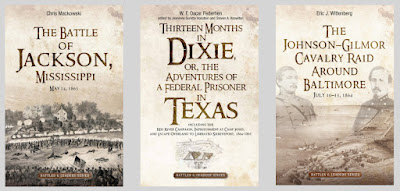
   This new project will be a part of Savas Beatie’s new Battles and Leaders Series, one that focuses on small battles and events that took place during the war. There are three titles so far in this series, and I encourage you to check them out here

Battles and Leaders Series from Savas Beatie

   What am I bringing to this project? Years of writing about the war, and years of writing about North Carolina to start with. I’ve already uncovered some little-used sources, and I am sure there are many more out there waiting to be found. Another aspect are some well-crafted maps that explore the battlefield. As far as the battlefield goes, there is really not much left today of the entrenchments that the Federals constructed during the war. There is a really good museum in town, the Port o’ Plymouth Museum, that I encourage you to check out. (We were there this past July.) This will be my 2022-2023 winter project, and it will allow me to explore some topics I’ve only written about briefly, like the CS and US Navies.

   I’m really looking forward to diving into a new project!

Thursday, September 22, 2022

The fighting Averys

   “Major, tell my father I died with my face to the enemy,” is a well-known last request made during the war. It was uttered by Col. Isaac Avery after he was mortally wounded at the battle of Gettysburg. Isaac Avery was just one of five Avery brothers who rose to prominence in the 19th century. They were all the sons of Isaac and Harriet Erwin Avery. The Avery family were large landowners in western North Carolina.

William W. Avery
   The oldest brother was William Waightstill Avery. Born in Burke County in May 1816, W.W. Avery graduated from the University of North Carolina at Chapel Hill in 1837. He later studied law under Judge William Gaston and was admitted to the bar. Avery became a trustee of the University in 1850, and in 1857, became a director of the Western North Carolina Railroad. Avery served several terms in the General Assembly, and in the 1856-1857 term, was speaker of the North Carolina Senate. He, along with Thomas L. Clingman, was a strong advocate for secession. In 1858, he ran for a seat in the US House, but lost to Zebulon Baird Vance. In 1860, Avery was chairman of the state’s delegation to the Democratic National Convention, meeting in Charleston. Appointed Chairman of the resolution committee, Avery “favored the majority report denying the right of congress or territorial legislation to prohibit slavery in the territories, demanding federal protection for all property in those territories, upholding the Fugitive Slave Act, and advocating the acquisition of Cuba from Spain as soon as practicable.” Many delegates walked out, but not the North Carolinians. They would walk out when the convention met again in Baltimore. Once North Carolina left the Union, Avery served as a member of the provisional Confederate Congress and as chairman of the committee on military affairs. Avery failed to win an appointment to the Confederate senate and returned to western North Carolina, where he worked on raising a regiment for Confederate service. W.W. Avery was mortally wounded while leading local home guard in a skirmish with raiders in northern Burke County in late June 1864, dying on July 3, 1864. Avery was married to Mary Corinna Morehead, daughter of Governor John Motley Morehead, and they had several children.[1]

Clark M. Avery
   Clark Moulton Avery was the next son with a wartime connection. He was born in October 1820 and, like his older brother, graduated from the University of North Carolina at Chapel Hill. Unlike his brother, he was not a politician, but instead farmed a large piece of property in Burke County. In February 1861, friends enticed Avery to run for the state secession convention, and election that he won. However, the convention did not meet. Avery would not serve when the actual convention met in May. Instead, when the principles of the foundation of the United States came under attack, Avery joined the military. On April 25, 1861, he was elected captain of Company G, 1st North Carolina Volunteers, fighting at the battle of Big Bethel in June 1861. Then-colonel D.H. Hill wrote that "Captain Avery Company G displayed great coolness, judgment and efficiency in the battle of Bethel." As the regiment neared the end of its six-month term of enlistment, Avery was elected lieutenant colonel of the 33rd North Carolina Troops, and then in January 1862, colonel. In March 1862, Avery was captured at the battle of New Bern, being released seven months later. He returned to his regiment and was wounded in the fighting at Chancellorsville and at Gettysburg. At the battle of the Wilderness in May 1864, Colonel Avery was struck in the left arm. When he refused to go the rear, a stretcher was brought forward, and he was carried along the lines, encouraging his men. Avery was eventually struck four times that day, including in the leg, neck, and through the body. Avery survived for six weeks before dying of his wounds on June 18, 1864. Avery was married to Elizabeth Tilghman Walton and was survived by four children.[2]

Isaac E. Avery 
   Isaac Erwin Avery was born in December 1828 in Burke County. For one year, he attended the University of North Carolina at Chapel Hill but then left the school to help manage his father’s farms in Burke and Yancey Counties, North Carolina. He also worked with Charles F. Fisher and Samuel McDowell Tate to construct the Western North Carolina Railroad. When the war came, he worked on forming a company that became a part of the 6th North Carolina State Troops. Avery was elected captain of Company E on May 16, 1861. He was promoted to lieutenant colonel and then colonel of the 6th NC and was wounded at the battle of Malvern Hill. On July 2, 1863, while leading Hoke’s brigade in an attack on the Confederate left, Avery was mortally wounded, penning the famous note after his wound: “Major, tell my father I died with my face toward the enemy.” Avery died the next day. Colonel A.C. Godwin, 57th NC, wrote in his official report that, upon the death of Avery, “the country lost one of her truest and bravest sons, and the army one of its most gallant officers.” His slave, Elijah, began to return to Burke County with the body, but he was forced to stop and bury Avery in Williamsport, Maryland. Avery’s body was later moved to Rose Hill Cemetery in Hagerstown.[3]

   Alphonso Calhoun Avery was born in September 1835. After graduating from the University of North Carolina at Chapel Hill, Avery studied law under Chief Justice Richmond M. Pearson and was licensed in June 1860. AC Avery helped his brother Isaac raise a company and was then elected first lieutenant in that company in the 6th NCST. Following the battle of Seven Pines, he was promoted to captain, but by the end of 1862, he was transferred to the staff of Maj. Gen. D. H. Hill as assistant inspector general. Major Avery later served on the staffs of John C. Breckinridge, Thomas C. Hindman, and John B. Hood. At the end of the war, Avery was commanding a battalion in the western parts of North Carolina, attempting to curtail some of the damage being done by Federal raiding parties and bushwhackers. Avery was captured in Salisbury by some of Stoneman’s men and was imprisoned at Camp Chase until August 1865. After the war, Avery practiced law and was elected to the state senate; he lost his seat when the radicals came to power, served as a delegate to the Constitutional Convention of 1875, and then served as judge of the superior court. Trinity College (now Duke University) conferred upon him a MA, and the University of North Carolina honored him with an LL.D. In 1888, A. C. Avery was elected an associate justice of the Supreme Court, serving for eight years. In 1892, he assumed the position of dean of the law school at Duke University. Avery retired in 1897 and became a prolific writer, respected historian, and prominent member of the Southern Historical Society. His first wife was Susan Washington Morrison, daughter of the Rev. R. H. Morrison. His brothers-in-law included D.H. Hill, Stonewall Jackson, and Rufus Barringer. Avery’s second wife was Sarah Love Thomas, the daughter of Col. William Holland Thomas. A.C. Avery died in June 1913.[4]

   The last Avery brother to serve in the war was Willoughby Francis Avery, born in Burke County in May 1843. He was attending the University of North Carolina at Chapel Hill when the war broke out, and, leaving the school, he joined the 3rd North Carolina Cavalry, where he was elected third lieutenant. When the company was reorganized, he failed to win reelection and resigned. Avery was then appointed a second lieutenant in Company C, 33rd North Carolina Troops. Promotion to first lieutenant came on January 14, 1863, and on December 15, 1863, he was promoted to captain and transferred to Company E. A month later, he was transferred to Company I. Captain Avery was wounded in the mouth and throat at the battle of the Wilderness in May 1864, returned to duty in November 1864, and was captured at Salisbury on April 12, 1865. He was confined at Camp Chase and released in June 1865. After the war, Willoughby Avery edited newspapers in Charlotte and Asheville before returning to Burke County and establishing a newspaper in Morganton. He was married twice and died November 1876.[5]

   There are, of course, the Avery daughters as well. Adelaide Leah Avery (1822-1897) never married but became one of the first librarians in Burke County. Mary Ann Martha Avery (1831-1890) married Joseph Franklin Chambers. Harriet Justina Avery (1833-1902) married Pinckney B. Chambers, a major in the 49th North Carolina Troops. The last daughter, Laura Myra Avery (1837-1912), never married.


[1] Warner and Yearns, Biographical Register of the Confederate Congress, 9-10; Powell, Dictionary of North Carolina Biography, 1:67.

[2] Powell, Dictionary of North Carolina Biography, 1:111; Allardice, Confederate Colonels, 68.

[3] Jordan, NC Troops, 4:266; Allardice, Confederate Colonels, 47; The Herald-Mail, November 4, 2007.

[4] Powell, Dictionary of North Carolina Biography, 1:66-67.

[5] Manarin, NC Troops, 2:221; Jordan, NC Troops, 9:220; Powell, Dictionary of North Carolina Biography, 1:72.

Tuesday, September 06, 2022

Refusing to serve under Stonewall Jackson

   In all honesty, he was not “Stonewall” Jackson yet. He was still the eccentric Thomas J. Jackson, professor of Natural and Experimental Philosophy and Instructor of Artillery Tactics at the Virginia Military Institute. And the 12th Virginia Infantry wanted no part of him.

   Parts of the 12th Virginia predated the war. The Petersburg Old Grays were organized in 1828 and fought in the Mexican War. The Petersburg City Guard was organized in 1852. Those two companies served as a detail during the hanging of John Brown in December 1859. Several of the other companies were also organized prior to the war. Once the war came, these companies were organized into the 12th Virginia Infantry.

   Like every other infantry or cavalry command, the new regiment needed a colonel. Virginia Governor John Letcher was considering Professor Thomas J. Jackson for the post. On one hand, Jackson was extremely qualified for the post. He was a graduate of the United States Military Academy at West Point, and had seen service in the Mexican-American War in an artillery battery, earning several brevets for his actions. His tour in Mexico also saw him serving in the quartermaster’s and commissary’s offices. Jackson was then posted at Fort Columbus, New York; Carlisle Barracks, Pennsylvania (court-martial duty); then at Fort Hamilton, New York. In December 1850, Jackson and his company were sent to Florida. He then left the army to begin teaching at the Virginia Military Institute in Lexington.[1]

    Jackson was not the most engaging teacher, and his rigid teaching style soon earned the enmity of many of his young pupils. “[S]o difficult & taught by such a hell of a fool,” wrote one student in an optics class. A fellow professor wrote that “As a Professor of Natural and Experimental Philosophy -, Major Jackson was not a success. He had not the qualifications needed for so important a chair. He was no teacher, and he lacked the tact required in getting along with his classes. He was a brave man, a conscientious man, and a good man, but he was no professor.” That fellow professor would add “His genius was in the Science and Art of War.” [2]

   That view of Jackson, a genius in the science and art of war, had yet to emerge when the 12th Virginia was being formed. In April 1861, Jackson delivered the VMI cadets to Richmond to serve as drillmasters for the many new companies and regiments in the capital. Not having an assignment, Jackson volunteered to instruct artillery companies. Jackson was then appointed a major in the topographical engineers. Then Jackson was appointed colonel by Governor Letcher. But, what regiment to assign him to? Word arrived at the camp of the forming 12th Virginia Infantry that Letcher was considering Jackson to be their colonel. When his nomination came up before the Virginia legislation, someone asked “Who is this Thomas J. Jackson?” A post-war newspaper reported that,  at the beginning of the war, Jackson “was assigned by the Governor of Virginia to command of the Twelfth Virginia Infantry, stationed at Norfolk, and composed of crack companies from different parts of the State. The regimental officers had been told that Jackson was of ‘an eccentric and ascetic disposition,’ and they protested against him so strongly that the Governor assigned him to another field duty. He was soon heard from as Stonewall Jackson, and the Twelfth Virginia kept very quiet about a certain little matter.”[3]

   Jackson was promoted to colonel, then sent to Harpers Ferry to take command of all the troops present. On June 17, 1861, he was promoted to brigadier general. The 12th Virginia “kept very quiet about a certain little matter.” If you would like to learn more about the 12th Virginia Infantry, check out John Horn’s The Petersburg Regiment in the Civil War (2019).


[1] Robertson, Stonewall Jackson, 77.

[2] Robertson, Stonewall Jackson, 121, 125.

[3] Robertson, Stonewall Jackson, 219; The Somerset Press, February 15, 1875.

Monday, August 29, 2022

Halifax County

    Formed in 1758 from Edgecombe County, Halifax County was named for George Montague, second earl of Halifax (England) and President of the British Board of Trade and Plantations. At times, Halifax County has been called North Carolina’s “Cradle of History.” It was in the community of Halifax that the Halifax Resolves were drafted, debated, and signed in April 1776 by the delegates at the Fourth Provincial Congress. These resolves authorized North Carolina’s delegates to the Continental Congress to vote for independence. The resolutions were unanimously adopted. The county seat, also named Halifax, was established in 1757 and became the county seat in 1759.

   In 1860, Halifax County boasted a population of 19,442 people, including 10,349 slaves and 2,450 free people of color. In the 1860 presidential election, local voters cast 757 votes for John C. Breckinridge, 545 votes for John Bell, and 22 votes for Stephen Douglas. No votes were recorded for Republican candidate Abraham Lincoln (he failed to garner enough support to get on the ballot in North Carolina).

   During the February 1861 call for a convention to consider the question of secession, 1,049 cast their votes for the call, with 39 against. Only Edgecombe, Warren, and Martin Counties had fewer votes against the convention. Considering the population of Halifax County, two delegates were selected. An early history of Halifax County considered both men “union men.” Those two were Richard H. Smith and Littleberry W. Batchelor. Smith was born in 1810 in Scotland Neck and graduated from the University of North Carolina, later reading law. He was a member of the House of Commons in 1852 and 1854. He was in favor of the Union until the inauguration of Lincoln “when he became an ardent supporter of [the] war.” Batchelor was born in Halifax in 1823. He attended the Bingham School and later studied medicine in Philadelphia. He practiced medicine and was a Justice of the Peace. Batchelor “was a devoted Southerner and firm believer in the right of a State to secede.”

   There were several companies that enlisted in Confederate service during the war. These included: Companies I and K, 1st North Carolina Volunteers; Company K, 1st North Carolina State Troops; Company F, 2nd North Carolina Artillery; Companies G & I, 12th North Carolina State Troops; Company A, 14th North Carolina Troops; Company D, 24th North Carolina Troops; Company D and F, 43rd North Carolina Troops; Company G, 3rd North Carolina Cavalry; and Company K, 2nd Regiment North Carolina Junior Reserves. There does not seem to be an adequate list of men from the county who served in the Federal army. However, based upon the 1890 Veterans Census, several men served in the 14th United States Colored Heavy Artillery. There are four African Americans who applied for Confederate pensions after the war. 

Lawrence Branch
   Several high-ranking Confederate officers were born in Halifax County. Lawrence O’Bryan Branch was born near Enfield in 1820. He was brought up by his uncle, U.S. Secretary of the Navy John Branch. Lawrence was tutored by Salmon P. Chase, and in 1838, graduated from Princeton University. Branch practiced law, living in Tennessee and Florida before returning to North Carolina. He was a banker and served as president of the Raleigh and Gaston Railroad. From March 4, 1855, to March 3, 1861, Branch represented his district in the U.S. House of Representatives. Branch served as North Carolina’s quartermaster early in the war. He then accepted a position as colonel of the 33rd North Carolina Troops in September 1861. In November 1861, he was appointed brigadier general. Branch commanded on the coast, losing a battle at New Bern in March 1862. He was assigned command of the Second North Carolina brigade about three days after the battle and sent to Virginia the first of May 1862. Branch would again lose a battle at Hanover Court House on May 27, 1862. He and his brigade were then assigned to the Light Division under A.P. Hill, and Branch became a dependable brigade commander. At one point, he led the division and was complimented by Stonewall Jackson. On September 17, 1862, Branch was killed during the battle of Sharpsburg, Maryland. Branch is buried in the Old City Cemetery in Raleigh.

 Also from the area was Junius Daniel. He was born in Halifax in 1828 and graduated from the United States Military Academy at West Point in 1851. He resigned from the army in 1858 and lived in Louisiana for a time, but he was back in North Carolina by 1860. Daniel was colonel of the 14th North Carolina State Troops, then colonel of the 45th North Carolina Troops. He was appointed brigadier general in September 1862 and commanded a brigade in the Second Corps until mortally wounded at the battle of Spotsylvania Court House, Virginia, on May 12, 1864, dying the same day.

   David Clark was born in Scotland Neck in February 1829 and attended the Episcopal Male School of Raleigh. He was colonel of the 15th North Carolina Militia, then brigadier general of the Ninth Brigade, North Carolina Militia, in March and April 1862. He died in Halifax County in October 1882.

   William Ruffin Cox was born in Scotland Neck in March 1832. Four years later, he moved to Tennessee. He attended Franklin College and then Lebanon Law School. In 1852, Cox returned to North Carolina. In 1861, he was a member of the North Carolina Militia, then elected major of the 2nd North Carolina Infantry in June 1861. Cox was wounded at Malvern Hill in July 1862. He was promoted to lieutenant colonel on September 17, 1862; promoted to colonel on March 20, 1863; wounded at Chancellorsville on May 3, 1863; and wounded in the right shoulder and face at Rappahannock Station, Virginia, on November 7, 1863. On May 31, 1864, Cox was promoted to brigadier general. He led a brigade in Ewell’s Second Corps. On April 9, 1865, Cox was paroled at Appomattox Court House. After the war, he returned to the practice of law and later served as a judge. Cox represented North Carolina in the US House of Representatives from 1881 to 1887 and was Secretary of the US Senate from 1893 to 1900. He passed in 1919 and is interred in Oakwood Cemetery, Raleigh.

   James R. McLean was also born at Enfield in September 1823. He attended Bingham School and the Caldwell Institute, later reading law under John A. Gilmer. He practiced law in Greensboro, and later, in Rockford. He represented Surry County in the General Assembly in 1850-1851 but then moved back to Greensboro. In November 1861, McLean won a seat in the Confederate House of Representatives. In Congress, he usually supported the Davis Administration. McLean did not seek re-election due to poor health and later served as major in the senior reserves. He died in 1870 and is buried in Greensboro.

   Halifax County played a major role in the war. M. Fannie Whitfield of Enfield actually sent Vice-President Alexander Stephens five flag proposals early in the war. These were found after Richmond was captured in April 1865. The community at Weldon was an early mobilization and training camp for Confederate soldiers. The railroad that ran through Weldon also played a major role in the war, moving supplies from the Wilmington area to Virginia and transporting troops. Lieutenant General Theophilus Holmes made his headquarters in Weldon early in the war, as did Brigadier General L.S. Baker later in the war.  A Wayside Hospital opened in Weldon Methodist Church in December 1862. Near Scotland Neck, at Edwards’ Ferry, the ram Albemarle was constructed beginning in the spring of 1863. The Albemarle helped to capture the town of Plymouth in April 1864. In November 1863 there was a skirmish near Weldon. Between March 25 and April 11, 1865, there was a Federal expedition from Deep Bottom, Virginia, towards Weldon, North Carolina. On April 12, 1865, the Confederates abandoned Weldon and moved toward Raleigh. What was left, like trains and engines, were driven onto the bridge over the Roanoke River and set fire. 


War Memorial in Enfield recently bulldozed. 

   After the war, Halifax County became home to at least two United Confederate Veterans camps. The Cary Whitaker Camp 1053 was established in Enfield, while the Bill Johnston Camp 1275 was in Weldon. Halifax had the Halifax Chapter 1232, Enfield had the Frank M. Parker chapter 1096,  and Weldon had the Junius Daniel Chapter 600, United Daughters of the Confederacy. There is no recorded post for a Grand Army of the Republic Post in Halifax County. A monument to Confederate and World War I soldiers was erected in Enfield in June 1929. It was later expanded to honor soldiers of other wars. In August 2022, the mayor of Enfield bulldozed the monument. Another monument was dedicated in Halifax in 1929. There are North Carolina Highway Historical Markers near Scotland Neck and in Halifax denoting the ram Albemarle. There are North Carolina Civil War Trail Markers at Roanoke Rapids concerning the Roanoke Canal and in Weldon concerning the Wilmington and Weldon Railroad Trestle. There is also a war memorial at the Weldon Confederate Cemetery with the names of those who died at the hospital and are interred nearby.

Monday, August 08, 2022

Wilmington, Fort Fisher, and Historiography

Monument at Fort Fisher. 

   Has the importance of Fort Fisher and the great Wilmington area been missed in the historiography of the past 160 years? I recently came up with this question during our annual visit to the greater Wilmington area. In working on my upcoming book on food and the Army of Northern Virginia, I came to the conclusion that Wilmington, at least during the second half of the war, was second only to Richmond.

   So what do the historians say? How important were Wilmington, Fort Fisher, and the Cape Fear River area? Charles Roland, The Confederacy (1960), William C. Davis, Look Away! A History of the Confederacy (2002), and Russell F. Weigley, A Great Civil War (2000) make no real mention of the importance of the area.

   Keegan, while making mention of Fort Fisher and the ensuing battle, does not really get to the importance of the area, writing that  “The most important military operation in North Carolina during the closing phase of the war was not the work of Sherman’s army but a deliberate and separate operation to close down the South’s last large blockade-running port at Wilmington…”[1] Vandiver writes that “In Wilmington. . . the best of the blockade ports outside of Bagdad, Mexico, things settled into a pattern of hard work. Most citizens decamped in fear of invasion or of pestilence from foreign ships, or because the town became little more than a military depot.” Once again, he does not really seem to get the importance that Wilmington had to the entire war effort.[2]  

   There are a couple of historians who kind of get it. James McPherson writes that “Wilmington became the principal Confederate port for blockade runners because of the tricky inlets and shoals at the mouth of the Cape Fear River…”[3] Edward Pollard, in his early (as in 1867) history of the Confederacy, concludes that Wilmington was the “the most important sea-coast port left to the Confederates, through which to get supplies from abroad, and send cotton and other products out by blockade-runners.”[4]

Only two of the texts in the sample survey (i.e., books on my shelf) seem to get the importance. Robert S. Henry writes in 1931 that Wilmington was “most important of all” ports in the South. Due to this, it became “one of the great centers of the business of blockade running.”[5]    One other example comes from the pen of Shelby Foote. Foote tells us that in the last nine weeks of 1864, supplies landed at the port of Wilmington included “8,632,000 pounds of meat, 1,507,000 pounds of lead, 1,933,000 pounds of saltpeter, 546,000 pairs of shoes, 316,000 pairs of blankets, 520,000 pounds of coffee, 69,000 rifles, 97 packages of revolvers, 2,639 packages of medicine, 43 cannons,” along with other munitions. “Just how important those cargoes were to the continued resistance by the rebels was shown by the fact that R.E. Lee himself had sent word…that he could not subsist his army without supplies brought in there.”[6]

   Overall, I think the importance of the port of Wilmington, with its surrounding fortifications, has been underrepresented in the greater portion of the historiography of the past 160 years.


[1] Keegan, The American Civil War, 278.

[2] Vandiver, Their Tattered Flags, 107.

[3] McPherson, Battle Cry of Freedom, 380.

[4] Pollard, The Lost Cause, 671.

[5] Henry, The Story of the Confederacy, 239, 437.

[6] Foote, The Civil War: A Narrative, 3:741.