Showing posts with label 3rd NCC. Show all posts

Monday, August 29, 2022

Halifax County

    Formed in 1758 from Edgecombe County, Halifax County was named for George Montague, second earl of Halifax (England) and President of the British Board of Trade and Plantations. At times, Halifax County has been called North Carolina’s “Cradle of History.” It was in the community of Halifax that the Halifax Resolves were drafted, debated, and signed in April 1776 by the delegates at the Fourth Provincial Congress. These resolves authorized North Carolina’s delegates to the Continental Congress to vote for independence. The resolutions were unanimously adopted. The county seat, also named Halifax, was established in 1757 and became the county seat in 1759.

   In 1860, Halifax County boasted a population of 19,442 people, including 10,349 slaves and 2,450 free people of color. In the 1860 presidential election, local voters cast 757 votes for John C. Breckinridge, 545 votes for John Bell, and 22 votes for Stephen Douglas. No votes were recorded for Republican candidate Abraham Lincoln (he failed to garner enough support to get on the ballot in North Carolina).

   During the February 1861 call for a convention to consider the question of secession, 1,049 cast their votes for the call, with 39 against. Only Edgecombe, Warren, and Martin Counties had fewer votes against the convention. Considering the population of Halifax County, two delegates were selected. An early history of Halifax County considered both men “union men.” Those two were Richard H. Smith and Littleberry W. Batchelor. Smith was born in 1810 in Scotland Neck and graduated from the University of North Carolina, later reading law. He was a member of the House of Commons in 1852 and 1854. He was in favor of the Union until the inauguration of Lincoln “when he became an ardent supporter of [the] war.” Batchelor was born in Halifax in 1823. He attended the Bingham School and later studied medicine in Philadelphia. He practiced medicine and was a Justice of the Peace. Batchelor “was a devoted Southerner and firm believer in the right of a State to secede.”

   There were several companies that enlisted in Confederate service during the war. These included: Companies I and K, 1st North Carolina Volunteers; Company K, 1st North Carolina State Troops; Company F, 2nd North Carolina Artillery; Companies G & I, 12th North Carolina State Troops; Company A, 14th North Carolina Troops; Company D, 24th North Carolina Troops; Company D and F, 43rd North Carolina Troops; Company G, 3rd North Carolina Cavalry; and Company K, 2nd Regiment North Carolina Junior Reserves. There does not seem to be an adequate list of men from the county who served in the Federal army. However, based upon the 1890 Veterans Census, several men served in the 14th United States Colored Heavy Artillery. There are four African Americans who applied for Confederate pensions after the war. 

Lawrence Branch
   Several high-ranking Confederate officers were born in Halifax County. Lawrence O’Bryan Branch was born near Enfield in 1820. He was brought up by his uncle, U.S. Secretary of the Navy John Branch. Lawrence was tutored by Salmon P. Chase, and in 1838, graduated from Princeton University. Branch practiced law, living in Tennessee and Florida before returning to North Carolina. He was a banker and served as president of the Raleigh and Gaston Railroad. From March 4, 1855, to March 3, 1861, Branch represented his district in the U.S. House of Representatives. Branch served as North Carolina’s quartermaster early in the war. He then accepted a position as colonel of the 33rd North Carolina Troops in September 1861. In November 1861, he was appointed brigadier general. Branch commanded on the coast, losing a battle at New Bern in March 1862. He was assigned command of the Second North Carolina brigade about three days after the battle and sent to Virginia the first of May 1862. Branch would again lose a battle at Hanover Court House on May 27, 1862. He and his brigade were then assigned to the Light Division under A.P. Hill, and Branch became a dependable brigade commander. At one point, he led the division and was complimented by Stonewall Jackson. On September 17, 1862, Branch was killed during the battle of Sharpsburg, Maryland. Branch is buried in the Old City Cemetery in Raleigh.

 Also from the area was Junius Daniel. He was born in Halifax in 1828 and graduated from the United States Military Academy at West Point in 1851. He resigned from the army in 1858 and lived in Louisiana for a time, but he was back in North Carolina by 1860. Daniel was colonel of the 14th North Carolina State Troops, then colonel of the 45th North Carolina Troops. He was appointed brigadier general in September 1862 and commanded a brigade in the Second Corps until mortally wounded at the battle of Spotsylvania Court House, Virginia, on May 12, 1864, dying the same day.

   David Clark was born in Scotland Neck in February 1829 and attended the Episcopal Male School of Raleigh. He was colonel of the 15th North Carolina Militia, then brigadier general of the Ninth Brigade, North Carolina Militia, in March and April 1862. He died in Halifax County in October 1882.

   William Ruffin Cox was born in Scotland Neck in March 1832. Four years later, he moved to Tennessee. He attended Franklin College and then Lebanon Law School. In 1852, Cox returned to North Carolina. In 1861, he was a member of the North Carolina Militia, then elected major of the 2nd North Carolina Infantry in June 1861. Cox was wounded at Malvern Hill in July 1862. He was promoted to lieutenant colonel on September 17, 1862; promoted to colonel on March 20, 1863; wounded at Chancellorsville on May 3, 1863; and wounded in the right shoulder and face at Rappahannock Station, Virginia, on November 7, 1863. On May 31, 1864, Cox was promoted to brigadier general. He led a brigade in Ewell’s Second Corps. On April 9, 1865, Cox was paroled at Appomattox Court House. After the war, he returned to the practice of law and later served as a judge. Cox represented North Carolina in the US House of Representatives from 1881 to 1887 and was Secretary of the US Senate from 1893 to 1900. He passed in 1919 and is interred in Oakwood Cemetery, Raleigh.

   James R. McLean was also born at Enfield in September 1823. He attended Bingham School and the Caldwell Institute, later reading law under John A. Gilmer. He practiced law in Greensboro, and later, in Rockford. He represented Surry County in the General Assembly in 1850-1851 but then moved back to Greensboro. In November 1861, McLean won a seat in the Confederate House of Representatives. In Congress, he usually supported the Davis Administration. McLean did not seek re-election due to poor health and later served as major in the senior reserves. He died in 1870 and is buried in Greensboro.

   Halifax County played a major role in the war. M. Fannie Whitfield of Enfield actually sent Vice-President Alexander Stephens five flag proposals early in the war. These were found after Richmond was captured in April 1865. The community at Weldon was an early mobilization and training camp for Confederate soldiers. The railroad that ran through Weldon also played a major role in the war, moving supplies from the Wilmington area to Virginia and transporting troops. Lieutenant General Theophilus Holmes made his headquarters in Weldon early in the war, as did Brigadier General L.S. Baker later in the war.  A Wayside Hospital opened in Weldon Methodist Church in December 1862. Near Scotland Neck, at Edwards’ Ferry, the ram Albemarle was constructed beginning in the spring of 1863. The Albemarle helped to capture the town of Plymouth in April 1864. In November 1863 there was a skirmish near Weldon. Between March 25 and April 11, 1865, there was a Federal expedition from Deep Bottom, Virginia, towards Weldon, North Carolina. On April 12, 1865, the Confederates abandoned Weldon and moved toward Raleigh. What was left, like trains and engines, were driven onto the bridge over the Roanoke River and set fire. 


War Memorial in Enfield recently bulldozed. 

   After the war, Halifax County became home to at least two United Confederate Veterans camps. The Cary Whitaker Camp 1053 was established in Enfield, while the Bill Johnston Camp 1275 was in Weldon. Halifax had the Halifax Chapter 1232, Enfield had the Frank M. Parker chapter 1096,  and Weldon had the Junius Daniel Chapter 600, United Daughters of the Confederacy. There is no recorded post for a Grand Army of the Republic Post in Halifax County. A monument to Confederate and World War I soldiers was erected in Enfield in June 1929. It was later expanded to honor soldiers of other wars. In August 2022, the mayor of Enfield bulldozed the monument. Another monument was dedicated in Halifax in 1929. There are North Carolina Highway Historical Markers near Scotland Neck and in Halifax denoting the ram Albemarle. There are North Carolina Civil War Trail Markers at Roanoke Rapids concerning the Roanoke Canal and in Weldon concerning the Wilmington and Weldon Railroad Trestle. There is also a war memorial at the Weldon Confederate Cemetery with the names of those who died at the hospital and are interred nearby.

Thursday, March 22, 2018

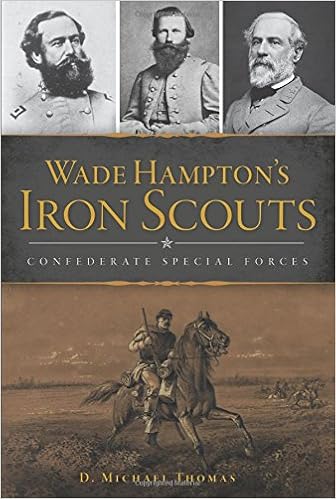
Wade Hampton's Iron Scouts


A week or so ago, I picked up a copy of D. Michael Thomas's Wade Hampton's Iron Scouts: Confederate Special Forces, released by The History Press on March 5, 2018. Thomas's tome follows a group of Confederate cavalry, made up of men from other regiments, detailed to gather information on the movements of the Army of the Potomac in late 1862 through 1865. The group, unofficially known as Hampton's Iron Scouts, raided Federal picket posts and clashed with Federal cavalry patrols, earning praise from Confederate leaders and the enmity of Federal officers. Probably their most famous role came in the September 1864 Beefsteak Raid. The scouts were the ones who found the cattle, notified Hampton, and guided his cavalry force toward their prize.


While I have read deeply into the Army of Northern Virginia's history, the role of scouts is something I have not read much about (probably because, outside of Mosby, there is not a lot of information on the subject). Thomas has done a superb job of scouring various sources to put together a history of a neglected branch of the Confederate army. He not only details their exploits, but provides brief biographical pieces on many of the scouts. Hampton's Iron Scouts were largely men from South Carolina regiments, but there were a few from other commands. Thomas identified these Tar Heels: William M. Waterbury, 3rd NCC; James M. Sloan, 1st NCC; Julius S. Harris, 1st NCC; and George J. Hanley, 1st NCC.


If you are interested in the fringe elements of the Army of Northern Virginia, then Thomas's Wade Hampton's Scout's is recommended. 

Tuesday, February 21, 2017

Confederates beyond the War - Governors


One of those questions floating around my mind on Sunday as I drove to Raleigh was how many governors in North Carolina had Confederate service behind them: several, it turns out. An even greater question is how the military experience of these men influenced their lives and hence the direction of the state. We'll save that one for another post.

Brogden
William W. Holden (1865) was appointed military governor at war's end by US President Andrew Johnson. He was a newspaper editor and had no military experience.

Jonathan Worth (1865-1868) was elected in late 1865. He was a strong Unionist and never really supported the war. Worth was appointed state treasurer by the General Assembly in 1862, and he held the post until elected governor.

William W. Holden (168-1871) was elected to serve a regular term, but was impeached in 1871.
Tod Robinson Caldwell (1871-1874) took over after the impeachment of Holden. The new state constitution of 1868 provided for a lieutenant governor, and Caldwell was the first to hold the position. Like Worth, Holden was a Unionist, but had served as a solicitor of Rutherford County during the war years.  

Curtis Hooks Brogden (1874-1877) was state comptroller during the war years. He was a Democrat at the start of the War and supported Vance for governor, but like Holden and Worth, moved toward the Republican party once the war ended. Brogden was Caldwell's lieutenant governor, and took over the governorship when Caldwell died in office.

Jarvis
Zebulon Baird Vance (1877-1879) was the first Confederate military officer to hold the position of governor after the War ended. Vance had served as a company officer in the 14th North Carolina State Troops, and as colonel of the 26th North Carolina Troops, before being elected governor in 1862. He was reelected in 1864, but arrested in May 1865, and unable to hold political office for a number of years after the end of the war. His third term as governor only lasted a couple of years, he was sent to the United States senate in 1877.

Thomas Jordan Jarvis (1879-1885) was originally a private in Company L, 17th North Carolina Troops, joining on May 4, 1861. Two weeks later, he was appointed a lieutenant in the 8th North Carolina State Troops and transferred. Jarvis was captured when Roanoke Island fell on February 8, 1862, but was back with the army by November 1862. In April 1863, he was promoted to captain of Company B. He was wounded in the right shoulder at Drewry's Bluff in ay 1864, and reported absent wounded the rest of the war.

Scales
Alfred Moore Scales (1885-1889) was elected captain of what became Company H, 13th North Carolina Troops on April 30, 1861. In October, he was elected colonel of the same, replacing William Dorsey Pender, who was appointed colonel of the 6th North Carolina State Troops. Scales was wounded in the right thigh at Chancellorsville, and then promoted to brigadier general on June 13, 1863.  Scales was again wounded at Gettysburg, then fought through the Overland Campaign, but appears to have been sick the last months of the war.

Daniel Gould Fowle (1889-1891) was appointed lieutenant colonel of the 31st North Carolina Troops on September 19, 1861. He was also captured when Roanoke Island fell in early 1862. Fowle was defeated for reelection when his regiment was reorganized in September 1862. Fowle served in the General Assembly, then as adjutant general, then was back in the General Assembly after a disagreement with Vance. He also died in office while serving as governor.

Thomas Michael Holt (1891-1893), lieutenant governor, filled the unexpired term of Fowle. Holt does not appear  to have served during the war. Instead, he stayed and managed part of his family's textile interests, namely the Granite Mill on the Haw River.

Elias Carr (1893-1897), as the story goes, was a private in Company G, 3rd North Carolina Cavalry, serving from September 1861 through June 1862. He was then called back to North Carolina to manage his very large farm. It appears that Carr later served as a sergeant in Company K, 67th North Carolina Troops, and possibly as a private in Company A, 8th Battalion North Carolina Partisan Rangers.

Daniel Lindsay Russell (1897-1901) was appointed a 1st lieutenant in the "Lamb Artillery" on May 5, 1862. The battery was also known as Company G, 2nd North Carolina Artillery. He was promoted Captain in January 1863, but was court martialed for assaulting another officer. He was later restored to his command, but resigned in February 1865. He was also a Republican.

Russell was the last Confederate veteran to serve as governor of North Carolina.


Tuesday, March 02, 2010

Onslow County

The county-by-county exploration of North Carolina and the War is not going as fast as I hoped. Maybe we will be able to wrap up by the end of the sesquicentennial. I thought today we would turn our attention to Onslow County.

Onslow County, a part of North Carolina’s Costal Plane, was formed in 1734 from New Hanover County. It was named for Arthur Onslow, Speaker of the House of Commons in the British Parliament. The county seat is located in Jacksonville, which was incorporated in 1843 and named for President Andrew Jackson. Onslow County is probably best known for these two things: the birthplace of Otway Burns, a privateer during the War of 1812 and later a member of the state house, and Camp Lejeune Marine Base.

In 1860, Onslow County had a population of 8,856 people, including 3,499 slaves and 159 free persons of color. In 1861, the men in Onslow County cast 781 votes for Breckinridge, 153 for Bell, and 24 for Douglas. In February 1861, the county cast 631 votes for calling a convention to consider the question of secession, and 89 votes against. Dr. G. W. Ward was their first elected delegate. Ward hailed from New Bern, but had spent some time in Mississippi. He was educated at UNC Chapel Hill, and later in Philadelphia. Ward served as a magistrate, County Superintendent of Public Instruction, and chairman of the county medical board. He resigned to enter the Confederate Cavalry and was replaced by Andrew J. Murrill, a farmer, magistrate and chairman of the board of county commissioners. Murrill later served in the state house and senate.

Men from Onslow County served in Companies E and G, 3rd NCST; Company B, 24th NCT; Company A, 35th NCT; Company H, 55th NCT; Company K, 61st NCT; Company I, 66th NCT; Company H, 67th NCT; Companies B and H, 3rd NC Cavalry; and, Company F, 8th Batt. Partisan Rangers.

Onslow County saw limited action during the war. In April 1862 there was a night-time skirmish at Gillett’s Farm, with the 2nd North Carolina Cavalry attacking a portion of the 103rd New York. On November 23, 1862, Lt. William B. Cushing, aboard the Union gunboat Ellis, arrived off the coast of Onslow County and destroyed salt works, then captured and burned a vessel loaded with turpentine and cotton at Stone’s Point. Cushing later captured the town of Jacksonville and captured two more schooners at Wantland’s Landing. The Ellis later grounded on the shoals across from Traps Bay and was attacked by the Confederates. The Federal Tars abandoned the vessel.

There is not much more to mention on Onslow County and the War. A visitor might learn more by visiting one of the local history museums – the Onslow County History Museum is in Richlands, and there is the Museum of the Marines on the base in Jacksonville. Louis H. Manarin wrote a small book entitled “Onslow County during the Civil War” back in 1982, but I do not have a copy and could find only one in a library in the state.