Showing posts with label 62nd NC. Show all posts

Thursday, January 27, 2022

Confederate General John W. Frazer and the capture of Cumberland Gap

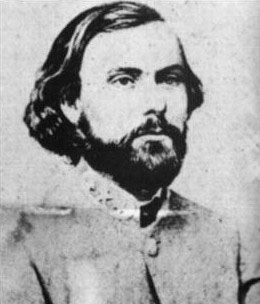
   Brig. Gen. John W. Frazer was in an awkward position. As Braxton Bragg stripped Confederate forces from east Tennessee to strengthen the Army of Tennessee prior to attacking the Federals around Chattanooga, Frazer’s brigade, posted at Cumberland Gap, was left behind. Frazer was a native of Hardin County, Tennessee, and received an appointment from Mississippi to the United States Military Academy, graduating in 1849. He performed garrison duty in New York, California, Virginia, and Washington State before resigning and joining the Confederate States army. He was commissioned lieutenant colonel of the 8th Alabama Infantry, and then colonel of the 28th Alabama Infantry. On May 19, 1863, he was appointed brigadier general and assigned to command the 5th brigade, Army of East Tennessee. His command, composed of the 55th Georgia Infantry, the 62nd and 64th North Carolina Troops, the 64th Virginia Infantry, and the 1st Tennessee Cavalry regiment, was assigned to guard various gaps in and around Cumberland Gap.[1] 

Brig. Gen. John W. Frazer 
   Simon Buckner, Frazer’s immediate commander, wrote on August 21, asking Frazer if he needed ammunition or other supplies. “Matters do not look gloomy,” the letter stated. Toward the end of August, it appears that Frazer was getting ready to evacuate Cumberland Gap.  But that same day, August 30, Buckner ordered Frazer to “hold the gap…” and if he evacuated Cumberland Gap, to fall back to Abington. With Buckner gone, Major General Samuel Jones assumed commander of the department. From surviving correspondence, it appears that Frazer had not taken any action on the matter, for on September 7, Jones asked the War Department “Shall I order the evacuation of Cumberland Gap?” James Seddon proposed to Jefferson Davis that same question the next day: “Shall I authorize the gap to be held?” Davis, wanting to “save the railroad and the valuable position at Cumberland Gap,” allowed Jones to make that decision. Davis did not believe that the Federals in east Tennessee, filling the void left by the redeployed Confederates, were a serious threat.[2]

   But they were. Bypassing the Confederate stronghold at Cumberland Gap, Federal forces used a gap fifty miles southwest of the area. The attacking Federal force in East Tennessee was under the command of Major General Ambrose Burnside. He sent one brigade to approach Cumberland Gap from the south, while another Federal brigade was slated to move south from Crab Orchard along the old Wilderness Road toward Cumberland Gap. The two Federal forces appeared about the same time on opposite sides of Cumberland Gap. On September 7 came the first demand to surrender, a demand that Frazer rejected. Under the cover of darkness the Federals burned the mill Frazer was using to grind corn for his command, along with some of the meal. The next morning came another demand for surrender. While Frazer weighed his options, another demand of surrender was received, this one from Burnside, who had just taken Knoxville. At 3 o’clock on September 9, Frazer surrendered his entire force, except about four hundred men who had slipped off into the woods.[3]

   Frazer’s surrender to a smaller force was not without controversy. He was rumored to be drunk. “Two thousand men and guns & ammunition have also been given away at Cumberland Gap, where a drunken Brigadier named Frazer commanded,” Josiah Gorgas wrote in his diary on September 17, 1863.[4] War Department Clerk J. B. Jones wrote that the “country is indignant at the surrender of Cumberland Gap by Brig.-Gen. Frazier, without firing a gun, when his force was nearly as strong as Burnside’s. . . The country did not know there was such a general until his name became famous by this ignominious surrender. Where did Gen. Cooper find him?”[5] Frazer apparently did not consult the officers of the regiments in his command on September 9. He surrendered between 1,700 and 2,300 men, and most of those men were sent to Camp Douglas in Chicago, Illinois. Many of these men died of illness. Frazer was criticized by Jefferson Davis, and in February 1864, the Confederate senate voted unanimously against confirming his nomination as a brigadier. From Fort Warren in Boston Harbor, Frazer wrote an official report on November 27, 1864. Frazer criticized the troops under his command. They were “in a deplorable condition.” One of his regiments, the 62nd North Carolina Troops, the current brigade commander had been “for some time. . . trying to get rid of it.” Frazer considered this regiment “badly disciplined and badly drilled” One captain was under arrest for “disseminating papers hostile to the Confederacy among the command.” The 64th North Carolina Troops was small, “having been reduced by desertions. . . the colonel and lieutenant colonel had left in disgrace for dishonorable conduct.” The 55th Georgia Infantry, Frazer thought, was the best regiment he had, although the soldiers had recently ridden their colonel on a rail. His two artillery batteries had no experience. The “character, confidence, and condition of the troops hastily collected to defend the gap were such as to justify no hope of a successful defense against an equal number of the enemy. . . It is proper to state that the want of confidence in the troops was of gradual conviction in my mind. . .”[6] 

   Frazer spent the rest of the war as a prisoner. After his release in April 1865, he moved to Arkansas, and then to New York City where he died in 1906. James D. Porter, writing in 1899, believed that “when all the facts were made known,” Frazer was exonerated.[7] John W. Frazer remains one of those little-discussed Confederate generals and probably deserves more of our attention. Was he drunk while Cumberland Gap was surrounded? Maybe. The Federal colonel commanding the brigade moving from Crab Orchard thought so. Were the troops he had to work with subpar? When it comes to the 62nd  and 64th North Carolina Troops, well, they were not the best the Confederacy had to offer.  


[1] Davis, The Confederate Generals, 2:146-47.

[2] Official Records, vol. 30, pt. 4, 528, 568, 571, 572, 616.

[3] Kincaid, The Wilderness Road, 262-73.

[4] Wiggins, The Journals of Josiah Gorgas,­ 81.

[5] Robertson, A Rebel War Clerk’s Diary, 2:43.

[6] Official Records, vol. 30, pt.2 610-612.

[7] Evans, Confederate Military History, 8:309.

Saturday, January 30, 2021

Site Visit Saturday: Cumberland Gap


Lay down boys, take a little nap

Lay down boys, take a little nap

Lay down boys, take a little nap

14 miles to the Cumberland Gap!

   For those of us living in the east, Cumberland Gap has a special history. It is the site of an ancient road used by Natives to travel, at times trading with others, and at other times, making war. Daniel Boone passed through the Gap in 1775. He traversed the Gap several times on a route we now call the Wilderness Road, taking settlers into Kentucky.

   During the Civil War, both North and South viewed Cumberland Gap as a strategic stronghold. The gap sits on the juncture of the state lines of Kentucky, Tennessee, and Virginia. The Cumberland Mountains are a long mountain chain that runs along the Kentucky-Virginia border, and on into West Virginia. There are other gaps (like Pound Gap), but Cumberland is the most accessible.

Braxton Bragg and his rebel band

Braxton Bragg and his rebel band

Braxton Bragg and his rebel band

Run George Morgan in the Bluegrass land

   At the beginning of the war, many thought that the Cumberland Gap area would be the site of a major conflict. If Federal forces could seize the gap, then Federal soldiers could move into Unionist East Tennessee, seizing control of the railroad in the area. Southwest Virginia with its salt and lead mines could be easily taken; after that, western and central North Carolina, then back into middle Tennessee could all be vulnerable. And there was a plan kind of like this in November 1861. East Tennessee Unionists planned to destroy several of the railroad bridges in East Tennessee, while Federal soldiers passed through the Gap and seized control before Confederate sources could react. Several of the bridges were burnt on the night of November 8, but the Federal soldiers never came.

   Cumberland Gap changed hands several times during the war. Confederate forces held the Gap from the start of the war until June 1862. Then in September 1862, it was abandoned by the Federals, and the Confederates again assumed control September 1863. The defenses at Cumberland Gap were seen as impregnable. While the Gap never fell in a battle, it was all to easy to cut off lines of supply and starve out the defenders. Confederate forces that defended the Cumberland Gap at various times included the  29th North Carolina Troops, 58th North Carolina Troops, 55th Georgia Infantry, 62nd North Carolina Troops, 64th North Carolina Troops, 64th Virginia Infantry, 1st Tennessee Calvary, and others.

Rebels now give a little yell

All you rebels give a little yell

All you rebels give a little yell

Scare the Yankees all to Hell

   Cumberland Gap has been a national park since 1940. The park today covers 24,000 acres and is one of the largest parks in the eastern United States. There is a great visitor center, campground, and numerous trails, some of which explore some of the defensive works constructed by Confederate and Federal forces during the war.

   I have explored this park numerous times over the years. My last visit was in December 2020.

Wednesday, November 11, 2020

The four battles of Carter’s Depot

   Not long ago, I acquired a little book by Lawrence M. Jarratt entitled A Complete County by County Guide to Civil War Battles, Actions, Engagements, Skirmishes, Affairs, Reconnaissances, Expeditions, Scouts and Camps in Tennessee (1986). For Carter County, Tennessee, there are four skirmishes noted, all centering around a spot then known as Carter’s Depot or Carter’s Station, now known as the town of Watauga, Tennessee. Since Carter County’s war-time history is a big gap, this post, hopefully with several others I have written in the past couple of years, will fill in a few holes. (The town of Watauga is on the Carter-Washington County border.)


   At the time of the war, Carter’s depot was a simple stop on the East Tennessee and Virginia Railroad. The line, constructed in the 1850s, was the most direct route between the lower and upper South, and it was vitally important until it was lost to the Federals in September 1863. The site had a depot, water tank, and possibly a telegraph office, with the wooden trestle sixty feet high and four hundred feet long bridging the Watauga River.[1]

   It was in November 1861 that the bridge first came under attack… almost. A group of Unionists planned to burn several bridges in east Tennessee, and while the Confederates in the area were immobilized, Federal forces would sweep in from Kentucky and capture the area. The bridge over the Watauga River at Carter’s Depot was one of the bridges targeted. However, the saboteurs found this bridge heavily guarded, and they abandoned this target to concentrate their efforts on another bridge.   Several of the bridges were burned, but the Federal forces failed to materialize and several of the bridge burners were caught and either hanged or imprisoned.[2]

   It would be a year before any serious action transpired at Carter’s Depot. In December 1862, Brig. Gen. Samuel P. Carter (US) led a cavalry raid out of east Kentucky and into east Tennessee. His goal was to break up the East Tennessee and Virginia Railroad. Upon leaving Blountville, Carter sent Col. Charles J. Walker, with six companies, to capture the depot. Before arriving at the depot, Walker captured a train with several Confederates onboard, including Colonel Love. On arriving at Carter’s Depot, Walker attacked. “The enemy made a spirited resistance for a few minutes and then fled to the brush,” Walker wrote. Federal losses were 1 killed, 4 wounded. Confederates lost 12 killed, 15 or 20 wounded, and 138 captured. Walker then proceeded to burn the bridge and camp, before departing. The captured Confederate officer was Col. Robert G.A. Love, 62nd North Carolina Troops. Confederate losses were reported as somewhere around 7 wounded, one mortally, and 114 captured, all members of the 62nd North Carolina Troops.[3]  

   The bridge was rebuilt, and earthworks were added to protect defenders. The next series of skirmishes came in September 1863. When Confederate forces stripped defenders from east Tennessee to support Braxton Bragg and the Army of Tennessee during the Chickamauga campaign, there was a void left in the area, a void quickly filled by Federal troops from Kentucky. Federal soldiers drove east, trying to secure as much territory as possible. Federal artillery bombarded Confederate defenders at Carter’s Depot on September 21 and 22. Flanked out of their entrenchments, the Confederates retreated to Zollicoffer, burning the bridge over the Watauga River at Carter’s Depot as they left.  [4]

   Much of East Tennessee, from Carter’ Depot to Knoxville, became a no-man’s land for the rest of the war. There were times when  the Federals were in possession of Greeneville, and Longstreet’s divisions wintered near Rogersville in early 1864, but the area was susceptible to frequent raids by Union troops, Confederate troops, and bands of dissidents.

   Once the Federals returned west toward Knoxville, Confederate forces again occupied the defenses around Carter’s Depot. In April 1864, Federal commander Maj. Gen. John M. Schofield was ordered to destroy the bridges about Bull’s Gap. While Carter’s Depot was not specifically mentioned in Federal orders, the bridges over the Watauga were. A combined cavalry and infantry force set out from Bull’s Gap on April 24. On April 27, Schofield reported that “the rebels destroyed the bridge [Watauga] after being driven across it by our cavalry.” The event was obviously, for a short time, a pretty hot skirmish, as Federal losses were reported as three killed and eighteen wounded. However, the bridge was too high to be forded. Confederate General Simon Buckner reported to Richmond on April 26 that skirmishing had started the day before at Carter’s Depot. Buckner, however, felt that if the Federal attack was too large, the Confederate defenders at Carter’s Depot should fall back to Zollicoffer. However, Buckner ordered the area commander to hold Carter’s Depot if possible.[5]

Brig. Gen. John C. Vaughn
   In September 1864 came Maj. Gen. Stephen G. Burbridge’s (US) raid into the area. On September 30, Brig. Gen. Jacob Ammem (US) led a force from Jonesborough toward Carter’s Depot. The Federals attacked, driving many of the Confederate defenders from their entrenchments and back across the river. The next morning, with artillery posted “advantageously,” the Federals attacked again, driving away the remaining defenders. Federal losses were reported as four wounded. The Federals reported that the Confederate defenders were under the command of Brig. Gen. John C. Vaughn (CS). Vaughn’s brigade was composed of the 16th Georgia Battalion, the 1st, 3rd, 31st/39th, 43rd, 5th, 60th, 61st, 62nd Tennessee Infantry regiments (mostly mounted), and the 12th and 16th Tennessee Battalions. It can be assumed that some of these regiments or men were present during the skirmishing at the end of September and beginning of September.[6]

   There are undoubtedly other skirmishes that took place. As Stoneman’s forces moved through in late March 1865, did the Confederate defenders simply fall back to Zollicoffer or Bristol? What else has escaped the attention of the historian? Jarrett, in his “complete” county guide to the Civil War in Tennessee, only lists dates and sources. No further details. This is one geographical area that needs to be fleshed out a little more.

By the way, if you are interested in the war in east Tennessee and Western North Carolina, please check out my Kirk’s Civil War Raids Along the Blue Ridge.


[1] Piston, Carter’s Raid, 51.

[2] Judd, The Bridge Burners, 50.

[3] Official Records, Vol. 20, 1:93-94; Jordan, North Carolina Troops, 15:7.

[4] Official Records, Vol. 30, 2:605, 645.

[5] Official Records Vol. 32, 3:475, 533, 831, 835.

[6] Official Records, Vol. 39, 2:558-59; 3:46; 3:907.