Showing posts with label Cumberland Gap. Show all posts

Tuesday, August 11, 2026

Dueling Houses in Elizabethton, Tennessee

   We often talk about the Civil War being a conflict of brother versus brother or family versus family. Some stories are more famous, like that of the Gibbon brothers (read here) or the Flusser family (here). But how about the conflict being symbolized by a house versus a house?

   Many areas during the war were split, and Tennessee was no different. Historians estimate that 25,000 men from east Tennessee served in the Confederate army, while 30,000 joined the Union army. However, no one has really done the deep-dive to prove or disprove these numbers. 

The Carter home on the left and the Folsom home on the right. 

   Elizabethton, in Carter County, was just as divided as any other place in East Tennessee. The Asheville News reported in early January 1862 one story of a divided population. According to the correspondent, a “unionist said that no Southern flag should be raised in town, or taken through it. Not long afterwards, however, Mrs. Mary C. Carpenter procured a flag bearing the emblems of our native South-got into her buggy and drove through town, and I have been told that she drove all round town, with the Southern flag ‘waving gloriously.’ The unionists failed to execute their threats in regard to shooting the flag to pieces.”[1]

Brig. Gen. Samuiel P. Carter (wiki)
   Samuel P. Carter was born in Elizabethton in 1819, the eldest son of Alfred M. Carter. Samuel attended Duffield Academy in Elizabethton, Washington College in Limestone, and Princeton University before enlisting in the United States Navy in 1840. He transferred to the United States Naval Academy, graduating in 1846, then saw service on board the USS Ohio at the battle of Veracruz during the Mexican-American War. Various assignments follow, including stints at the United States Naval Observatory; assistant professor of mathematics at the Naval Academy; tours in the Pacific and along the coast of Brazil; and in China. At the request of Senator Andrew Johnson, Carter was detached from the Navy and worked on recruiting East Tennessee Unionists. He was commissioned a brigadier general at the request of Abraham Lincoln, becoming the only man to hold both naval and army commissions. Carter went on to lead his brigade at the battle of Mill Springs, Kentucky, helped capture Cumberland Gap in October 1862, led a raid against the East Tennessee railroad in December 1862, fought at Blue Springs while commanding cavalry, and fought at Wyse Fork in 1865. Carter ended the war as a brevet major general of volunteers and as a commander in the United States navy. After the war, Carter returned to the navy, finally retiring in August 1881. Rear Admiral Samuel P. Carter passed in 1891 and is buried Oak Hil Cemetery, Washington, D.C. The home where he grew up still stands in Elizabethton.[2]

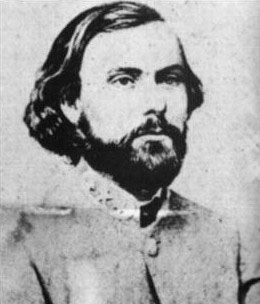
Maj. Henderson M. Folsom (ancestry)
   On October 4, 1831, Henderson M. Folsom was born in Elizabethton, Tennessee. In the 1860 census, Folsom is listed as a clerk. When the war came, Folsom joined the 2nd Tennessee Cavalry (Ashby’s) where he was mustered in as a private. In October 1862, he appears in the records as a clerk to Brig. Gen. Alfred E. Jackson. A few months later, Folsom is reported as being appointed major and Assistant Quartermaster in February 1863 for Jackson’s brigade and in December 1863, chief quartermaster of Jackson’s brigade. During Early’s Valley Campaign, Folson is listed serving on the staff of Maj. Gen. John B. Gordon’s division, and then as Commissary of Subsistence in Brig. Gen. Gabriel S. Wharton’s brigade. On an unknown date, but at least by January 1865, Major Folsom was appointed Commissary of Subsistence to Thomas’s Legion.[3] In his application for presidential pardon, written on July 14, 1865, from Elizabethton, Folsom informed the President that “he was an original Unionist and as such, cast the whole weight of whatever influence he possessed, and [voted] against every against every proposition, looking for a chance [to continue the] relations which existed between Tennessee and the Federal government.” However, when the vote was cast, Folsom believed it was his duty to side with the “overwhelming voice of the people and thereby became identified with the Rebellion.” He served three years as a quartermaster. Folsom had to apply directly to the president due to the charge of treason against him in Federal court in Knoxville. For character witnesses, Folsom recommended Colonel Thomas Miller, 13th Tennessee Cavalry (US). Five officers, including Colonel Miller, from the 13th Tennessee Cavalry, signed a supporting letter, along with seven citizens.[4]

   Folsom was pardoned in November 1865 and commenced the study of law.[5] He was listed as being an attorney in Elizabethton as early as August 1868.[6] At the time of his death in 1908, Folsom was considered one of the leading lawyers in the state.[7] He is buried in the Highland Cemetery, Carter County, Tennessee.

   Folsom built his home across the street from the house that Samuel P. Carter was born in. As of 2026, both houses survive. The Carter home has been used as a restaurant for a number of years. The Folsom home was used as county offices but was damaged during the hurricane in 2024. There are a few local government officials who want to demolish the home. The Folsom house would make a great county museum and archives. Hopefully, the Folsom house can be stabilized and restored before it is truly too far gone. It is not in bad shape, even with storm damage. Hopefully, the powers that be will not drag their feet in preservation, waiting until the Folsom house is in a bad state of repair.


[1] Asheville News, January 9, 1862.

[2] Eicher and Eicher, Civil War High Commands, 166-67; Warner, Generals in Blue, 74.

[3] CMSR, M331, RG109, NARA; Brown and Coffey, North Carolina Troops, 16:247.

[4] H.M. Folson to Andrew Johnon, M1009, Roll 49, RG 94, NARA.

[5] The Union Flag, November 10, 1865.

[6] Bristol News, August 14, 1868.

[7] Chattanooga Daily Times, August 17, 1908.

Thursday, January 27, 2022

Confederate General John W. Frazer and the capture of Cumberland Gap

   Brig. Gen. John W. Frazer was in an awkward position. As Braxton Bragg stripped Confederate forces from east Tennessee to strengthen the Army of Tennessee prior to attacking the Federals around Chattanooga, Frazer’s brigade, posted at Cumberland Gap, was left behind. Frazer was a native of Hardin County, Tennessee, and received an appointment from Mississippi to the United States Military Academy, graduating in 1849. He performed garrison duty in New York, California, Virginia, and Washington State before resigning and joining the Confederate States army. He was commissioned lieutenant colonel of the 8th Alabama Infantry, and then colonel of the 28th Alabama Infantry. On May 19, 1863, he was appointed brigadier general and assigned to command the 5th brigade, Army of East Tennessee. His command, composed of the 55th Georgia Infantry, the 62nd and 64th North Carolina Troops, the 64th Virginia Infantry, and the 1st Tennessee Cavalry regiment, was assigned to guard various gaps in and around Cumberland Gap.[1] 

Brig. Gen. John W. Frazer 

   Simon Buckner, Frazer’s immediate commander, wrote on August 21, asking Frazer if he needed ammunition or other supplies. “Matters do not look gloomy,” the letter stated. Toward the end of August, it appears that Frazer was getting ready to evacuate Cumberland Gap.  But that same day, August 30, Buckner ordered Frazer to “hold the gap…” and if he evacuated Cumberland Gap, to fall back to Abington. With Buckner gone, Major General Samuel Jones assumed commander of the department. From surviving correspondence, it appears that Frazer had not taken any action on the matter, for on September 7, Jones asked the War Department “Shall I order the evacuation of Cumberland Gap?” James Seddon proposed to Jefferson Davis that same question the next day: “Shall I authorize the gap to be held?” Davis, wanting to “save the railroad and the valuable position at Cumberland Gap,” allowed Jones to make that decision. Davis did not believe that the Federals in east Tennessee, filling the void left by the redeployed Confederates, were a serious threat.[2]

   But they were. Bypassing the Confederate stronghold at Cumberland Gap, Federal forces used a gap fifty miles southwest of the area. The attacking Federal force in East Tennessee was under the command of Major General Ambrose Burnside. He sent one brigade to approach Cumberland Gap from the south, while another Federal brigade was slated to move south from Crab Orchard along the old Wilderness Road toward Cumberland Gap. The two Federal forces appeared about the same time on opposite sides of Cumberland Gap. On September 7 came the first demand to surrender, a demand that Frazer rejected. Under the cover of darkness the Federals burned the mill Frazer was using to grind corn for his command, along with some of the meal. The next morning came another demand for surrender. While Frazer weighed his options, another demand of surrender was received, this one from Burnside, who had just taken Knoxville. At 3 o’clock on September 9, Frazer surrendered his entire force, except about four hundred men who had slipped off into the woods.[3]

   Frazer’s surrender to a smaller force was not without controversy. He was rumored to be drunk. “Two thousand men and guns & ammunition have also been given away at Cumberland Gap, where a drunken Brigadier named Frazer commanded,” Josiah Gorgas wrote in his diary on September 17, 1863.[4] War Department Clerk J. B. Jones wrote that the “country is indignant at the surrender of Cumberland Gap by Brig.-Gen. Frazier, without firing a gun, when his force was nearly as strong as Burnside’s. . . The country did not know there was such a general until his name became famous by this ignominious surrender. Where did Gen. Cooper find him?”[5] Frazer apparently did not consult the officers of the regiments in his command on September 9. He surrendered between 1,700 and 2,300 men, and most of those men were sent to Camp Douglas in Chicago, Illinois. Many of these men died of illness. Frazer was criticized by Jefferson Davis, and in February 1864, the Confederate senate voted unanimously against confirming his nomination as a brigadier. From Fort Warren in Boston Harbor, Frazer wrote an official report on November 27, 1864. Frazer criticized the troops under his command. They were “in a deplorable condition.” One of his regiments, the 62nd North Carolina Troops, the current brigade commander had been “for some time. . . trying to get rid of it.” Frazer considered this regiment “badly disciplined and badly drilled” One captain was under arrest for “disseminating papers hostile to the Confederacy among the command.” The 64th North Carolina Troops was small, “having been reduced by desertions. . . the colonel and lieutenant colonel had left in disgrace for dishonorable conduct.” The 55th Georgia Infantry, Frazer thought, was the best regiment he had, although the soldiers had recently ridden their colonel on a rail. His two artillery batteries had no experience. The “character, confidence, and condition of the troops hastily collected to defend the gap were such as to justify no hope of a successful defense against an equal number of the enemy. . . It is proper to state that the want of confidence in the troops was of gradual conviction in my mind. . .”[6] 

   Frazer spent the rest of the war as a prisoner. After his release in April 1865, he moved to Arkansas, and then to New York City where he died in 1906. James D. Porter, writing in 1899, believed that “when all the facts were made known,” Frazer was exonerated.[7] John W. Frazer remains one of those little-discussed Confederate generals and probably deserves more of our attention. Was he drunk while Cumberland Gap was surrounded? Maybe. The Federal colonel commanding the brigade moving from Crab Orchard thought so. Were the troops he had to work with subpar? When it comes to the 62nd  and 64th North Carolina Troops, well, they were not the best the Confederacy had to offer.  


[1] Davis, The Confederate Generals, 2:146-47.

[2] Official Records, vol. 30, pt. 4, 528, 568, 571, 572, 616.

[3] Kincaid, The Wilderness Road, 262-73.

[4] Wiggins, The Journals of Josiah Gorgas,­ 81.

[5] Robertson, A Rebel War Clerk’s Diary, 2:43.

[6] Official Records, vol. 30, pt.2 610-612.

[7] Evans, Confederate Military History, 8:309.

Wednesday, July 14, 2021

Torn families – the Burlesons, Yancey County, North Carolina.


Cumberland Gap

The War years are full of interesting stories and sad coincidences. Part of the latter may be found in the story of Daniel W. Burleson and his son William.

The Burlesons (sometimes Burlisons) were a middle-class family living in the mountains of western North Carolina. While the 1860 census enumerator did not divide their home county (Yancey County) into districts, they claimed they received their mail in Burnsville, North Carolina.

Like many families in the area, the war tore this family apart. William P. Burleson joined the 58th North Carolina Troops in the summer of 1862. Like many records in the 58th North Carolina, Burleson’s compiled service record is rather incomplete. We don’t know the exact date he enlisted, what company he joined, nor his rank. He was 18 years old. We might be able to assume that he was forced to enlist by the Conscription Act, but we really don’t know that either. All the records tell us is that he died of “typhoid fever” on September 15, 1862, at Cumberland Gap, Tennessee. An announcement in the Asheville News on October 9, 1862, told people that William A. Burleson “was a pious boy and a good boy, and leaves a father and mother to mourn his loss.” (Jordan, NC Troops,14:422)

William’s father, Daniel, also joined the military. On May 6, 1864, in Cumberland Gap, where his son had died several months earlier, Daniel joined Co. H, 2nd North Carolina Mountain Infantry (US). Daniel was 45 years old at the time of his enlistment. Five months later, on October 5, 1864, Private Daniel Burleson died of chronic diarrhea at the hospital in Cumberland Gap, Tennessee. We really don’t know why or what compelled Daniel to enlist in the Federal army. The two North Carolina regiments from the western part of the state were not exactly models of fighting to preserve the Union, or even to free the slaves. They were more akin to robbing and plundering their neighbors. Daniel would leave several children back in Yancey County fatherless. (Two other sons would also join local Federal regiments in 1864).

There is really little more to add to this story. In a post-war widow pension application, John W. Burleson, one of Daniel’s other sons, stated that Daniel had been forced into the home guard and forced “to hunt up his neighbors, union men, [and] help force them into the rebel army and he did not want to do this any longer. The only thing left for him was to join the federals…” Of course, pension records are not always the most reliable source.

In the end, it is just another tragic glimpse of our history. Most of the graves of the Federal soldiers were relocated to the Knoxville National Cemetery after the war.  There is a good chance that is where Daniel Burleson is interred. The grave of William, and hundreds of other Confederates who died in the Cumberland Gap area, seems to be lost to history.

Saturday, January 30, 2021

Site Visit Saturday: Cumberland Gap


Lay down boys, take a little nap

Lay down boys, take a little nap

Lay down boys, take a little nap

14 miles to the Cumberland Gap!

   For those of us living in the east, Cumberland Gap has a special history. It is the site of an ancient road used by Natives to travel, at times trading with others, and at other times, making war. Daniel Boone passed through the Gap in 1775. He traversed the Gap several times on a route we now call the Wilderness Road, taking settlers into Kentucky.

   During the Civil War, both North and South viewed Cumberland Gap as a strategic stronghold. The gap sits on the juncture of the state lines of Kentucky, Tennessee, and Virginia. The Cumberland Mountains are a long mountain chain that runs along the Kentucky-Virginia border, and on into West Virginia. There are other gaps (like Pound Gap), but Cumberland is the most accessible.

Braxton Bragg and his rebel band

Braxton Bragg and his rebel band

Braxton Bragg and his rebel band

Run George Morgan in the Bluegrass land

   At the beginning of the war, many thought that the Cumberland Gap area would be the site of a major conflict. If Federal forces could seize the gap, then Federal soldiers could move into Unionist East Tennessee, seizing control of the railroad in the area. Southwest Virginia with its salt and lead mines could be easily taken; after that, western and central North Carolina, then back into middle Tennessee could all be vulnerable. And there was a plan kind of like this in November 1861. East Tennessee Unionists planned to destroy several of the railroad bridges in East Tennessee, while Federal soldiers passed through the Gap and seized control before Confederate sources could react. Several of the bridges were burnt on the night of November 8, but the Federal soldiers never came.

   Cumberland Gap changed hands several times during the war. Confederate forces held the Gap from the start of the war until June 1862. Then in September 1862, it was abandoned by the Federals, and the Confederates again assumed control September 1863. The defenses at Cumberland Gap were seen as impregnable. While the Gap never fell in a battle, it was all to easy to cut off lines of supply and starve out the defenders. Confederate forces that defended the Cumberland Gap at various times included the  29th North Carolina Troops, 58th North Carolina Troops, 55th Georgia Infantry, 62nd North Carolina Troops, 64th North Carolina Troops, 64th Virginia Infantry, 1st Tennessee Calvary, and others.

Rebels now give a little yell

All you rebels give a little yell

All you rebels give a little yell

Scare the Yankees all to Hell

   Cumberland Gap has been a national park since 1940. The park today covers 24,000 acres and is one of the largest parks in the eastern United States. There is a great visitor center, campground, and numerous trails, some of which explore some of the defensive works constructed by Confederate and Federal forces during the war.

   I have explored this park numerous times over the years. My last visit was in December 2020.

Thursday, August 07, 2008

Cumberland Gap


I'm back from my excursion to Cumberland Gap. I got to see some great Civil War related sites in Claiborn County, Tennessee, on Saturday –including some unmarked graves, a wartime church used as a hospital, the site of the battle of Tazwel, and plenty of other really interesting sites. Hats off to David Honeycutt for showing me around.


I went hoping to find the graves of a dozen members of the 58th North Carolina who died in September-November 1862 while on duty at the Gap. I was shown a site and told a story that the Confederates were buried here, and after the war were disinterred and taken to Chattanooga for reburial. Alas, I am not yet convinced. The depressions in the ground could have been burial trenches, but they might just as well have been the site of winter quarters/huts. I’ve read on other occasions of soldiers building log huts three or four feet high, and then excavating inside the huts another two or three feet so the occupants could stand up. And, why Chattanooga? Most of the Confederate dead in Chattanooga were later taken to Marietta. Why not Tazwell or Knoxville?


So, I am still on the lookout for the site of the Confederate cemetery in Cumberland Gap. Any ideas?