Tuesday, July 25, 2023

Wounded at Chancellorsville


   Diaries written by common soldiers provide the best insights into the day-to-day life of soldiers. They were not written for wide publication, nor to ‘set history straight,’ as post-war reminiscences. Lieutenant James M. Malbone chronicled his life in a diary that now resides in the collection of the New York State Military Museum and Veterans Research Center in Saratoga Springs, NY.

   Malbone was born in 1828, probably in Princess Anne County, Virginia. Prior to the war, he served as a private tutor. He enlisted March 25, 1862, in Interior Line, Virginia. Malbone was mustered in as a private in Company B, 6th Virginia Infantry. About six weeks later, Malbone was elected 2nd lieutenant. He was reported as present until wounded at the battle of Chancellorsville, and remained absent until March 1864 when he was reported on light duty in Gordonsville, Virginia. It does not appear that he ever rejoined his company. Malbone passed away on February 20, 1917, and is buried in the Moore Family Cemetery, Virginia Beach, Virginia.[1]

   At the time of Chancellorsville, the 6th Virginia Infantry was assigned to Mahone’s brigade. Mahone’s brigade led the advance of Anderson’s division on May 1, moving toward the Federals who were positioned west of Fredericksburg. Malbone’s company was on picket duty and rejoined the 6th Virginia just in time. He mentioned in his diary advancing some two miles.[2]

   As Jackson launched his attack late on the afternoon of May 2, Mahone was busy holding the attention of the Federals on the eastern front. The skirmishers of the 6th Virginia captured the flag on the 107th Ohio. Chronicling a few days after the event, Malbone stated that he was wounded in the right arm about six that morning. As soon as he was wounded, he headed to the rear, “a bout two miles,” to the hospital to have his wound treated. On May 3, he started for Guinea Station, some twenty miles away, walking the entire distance. When he arrived, he found his captain, William C. Williams, mortally wounded.  Malbone stayed with his captain “in the depot house and on a few old bags close by my Capt.” until he died. Malbone then procured a coffin and had Williams buried. [3]

   Malbone found the hospital at Guinea Station “An awful place, for wounded men[.]” After Williams was buried, Malbone returned to Guinea Station, “sick & my wound was very painful.” Later that day, he set out on foot in the rain, looking for his regimental commissary. “[A]t last I found him after so long a time,” he wrote. He returned to Guinea Station the next day and attempted to board a train to Richmond. Federal cavalry had cut the rail lines and it was two days before Malbone could be transported South. During that time, he was able to “sleep in a negro kitching.” On May 8, he was transported to General Hospital No 10, “A regular officers Hospitals.”[4]

   The battle of Chancellorsville produced 9,233 Confederate wounded. Most did not leave accounts of their ordeal, but James M. Malbone did, and his account might represent the rest.


[1] James M. Malbone, CMSR, RG109, M324, Roll#0442, NA.

[2] Sears, Chancellorsville, 198-99; Malbone, Diary, May 1, 1863.

[3] Sears, Chancellorsville, 282; Malbone, Diary, May, 4, May 5, May 8, 1863.

[4] Malbone, Diary, May 4, May 9, 1863.


Wednesday, July 12, 2023

Florida Leading the Historiography Charge!

   There have been tens of thousands of books written about the war. Even with that seemingly gluttonous number, there are huge gaps in that historiography. For the longest time, Florida seemed to be lagging behind in that quest to document that history. There were just a handful of books – Dickison and His Men (1890), Civil War in Florida  (1899), Florida During the Civil War (1975), Confederate Florida; The Road to Olustee (1990),  Blockaders, Refugees, and Contraband: Civil War on Florida’s Gulf Coast, 1861-1865 (1993), or the volumes that Lewis G. Schmidt wrote in the late 1980 and early 1990s.

   However, in the twenty-first century, the sunshine state has really been making up for lost time. Now there are numerous forays into the history of Florida and the war, as evidenced by the list below. This list is not conclusive. It only looks at books published in the last two decades or so. And, there are several books not included. Claude Kenneson has several books looking at Civil War Veterans buried in various Florida cemeteries. But, is there a state that has done a better job? These books are from both academic presses and public presses, with a few self-published as well. I do not have all of these, nor have I read them all. I think other states need to catch up!


Thunder on the River: the Civil War in Northeast Florida (University Press of Florida, 2010) Daniel L. Schafer

The Battle of Natural Bridge, Florida: The Confederate Defense of Tallahassee (Dale Cox, 2010) Dale Cox

A Small but Spartan Band: the Florida Brigade in Lee’s Army of Northern Virginia (University of Alabama Press, 2010) Zach C. Waters and James C. Edmonds

The Battle of Marianna, Florida (Dale Cox, 2011) Dale Cox

Florida’s Civil War (Keith Kohl, 2011) Keith Kohl

Florida Civil War Blockades: Battling for the Coast (History Press, 2011) Nick Wynee and Joe Crankshaw

Discovering the Civil War in Florida: A Reader and Guide (Pineapple Press, 2012) Paul Taylor

By the Noble Daring of her Sons: The Florida Brigade of the Army of Tennessee (The University of Alabama Press, 2012) Jonathan C. Sheppard

Civil War Memories: A Compilation of Remembrance from the Families of Boca Grande Residents (Friends of Boca Grande, 2013)  Sandy Ross Jacobs

Recalling Deeds Immortal: Florida Momunemts to the Civil War (University press of Florida, 2014) William B. Lees and Frederick P. Gaske


Central Florida’s Civil War Veterans (Arcadia, 2014) Bob Grenier

St. Augustine and the Civil War (History Press, 2014) Robert Redd

The Yacht America in Florida’s Civil War (Old Book Shop Publications, 2015) Jack Owen

On this Day in Florida Civil War History (History Press, 2015) Nick Wynee and Joe Knetsch

Civil War Correspondence of Florida’s Governor John Milton (CreateSpace, 2015) M. Edward Hughes

Governor John Milton & the War for Southern Independence (FriesenPress, 2015) M. Edward Hughes

Florida’s Civil War: Terrible Sacrifices (Mercer University Press, 2016) Tracy J. Revels

The 1st Florida Union Cavalry in the Civil War (Sharon D. Marsh, 2017) Sharon D. Marsh

A Forgotten Front: Florida During the Civil War Era (University of Alabama Press, 2018) Seth A. Weitz and Jonathan C. Sheppard

Florida Postal History During the Civil War (Confederate Stamp Alliance, 2018) Deane R. Briggs

Storm Over Key West: the Civil War and the Call of Freedom (Pineapple Press, 2020) Mike Pride

Fort Clinch, Fernandina and the Civil War (History press, 2020) Frank A. Ofeldt

Florida Thunder: The Marion Light Artillery, 1861-1865 (Fulton Books, 2022), Michael Evans.

Key West’s Civil War: “Rather Unsafe for a Southern man to Live here.” (Shotwell Publishing, 2022) John B. Thuersam

Hidden History of Civil War Florida (History Press, 2022) Robert Redd

Monday, July 03, 2023

One Million


    I was kind of looking forward to this day – 1,000,000 hits on Looking for the Confederate War (6:00 pm on July 3, 2023). It was a dream earlier this year when I checked my stats. I thought just maybe I just might get that number by the end of the year. Little did I imagine that it would only take about three or four weeks in the middle of the year – 21,000 hits in that amount of time. Nope, it was not that I had put up some great post that generated a lot of views. Those 21,000 hits came from Singapore. As the youngsters say these days, I got Scraped. I’m quite certain that some AI bot is pulling my information for their cloud (or whatever it is called).

   But I think I am going to celebrate anyway. Maybe one of those students who use one of the chatbots to write their papers will actually read the paper before they turn it in. Maybe a teacher will read the same paper. Maybe, just maybe, I can share a slightly different perspective on a very complicated part of American History.

   I started blogging back in October 2006. It was not called Looking for the Confederate War back then. The title had something to do with North Carolina and the War. I used the format to share what I was working on and information about events in North Carolina dealing with the War. In 2016 (I think), I changed the name to Looking for the Confederate War, and I started to write about much more than just North Carolina. I started to write about the whole South. Of course, I’ve yet to write a detailed, series of long posts on the big events, like Gettysburg, or Chickamauga. No, most of these posts look at little events, things that have slipped by the notice of other scribes. Many of these events are just footnotes in history.

   There have been some favorites. “Sherman burning towns on the March to the Sea;” “Killing Confederates at Fort Gregg”; “Et Tu Dahlgren?: The Plot against Jefferson Davis”; “Confederate Wagon Trains, Teamsters, and Wagoneers”; “Robert E. Lee’s Cooks”; “Who carried Robert E. Lee’s flag”; “Witnesses”, just to name a few. There are some posts I thought would do better, like the one on Southern Lighthouses. Maybe one of these days it will catch someone’s attention.

   I’ve also used the platform to look at bad history as well, such as bad information on flags, and more than once, on the role of the Blalocks in the war. Then there is the post on Tom Dula (Tom Dooley). I drop this one frequently when the image pops up of that Federal soldier that many carelessly use as Dula.

   There have also been book reviews – not enough, considering how many I read, but I have tried to share some of the better books I have read.  

   Fan favorites? “Confederate Soldiers, Christmas, and Eggnog,” (December 2020) has accrued 1,150 hits so far. “Stonewall Jackson’s Lemons” (October 2019), 1,561 hits; “Who Rode with Lee at Appomattox” (September 2018), 1,873 hits; “Stonewall Jackson’s Requiem” (September 2018), 1,972 hits; “Was it really Witcher’s Cavalry?” (June 2017), with 1,977 hits. Many of the posts that came out prior to 2016 have over 3,000 hits. There have even been a few cases where some of these posts have been cited in articles and books.

   Occasionally, I wade into the fray, with posts like “No room for nuance in NPR’s narrative.” That one has 2,703 hits to date. “Why do people think Zeb Vance was in the Klan?” has 2,369 hits.

   So, what happens next? Now that I’ve been “Scraped” do I continue to put out material? Is blogging really worth it anymore? When I started in 2006, blogging was all the craze. There seemed to be scores of CW blogs – Rantings of a Civil War Historian, Old Virginia Blog, USS Monitor Center, CivilWarTime, Mysteries and Conundrums, and others. Now, there are just a handful. I think I will continue, but I’m also looking at new platforms. Maybe a substack, or a podcast. Of course, writing about Confederate history is like swimming upstream. Most months, I get 4,000-5,000 hits. That’s probably why it has taken me all these years to get to 1,000,000 hits. But then again, if I am going to get 25,000 hits a month like last month, that next one million should not take too long.

   By the way, thanks for taking the time to read, comment, and share! At least 970,000 hits came from (mostly) real people. It is really for you that I continue to put out more content.

Monday, June 26, 2023

Grant’s 1864 plan for North Carolina

   We seem to have this idea about the Overland Campaign of 1864. Overall Federal commander U.S. Grant was going to steal a march on Robert E. Lee, getting between Lee and the Confederate capital and forcing Lee to attack. We know, of course, Lee was up to the challenge, catching the Army of the Potomac in the Wilderness and negating the advantage of numbers that Lee had. Grant was stopped in the Wilderness and forced to shift his army once again to the east, where he once again ran into portions of Lee’s Army of Northern Virginia at Spotsylvania Court House. This same scenario would play out for the rest of May and June. What seems to be missing from the conversation is that Grant did not want to march over the same old ground that his predecessors had fought over during the course of the past two years. Instead of moving from the north, like McDowell, Pope, Burnside, and Hooker, or from the east, Like McClellan, Grant wanted to come from the south.

Henry Halleck and U.S. Grant 

   On January 19, 1864, Grant presented his plan for the upcoming spring campaign to Federal General-in-Chief Henry Halleck. Grant wrote: “I would suggest Raleigh North Carolina as the objective point and Suffolk as the starting point. Raleigh once secured I would make New Bern the base of supplies until Wilmington is secured. A moving force of sixty thousand men would probably be required to start on such an expedition. This force would not have to be increased unless Lee should withdraw from his present position. In that case the necessity for so large a force on the Potomac would not exist.”

   “A force moving from Suffolk would destroy first all the roads about Weldon, or even as far north as Hicksford. Once there the most interior line of rail way still left to the enemy, in fact the only one they would have, would be so threatened as to force . . . him to use a large portion of his army in guarding it. This would virtually force an evacuation of Virginia and indirectly East Tennessee. It would throw our Armies into new fields where they could partially live upon the country and would reduce the stores of the enemy. It would cause thousands of North Carolina troops to desert and return to their homes. It would give us possession of many Negroes who are not indirectly aiding the rebellion. It would draw the enemy from Campaigns of their own choosing, and for which they are prepared, to new lines of operations never expected to become necessary. It would effectually blockade Wilmington, the port now of more value to the enemy that all the balance of their sea coast. It would enable operations to commence at once by removing the war to a more southern climate instead of months of inactivity in winter quarters.”[i]

   The plan may not have been Grant’s. It might have come from Lt. Col. Cyrus B. Comstock. In Comstock’s diary is this entry dated January 18, 1864: “Gen. W. F. Smith & I submitted Mem. to Gen. as to landing 60000 men at Norfolk or Newbern & operating against Rail R. south of Richmond & alternately against Raleigh & Wilmington.” Regardless, Grant obviously thought the plan had merit and submitted it to Halleck.[ii]

   It took Halleck a month to reply, writing on February 17, 1864. Halleck did not seem to grasp the finer points of Grant’s proposal. Lee’s army, not Richmond, was to be Grant’s object, although Grant had not mentioned the Confederate capital. He had mentioned cutting off supplies from Wilmington sustaining Lee’s army. The plan had been debated before by military men in Washington, Halleck told Grant, and most plans required more than 60,000 men. Where were the men to come from, Halleck asked. “There is evidently a general public misconception of the strength of our army in Virginia and about Washington,” a misconception Halleck thought wise to perpetuate. Meade’s army numbered 70,000 men, with about 18,000 soldiers in various garrisons around Washington, D.C. “Suppose we were to send thirty thousand men from that army to North Carolina; would not Lee be able to make another invasion of Maryland and Pennsylvania?” Would Grant’s proposal force Lee to come to the aid of North Carolina? Halleck did not think so. “Uncover Washington and the Potomac river, and all the forces which Lee can collect will be moved north, and the popular sentiment will compel the Government to bring back the army in North Carolina to defend Washington, Baltimore, Harrisburg, and Philadelphia.” Halleck did not believe that Lee would exchange Richmond for Raleigh and Wilmington. Halleck then reminded Grant that a large force had been sent against Charleston, and for a year, had achieved no “important results.” Halleck went on to mention other operations in Texas and Alabama. “We have given too much attention to cutting the toe nails of our enemy instead of grasping his throat.” Halleck then goes on to lay out the tried and true Federal strategy in the East. “The overthrow of Lee’s army being the object of operations here.” Grant’s plan was probably mentioned to Lincoln, but the plan of bypassing the Army of Northern Virginia and cutting the railroad in eastern North Carolina was null and void in the eyes of the Lincoln administration. [iii]

   Grant replaced Halleck as General in Chief of the Armies of the United States on March 9, 1864. Grant was named Commanding General and given the rank of Lieutenant General. As commanding general, he could have revisited the idea of a campaign into southeastern Virginia and North Carolina, cutting that all-so important rail line coming out of Wilmington. It is interesting to speculate just how much shorter the war in the east would have been had a foray from New Bern to Goldsboro or Tarboro been approved. To cut and hold the railroad at those places, combined with the actions of Hunter and Sheridan in the Shenandoah Valley, would have pretty much starved out the Army of North Virginia. Of course, Halleck was wrong about clipping the toe nails. It is not until the toe nail at Wilmington is clipped that the situation in Virginia becomes dire.

   For more information, check out Brooks D. Simpson’s essay, “Ulysses S. Grant and the Problem of Command in 1864,” in The Art of Command in the Civil War, Steven Woodsworth, ed.


[i] The Papers of Ulysses S. Grant, 10: 39-40.

[ii] The Papers of Ulysses S. Grant, 10:41n.

[iii] The Papers of Ulysses S. Grant, 110-112.

Thursday, May 18, 2023

Camp Holmes

   There was more than one Camp Holmes during the war. In September 1861, there was Camp Holmes  in the Fredericksburg area.[1] Another was located near the mouth of the Little River in Indian Territory.[2] And there was also a Camp Holmes in Raleigh, North Carolina. It is unclear just who was the source of the name for the one in the Indian Territory. The ones near Fredericksburg and in Raleigh were both named for Confederate Lieutenant General Theophilus H. Holmes (1804-1880).

   A North Carolina native and son of former North Carolina governor Gabriel Holmes, T.H. Holmes was a graduate of West Point and a career army officer prior to the war. Holmes bounced around in different commands, including eastern North Carolina. After a lack-luster showing during the Seven Days campaign, Holmes was shuffled off to the Trans-Mississippi theater, commanding the district from October 1862 to March 1863. The new commander, E. Kirby Smith, appointed Holmes to command the Department of Arkansas. Holmes resigned that appointment and was appointed commander of the reserve forces in North Carolina.

   At the start of the war, there were many different camps of instruction in the greater Raleigh area : Camps Badger, Boylan, Vance, Winslow, Wyatt, Ellis, Mangum and Crabtree. Many of the camps were short lived, opened to handle the influx of new volunteers as the state began recruitment efforts in 1861. The Conscription Law mandated that most of these camps be closed. Camp Holmes, opened in 1862, became the primary camp of instruction not only for the Raleigh area, but for the state.[3]

Camp Holmes (National Archives)

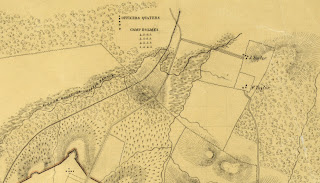
  Camp Holmes contained barracks for soldiers, but also a hospital, quartermaster and ordnance depots, offices, and a guardhouse. In charge was Major (later colonel) Peter Mallett. Mallett was able to report by June 10 that he had selected a location to the north of Raleigh for the camp.[4] The camp was opened by July 15, 1862.[5] The primary function of Camp Holmes was to process new soldiers coming in due to the Conscription Law. It was also a place to hold those new recruits and to hold deserters who had been captured, until they could be forwarded to regiments in the field.

   Camp Holmes would assume a new responsibility in March 1863. The previous October, the Confederate Congress had passed regulations stipulating what was to become of recaptured slaves. Section 2 stipulated that the depots for recaptured slaves were to be established by the Secretary of War  “at convenient places, not more than five in number, in each State, and all slaves captured in such State shall be kept in such depots.” According to section 3, physical descriptions of each slave, where they were arrested, and the name of their owners were to be recorded and published in one or more newspapers. Section 4 stated that “While such slaves are in the depot they may be employed under proper guard on public works…”[6] While other states had more than one camp (Virginia had three) North Carolina had only one – the Camp of Instruction in Raleigh.

   The late Walter C. Hilderman III wrote a good book on Confederate Conscription in North Carolina – They Went into the Fight Cheering (2005) that makes frequent mention of Camp Holmes, Colonel Mallett, and the role of Mallott’s Battalion in the enforcement of the Conscription Act. There is not, however, anything on just Camp Holmes or the role of the camp as a depot for recaptured slaves.

The other Camps of Instruction that Cooper designated were  Alabama – Notasulga (Camp Watts) and Talladega (Camp Buckner); Arkansas – Little Rock; Florida – Tallahassee; Georgia – Macon and Decatur; Louisiana – Monroe, Camp Moore, and New Iberia; North Carolina – Raleigh (Camp Holmes); Mississippi – Brookhaven and Enterprise; South Carolina – Columbia (Camp Johnson); Tennessee – Knoxville and McMinn; Texas – Houston; Virginia – Richmond (Camp Lee), Petersburg, and Dublin.[7]


[1] OR Ser. 1, Vol. 5, 884.

[2] OR Ser. 1, Vol. 13, 892, 893.

[3] Hilderman, They Went into the Fight Cheering, 25.

[4] OR, Ser. 4, Vol. 1, 1148.

[5] Camp Holes Letterbook, Vol. 6, Peter Mallett Papers, SHC.

[6] OR, Ser, 2, vol. 5, 844.

[7] OR, Ser, 2, vol. 5, 844.

Thursday, April 27, 2023

James Dearing at Plymouth

Over the past few months as I have worked on the Plymouth project, I discovered that no one really understands the role of Col. James Dearing. It is like he was every place, and in command of everything. How much of this is actually true? Maybe we should dig a little deeper into this story. 

James Dearing (Avoca Museum)

   Dearing was born in Campbell County, Virginia, on April 25, 1840. He entered West Point in 1858, and when Virginia seceded, he resigned on April 22, 1861, and returned to his native state.  Dearing first served as a lieutenant in the Washington Artillery, seeing action at the first battle of Manassas. In April 1862, he was promoted to captain, followed by a transfer to Latham’s battery. Dearing saw action during various portions of the Peninsula Campaign, although he was reported out sick during the Seven Days battles. Dearing was back with his battery during the battle of Second Manassas, this time as a part of James Longstreet’s command. Dearing missed the battle of Sharpsburg, being sent to southeastern Virginia. By December of 1862, Dearing was in command of three batteries. Following the battle of Fredericksburg, he was promoted to major.

   It was back to eastern Virginia for Dearing and his artillery battalion. While there, he was given command of a scouting expedition of infantry and cavalry, and captured several Federal pickets close to Suffolk. Dearing had his battalion broken up, and a portion of it was captured. With the reorganization of the army after Chancellorsville, Dearing’s battalion was enlarged. It was still assigned to Longstreet’s command. Following their involvement in the battle of Gettysburg, Dearing returned to Virginia. Dearing was back in Southeast Virginia that fall and early winter, this time in command of a cavalry battalion. He was also promoted to colonel and commanded a small group of mixed cavalry and artillery, and participated in the failed attempt to capture New Bern.[1]

   Dearing was a part of Robert F. Hoke’s force that invested and captured Plymouth in April 1864. He commanded the 8th Confederate Cavalry with the Virginia Horse Artillery. Since no official record from Dearing, or Hoke, or the other two Confederate brigade commanders survives, it is really hard to say what his role in the battle was. Letters and diaries have him every place, fighting on every part of the field. Some of Dearing’s cavalry opened the battle by capturing Federal pickets.

   On April 17, Hoke ordered Kemper’s brigade, under Col. William R. Terry, with Dearing, to the Confederate left, testing the defenses of Fort Gray to the north of town. One historian writes that Dearing was ordered by Hoke to attack the fort. However, Terry outranks Dearing and the command to attack the fort should have gone to Terry.[2]

   Portions of Dearing’s command were sent to the Confederate right to scout the Columbia road, but just who these Confederates were serving under is not clear. On April 18, the second day of the battle, Dearing was ordered to take his artillery and reposition towards the Confederate center, this time facing Fort Wessells. Terry also repositioned Kemper’s brigade, and his brigade supports Hoke’s brigade, under the command of Col. John T.  Mercer, in their attack that captures the fort. One account has Dearing’s artillery arriving after the first charge to take the fort had failed.[3]

   After the Albemarle arrives and sinks the Southfield and drives off the Miami, early on the morning of April 19, it is Dearing that is sent to demand that Brig. Gen. Henry Wessells surrender the garrison at Plymouth, a demand that is refused. Late in the day, all of Dearing’s Cavalry, with Ransom’s brigade, is sent to the Confederate right. Dearing is in the area in the darkness, scouting the Federal lines and looking for a way over Conaby Creek. Ransom’s brigade makes its way over the creek, and early on the morning of April 20, launches an attack that captures the redoubt on that side of the town, in which Dearing is in front during the attack. After the works are successfully captured by the Confederates forces, Dearing and an unnamed officer from the Albemarle are seen rowing up the river toward Fort Gray. They are bringing a message from Hoke to the commander of the small fort, stating that further resistance is futile.[4]

   As already stated, if Dearing, Ransom, Lewis (who took command of Kemper’s brigade after Mercer was killed) or Hoke wrote an official report after the battle, they appear lost to history. Dearing was promoted to brigadier general soon after the battle. He spent the next couple of months in North Carolina, then in July, was transferred back to the Army of Northern Virginia and placed in Rooney Lee’s division. Beauregard recommend Dearing for promotion to major general, but that never happened. Dearing was mortally wounded at the battle of High Bridge on April 6, 1865, dying in Lynchburg on April 22.[5]  


[1] Parker, General James Dearing, 1-50.

[2] Newsome, The Fight for the Old North State, 208.

[3] Roanoke Beacon, July 26, 1895; Richmond Dispatch, May 2, 1864.

[4] Johnston, Four Years a Soldier, 298; The Smithfield-Herald, April 19, 1901; The Standard Union, August 2, 1890; The National Tribune, September 25, 1884.

[5] Parker, General James Dearing, 60-95.

Thursday, April 20, 2023

Quantrill goes to Richmond

   In the 1860s, with a war going on, the theater of operation for William Quantrill was a long way from the Confederate capitol in Richmond. Some might even say they were worlds apart. Yet the famed Confederate leader took that long trip in January 1863.

   The war waged beyond the Mississippi was brutal, spanning back a decade prior to April 1861. “Bleeding Kansas” had spilled over into the surrounding areas between 1854 and 1859. There were instances of electoral fraud, raids, and violent clashes carried out. The violence continued into the 1860s, spreading over the entire country. William C. Quantrill arrived in Kansas in 1857, and in 1858, joined an army expedition headed to Utah. Quantrill served as a teamster, and most of the group died during the trip. Quantrill returned to Kansas, associated with the Free-Staters, then the proslavery group. At the start of the war, Kansas Jawhawkers, described as “antislavery Unionists,” crossed over into Missouri “to burn and plunder.” Quantrill and others in Missouri organized guerrilla bands to fight against the plunderers.[1] 

William Quantrill (LOC)

   Quantrill served in different groups at the beginning of the war, including Mayes’s 1st Cherokee Regiment and then Sterling Price’s Missouri State Guard, fighting with the latter at Wilson’s Creek. When Quantrill’s enlistment expired, he was allowed to go home to wage war locally, including cutting telegraph lines, attacking foraging parties, Union garrisons, and disrupting Union activities whenever possible. He returned to Blue Springs, recruited ten men, and joined with others in an attempt to root out Federal forces from their home counties. Quantrill was commissioned a captain in Confederate service.[2]

   In the winter of 1862-1863, with his men in winter quarters, Quantrill set out to visit Richmond and Jefferson Davis, lobbying the Confederate president for a colonel’s commission. It was Quantrill’s argument that he was already commanding enough men to warrant the promotion. Quantrill made his way to Little Rock, catching a train toward Memphis. He was traveling with two fellow soldiers. Memphis was in Federal hands, and at some point, Quantrill moved overland to a train that took him to Jackson, Mississippi. Another train took him to Atlanta, then Columbia, South Carolina. Quantrill then entered North Carolina, passed through Petersburg, and eventually reached Richmond. (It is unclear why Quantrill followed this route, rather than the closer route through Knoxville and Bristol.)[3]

   Jefferson Davis was not in Richmond. He had left Richmond on December 9, reaching Chattanooga on December 11. He visited Murfreesboro, Atlanta, Montgomery, Vicksburg, Augusta, Charlotte, and Raleigh. Davis did not return to Richmond until January 4, 1863.[4]

   Outside of “Christmas time,” it is unclear just when Quantrill arrived. Davis was not present, and Quantrill met with Secretary of War James A. Seddon. There is no really good account of the meeting, but one biographer reported that Quantrill asked Seddon for a colonel’s commission under the Partisan Ranger Act. A much later account had Quantrill stating that he would “cover the armies of the Confederacy all over with blood. I would invade. I would reward audacity. I would exterminate. I would break up foreign enlistments [in indiscriminate massacre. I would win the independence of my people or I would find them graves.” When it came to prisoners, Quantrill stated that he would take no prisoners. “Do they take prisoners from me?” he reportedly questioned Seddon.[5]

   Quantrill was soon on his way back to his command in the Trans-Mississippi department. There is no documentation that the Confederate War Department ever promoted Quantrill to the rank of colonel. However, as Petersen pointed out, several of Quantrill’s men affirmed he was promoted to colonel, something that Quantrill’s commander, Sterling Price, had the authority to do.[6]

   For the next couple of years, Quantrill fought his war. Neither side in the Missouri – Indian Territory-Texas theater took many prisoners. Accounts paint a picture of some of the most vicious violence of the conflict. Quantrill met his end in Kentucky in June 1865, attempting to reach Confederate lines. His trip to Richmond in December 1862 to meet with Jefferson Davis is little documented, both then and today.


[1] Fellman, “William Clarke Quantrill,” Encyclopedia of the Confederacy, 3:1289.

[2] Peterson, Quantrill in Texas, 49, 52; William E. C. Quantrill, CMSR, NA.

[3] Paterson, Quantrill in Texas, 72-75.

[4] Cooper, Jefferson Davis, American, 417-18.

[5] Schultz, Quantrill’s War, 130-31.

[6] Petersen, Quantrill in Texas, 74-77.

Wednesday, April 19, 2023

Untold Civil War

Friends - I had a chance recently to sit down with Paul at Untold Civil War. We chatted about Lee's Body Guard: The 39th Battalion Virginia Cavalry. Give it a listen! https://untoldcivilwar.squarespace.com/podcast-and-videos

Thursday, April 13, 2023

Bad Mitchell County History

    As many of you know, from time to time I make comments on interesting things I find on the internet. This is not one I found, but it was emailed to the general staff of a place where I work. If you must, you can see the original here, although I have copied the whole thing below. After talking it over with a couple of friends (including people at the Mitchell County Historical Society), we believe that this is AI- generated. The saddest thing, or the one thing that induces anger, is that people are going to stumble across this on a general internet search and believe it! It is on the internet, so it has to be true, correct? My comments are red.


 7 Pieces Of History Near Spruce Pine, NC

 Spruce Pine, North Carolina is a small mountain town located in the western part of the state. This picturesque town has a rich history that spans a range of significant events, including Native American settlements,  battles during the Civil War, and mining booms. Here are seven historical events and landmarks that have taken place near Spruce Pine:


1. Native American settlements – Before European settlers arrived in the western part of North Carolina, Native American tribes inhabited the region, including the Cherokee, Catawba, and the Creek. Arrowheads and other artifacts have been discovered in the area, indicating a rich and complex history of indigenous people nearby.

Kind of true, except, the artifacts found in these areas date back hundreds of years, not at the time of European settlement in the mountains. The area was frequented by hunting parties but was kind of an in-between land of the Catawba and Cherokee.

2. Battle of McDowell - During the Civil War, Spruce Pine was the site of a significant clash between Union and Confederate forces. On May 9, 1862, in nearby McDowell, Union General John C. Fremont led his forces into battle against Confederate forces under General Thomas J. "Stonewall" Jackson. The Confederates ultimately won the battle, which was one of the first major engagements of the Civil War in western North Carolina.

Um, this would be the battle of McDowell, Virginia. This battlefield site is about 350 miles from Spruce Pine.

3. Roan Mountain Massacre - In 1863, Confederate soldiers from the 64th North Carolina Regiment carried out a massacre near Roan Mountain, located a few miles from Spruce Pine. The soldiers killed nine Union sympathizers, including elderly men and women, children, and a baby.

No, there was never a “Roan Mountain Massacre,” although Roan Mountain did have a couple of deserter and bushwhacker camps. I wonder if this is trying to connect the Shelton Laurel Massacre in Madison County in January 1863? It is a couple of counties to the west. People in other parts of Madison County got tired of being robbed by those in Shelton Laurel. They got the 64th North Carolina involved, and thirteen were executed, including a couple of teenage boys. One article from the time period went as far as to say that a gang of 10-15 year olds was worse than the adults.

4. Spruce Pine Tobacco Barn Murals- In the 1980s, artist Brenda Councill created a series of large-scale murals on the sides of tobacco barns in Spruce Pine. The murals depict scenes from the town's history, including the Battle of McDowell, the town's mining history, and the area's Native American past.

Um… (how many times can I say that?) I asked Brenda Council, a wonderful artist who does murals, if she had ever worked on barn murals in Mitchell County. Nope. She never has. As far as I can remember, there are no murals in Spruce Pine that deal with the battle in Virginia, the town’s mining history, or their Native American past.

5. Mining Boom- In the late 1800s, Spruce Pine became a hub for mica mining. The area's rich deposits of high-quality mica attracted miners from all over the world. In the early 1900s, the mining industry expanded to include feldspar, quartz, and other minerals. Today, the mining industry remains an important part of the local economy, with many companies still working in the area.

This one is almost true. Spruce Pine was a hub for mica, feldspar, quarts, and other mineral mining in the late 1800s into the mid-20th century. Except for a couple of mines, that industry has pretty much dried up as of 2023.

6. Flood of 1940- In July 1940, Spruce Pine was hit by a devastating flood that killed 29 people and caused extensive damage to the town. The flood was caused by heavy rains that caused rivers to overflow their banks. Many buildings and homes were destroyed or damaged, and the cleanup and recovery efforts lasted for several weeks.

The flood of 1940 was bad, but I’ve never seen where 29 Spruce Pine residents were killed.

7. Little Switzerland- Located a few miles from Spruce Pine, Little Switzerland is a quaint mountain town that has been a popular tourist destination since the early 1900s. The town was named by a group of Swiss immigrants who settled in the area in the late 1800s. Today, Little Switzerland is known for its scenic beauty, charming shops and restaurants, and outdoor recreation opportunities.

Nope. No Swiss immigrants. The community was founded in 1910 by Charlotte Judge Heriot Clarkson. It was so named due to the fact that the mountains resembled the mountains of Switzerland.  

Spruce Pine, NC is a town with a rich and varied history that spans centuries. From Native American settlements to the Civil War clashes, mining booms, and devastating floods, the town has witnessed many significant events that have shaped its character and identity. Whether you're a history buff or simply curious about this beautiful part of the country, Spruce Pine has plenty to offer visitors seeking a deeper understanding of its past.

Yes, Spruce Pine has plenty to offer visitors seeking a deeper understanding of the past, but not from articles like this one! What do you think? AI generated? Or just a dupe pulling material off web searches?

Monday, April 03, 2023

The Slave on the Ten Dollar Note


   We have talked about Confederate currency once before – Lucy Pickens, the first woman on American paper money. You can check out that post here. Another interesting story is found on a Confederate ten dollar note – that of Oscar Marion, the slave of Francis Marion. Francis Marion, of course, was known as the Swamp Fox. Starting in 1780, he often led small bands of men against British supply lines and gathered intelligence for Gen. Nathaniel Greene. Marion’s men would often hide out in the swamps of South Carolina after conducting their raids. In one episode, an officer, wishing to discuss a prisoner of war exchange, was blindfolded and led to Marion’s headquarters in the swamp on Snow Island. As the meeting began, the blindfold was removed, and Marion offered the officer a seat on a log. After the meeting, Marion asked the officer to remain for dinner, which was a sweet potato, roasted on the fire, and served on a piece of bark. The British office then learned that Marion and his men served without pay. According to one Marion biographer, the British “officer was so much impressed with what he had heard and seen, and so convinced of the impossibility of overcoming soldiers who fought thus upon principle, and for the pure love of liberty, that he decided to” resign his commission.[1]

   In 1840, South Carolina artist John Blake White painted this very scene. There is Francis Marion, the British officer, and Oscar, Marion’s slave, cooking the sweet potatoes on the fire. This image was later cut into a plate and appeared in the center on the 1861 Confederate ten dollar note. To the image’s left is Robert M. T. Hunter, Confederate Secretary of State and later Confederate senator and to the right is a statue of Minerva, the Roman goddess of wisdom, justice, law, and victory.[2]

General Francis Marion Inviting A British Officer to Share His Meal or The Swamp Fox


Monday, March 27, 2023

The 1861 election of T.A.R. Nelson and Joseph B. Heiskell

   Politics always makes strange bedfellows, and the August 1861 contest in District 1 in east Tennessee might make one of the most interesting contestss of the war. It pitted Tennessee state senator Joseph B. Heiskell against US Congressman T.A.R. Nelson. Both Heiskell and Nelson were from east Tennessee and both were pre-war Whigs. Heiskell is described as being a “staunch Union Whig in politics.” However, after the firing on Fort Sumter and Lincoln’s call for troops, he “cast his lot with the Confederacy.”[1]   

    Once Tennessee left the Union and joined the Southern Confederacy, the state was allowed to elect representatives in the Confederate House and Senate. Heiskell ran for Confederate House. Strangely enough, Nelson was also running. Except, Nelson was running for the same district in the US House: two men, from the same area, running for the same designated seat, but in two different bodies politic. The remaining sources are somewhat silent on the actual campaign, although one post-war scribe told of a secession meeting held in Elizabethton in May 1861. Nelson, with US Senator Andrew Johnson, spoke one week, while Heiskell, with former US Congressman William Cocke, spoke the following week. For the Congressional seats, it appears that they ran pretty much unopposed.[2]

   Of course, both men won. Had they been contending for the same seat, Nelson would have steamrolled Heiskell. The numbers looked like this: Johnston County - Nelson, 1129, Heiskell, 109; Carter County – Nelson 1229, Heiskell 81; Greene County – Nelson, 2352, Heiskell, 831; Jefferson County, Nelson 1509, Heiskell, 727. The only two counties that Heiskell won were Washington County – Nelson 979, Heiskell, 1061 and, Hawkins County – Nelson, 841 and Heiskell, 957.[3]

   Heiskell would soon make his way to Richmond. Nelson would head to Washington, D.C., but wound up in Richmond as well. He was arrested in Wise County, Virginia, on August 5, 1861, and jailed in Richmond. Nelson wrote Jefferson Davis, asking to be released, promising to return to east Tennessee and live peaceably. Davis ordered Nelson released on August 13, 1861. Heiskell would go on to be elected to serve in both the first and second Confederate Congresses.[4]  

   Outside of the presidential election of 1860, the race between Heiskell and Nelson might just be one of the more interesting elections of the 1860s.


Nelson                              Heiskell


[1] Warner and Yearns, Biographical Register of the Confederate Congress, 115.

[2] Scott and Angel, The Thirteenth Regiment, Tennessee Volunteer Cavalry, 38; The Tennessean, August 11, 1861.

[3] The Tennessee, August 11, 1861.

[4] OR, Series II, Vol. 1, 824, 826.