Showing posts with label Plymouth. Show all posts

Monday, January 13, 2025

The use of Black spies in Eastern North Carolina.

   While researching my upcoming book on the battle of Plymouth (Savas Beatie), I came across one of the few accounts of the execution of a Black man for spying. A member of the 1st Virginia Infantry, the morning of the battle, recalled that they found a Black man “wearing the dress of a field hand, and having a red handkerchief tied around his head.” Under these clothes was “the full uniform of a Yankee soldier.” The spy was “hung on the spot,” his identity unknown. Most people would either discount this story, or add it to a somewhat questionable list of atrocities committed by Confederate soldiers during the Plymouth Campaign.[1]

From Colyer.
   Yet in 1864, Vincent Colyer published an interesting account of using slaves as scouts and spies in Eastern North Carolina. Colyer, born in New York in 1824, was an artist. During the war, he served with the United States Christian Commission. In March 1862, after the battle of Roanoke Island and New Bern, Federal General Benjamin Butler appointed Colyer Superintendent of the Poor. He was ordered to employ up to 5,000 Black men, offering them $8 a month, one daily ration, and clothes. These men, mainly former slaves, constructed forts, unloaded cargo vessels, repaired bridges, built cots for hospitals, and operated as spies and scouts. Colyer writes that up to fifty Black men were employed as scouts and spies. “They went from thirty to three hundred miles within the enemy’s lines; visiting principal camps and most important posts, and bringing us back important and reliable information.”[2]

   Colyer then gives us a few names and exploits. One spy, Charley, made three trips to Kinston. W.M. Kinnegy also scouted for the Federals in Kinston. Two freemen who came into the lines were used to scout in the Beaufort area. 

   Spies are seldom mentioned in official correspondence. When they are, their race is almost never mentioned. Major General J.G. Foster, wrote from New Bern on January 20, 1863 to Henry Halleck, “I have just received information from a spy, who has been within the enemy’s lines and conversed with their soldiers, to the effect that the rebel force in this State has been largely increased; that the main body intended to be thrown by railroad either to Weldon or Wilmington… The rebel soldiers reported to the spy that 75,000 men were at Goldsboro.”[3] Writing from Suffolk on March 21, 1863, Maj. Gen. John J. Peck asked Major General Dix: “Is it not time for your peddler [spy] to return?”[4] Writing from Wilmington in August 1863, Maj. Gen. W.H.C. Whiting complained to the Secretary of War that he had too few men. The few that he did have were busy, among other things, in the “detection of spies.”[5]

   Spies were even used in the greater Plymouth area. Major General John Peck, commanding the eastern North Carolina district, gave several accounts of using the local population to gather intelligence on Confederate operations.  In February 1864 Peck mentions a letter from Brig. General Wessels, commanding at Plymouth, that Wessel’s “spy has just come in from Halifax. He came from Wilmington, and 25,000 pounds of iron was on the same train.” It was iron for a gun boat. On March 18, Peck reported that Wessels had reported on the “return of a man sent out … to procure information concerning the ram at Halifax.” On March 29, Peck wrote that “My spy came in from Kinston last evening, having been out seven days.” There is little clue about the race of each of these spies, although Peck adds that in March, an officer had examined “all the contrabands” and that they “agree that there is a large force at Kinston, and also at Greenville, and that the obstructions below Kinston are being removed.”[6]

   The use of Blacks as spies, both free and formerly enslaved, was something of which even the Confederate high command was aware. In May 1863, Robert E. Lee, in writing to Lt. Col. J. Critcher, 15th Virginia Cavalry, noted that "The chief source of information to the enemy is through our Negroes."[7]

   Was the treatment of the Black man caught wearing a Federal uniform under other clothes unusually harsh? Maybe not. Execution has been the normal punishment for spies caught by the enemy for quite some time. We need only to mention names like Timothy Webster and Sam Davis. There were other Black spies, probably the most famous on the Northern side being John Scobell, who worked for Pinkerton. Overall, the work of Black men and women as spies is one that needs to be explored more. That is a challenge. If spies are successful, no one, except their handlers, know of their accomplishments.


[1] The Daily Dispatch, April 23, 1864.

[2] Colyer, Report, 9.

[3] OR, 18: 524.

[4] OR, 18:566.

[5] OR Vol. 29, pt. 2, 670.

[6] OR, Vol. 33, 291.

[7] OR. Vol. 25, Pt. 2, 826.

Thursday, December 19, 2024

Samuel Johnson and the Plymouth Massacre

    Major General Benjamin F. Butler was in a tizzy. He had received a deposition from the provost marshal bearing incredible news, a note he had forwarded to General Grant. The deposition was from the orderly sergeant of Company D, 2nd United States Colored Cavalry (USCC), Samuel Johnson. Johnson claimed that he was in Plymouth, North Carolina, with a “Sergeant French.” French was a recruiting officer and was in Plymouth “to take charge of some recruits.” Johnson claimed to have witnessed the April 1864 battle of Plymouth, the most successful combined Confederate army-navy venture of the war. On learning that the Federal garrison was going to be surrendered to the Confederate command under Brig. Gen. Robert F. Hoke, Johnson

Pulled off my uniform and found a suit of citizen’s clothes, which I put on, and when captured I was supposed and believed by the rebels to be a citizen. After being captured I was kept at Plymouth for some two weeks and was employed in endeavoring to raise the sunken vessels of the Union fleet.

   From Plymouth I was taken to Weldon and from thence to Raleigh, N.C., where I was detained for about a month, and was forwarded to Richmond, where I remained until about the time of the battles near Richmond, when I went with Lieutenant Johnson, of the Sixth North Carolina, as his servant, to Hanover Junction. I did not remain there over four or five days before I made my escape into the lines of the Union army and was sent to Washington, D.C., and then duly forwarded to my regiment in front of Petersburg.

   Upon the capture of Plymouth by the rebel forces all the negroes found in blue unforms, or with any outward marks of a Union soldier upon him, was killed. I saw some taken to the woods and hung. Others I saw stripped of all their clothing and then stood upon the banks of the river with their faces riverward and there they were shot. Still others were killed by having their brains beaten out by the butt end of muskets in the hands of the rebels. All were not killed the day of the capture. Those that were not were placed in a room with their officers, they (the officers) having previously been dragged through town with ropes around their necks, where they were kept confined until the following morning, when the remainder of the black soldiers were killed.

   The regiments most conspicuous in these murderous transactions were the Eighth North Carolina and, I think, the Sixth North Carolina.[1]


   Johnson’s account is often used as an example of the brutality of Confederate soldiers toward Black Federal soldiers captured during the war. Yet, Johnson’s account has numerous problems. First and foremost, there is no Orderly (or First) Sergeant Samuel Johnson in the 2nd USCC.[2] Maybe the regiment was wrong. There was a Samuel Johnson in the 3rd USCC. He did not enlist until July 11, 1864, in Vicksburg, Mississippi. Another Samuel Johnson enlisted in the 4th USCC in New Orleans on March 1, 1864. Yet another Samuel E. Johnson enlisted in Columbus, Ohio, on December 20, 1864, in the 5th USCC. This soldier was appointed sergeant on February 1, 1865.[3] Maybe the provost marshal in his deposition got the first name wrong. There was a corporal Berry Johnson, but he was in Company G; Corp. Henry Johnson served in Company B; Sgt. Joseph Johnson served in Company L, but did not actually enlist until March 9, 1865; Pvt. Kuggs Johnson is the only Johnson in Company D, but he did not enlist until March 14, 1865; Richard Johnson enlisted on December 24, 1864 in Prince Anne County, Virginia. He was also a private, and his compiled service record states he was in various engagements like Petersburg, Virginia, on May 9, 1864; Richard R. Johnson was a sergeant in Company C but is reported present from March to June 1864. Maybe his service record was lost. But why not a pension record?[4]


   If Johnson’s service cannot be substantiated in the Company D, 2nd United States Colored Cavalry, then that should end the conversation right there. Digging a little further, there is a record for a George N. French somehow connected to the 2nd USCC. He does not seem to have been officially mustered into the regiment until March 18, 1866, at the rank of second lieutenant. In July (25th or July 2, ‘65?) a B.H. French writes to the government asking about a son who was a lieutenant in the 2nd USCC, stating he had been captured at Plymouth. B.H. French was living in Chicago at the time she wrote. There appears to be no prison record, no parole record, and no pension. What became of French?


   Johnson stated that after two weeks in Plymouth and a month in Raleigh, he was sent to Richmond, remaining an undisclosed time, when he was sent to be the servant of a “Lieutenant Johnson, of the Sixth North Carolina.” There is no Lieutenant Johnson/Johnston in the 6th North Carolina. By the time that Samuel Johnson arrived with the 6th North Carolina, that regiment had been ordered to the Shenandoah Valley.  From the vicinity of Hanover Junction, Johnson stated he escaped into Federal lines.


   What of the murder of Black Union soldiers so graphically described in Johnson’s affidavit?  One challenge is this: there were no Black regiments stationed in Plymouth during the battle. There were some recruiters and Black recruits for Black regiments. And it is possible that some were killed. However, one Richmond newspaper reported on April 27, 1864, that “two negroes in Yankee uniforms,” arrived with General Wessells (the Federal commander) and the other federal officers in Richmond.[5] Obviously, not all Black men found in uniform were executed in Plymouth.


   Black men, women, and children were held for some time in Plymouth. One newspaper reported that citizens from the surrounding area were “hastening” to Plymouth to “to reclaim the property stolen from them by the Yankees. Besides a large number of negroes, horses and other articles identified by their owners.”[6] On April 23, Gen. P.G.T. Beauregard telegraphed Gov. Zebulon B. Vance, instructing him to send “the slaves captured” at Plymouth “to Wilmington,” to work on the fortifications.[7]


   It is interesting that Samuel Johnson never mentions James Dearing. Dearing’s ad hoc cavalry command plays a role in hunting down both Blacks and local unionists in many other accounts (many post-war, or contemporary to our time) of the battle. Many had escaped to the swamps where Dearing was sent to hunt them down. One report stated that 300 to 400 actually gave themselves up, and Lt. Charles French, with the U.S.S. Miami, picked up “many escaped soldiers . . . who had taken to the swamps.”[8] Yet Johnson never brings those in the swamps up in his affidavit.


   After the war was over, the members of the 101st and 103rd Pennsylvania Infantry, who fought at Plymouth and were captured, considered the matter at one of their reunions. They came to the conclusion that men like Samuel Johnson, and the veterans who wrote about the “massacre” after the war, were “mistaken.” They believed that “many negroes and native North Carolina Union soldiers were killed, and perhaps an occasional one brutally murdered, by individual soldiers, but the victims, apprehending cruel treatment, were attempting to make their escape, when by the laws of war, the victors are justified in shooting even an unarmed man.” They believed that Union soldiers, placed in the same situation, might enjoy the “same kind of sport.” They believed that Wessells, who was still in Plymouth when this supposedly took place, “would have instantly taken issue with the Confederates, had he any suspicion of such atrocities.” Considering that the 101st and 103rd finished the war in Andersonville Prison and had every right to be embittered against their foe, they declined to endorse the idea of a large-scale massacre of Black soldiers following the battle.[9]


   It is interesting to note that Samuel Johnson claimed to belong to the 2nd USCC. Just a few weeks prior, the 2nd USCC ambushed portions of Ransom’s brigade near Suffolk, Virginia, killing and wounding several. When Confederates discovered the house the sharpshooters were using, they set fire to it, with the Black soldiers inside, later declaring that “Ransom’s brigade never takes any negro prisoners…”[10] On passing along Johnson’s affidavit, Butler told Grant that “something should be done in retaliation for this outrage.” He had several prisoners from the 8th North Carolina and, if in independent command, “I should take this matter into my own hands.” Grant ignored him and the testimony of Samuel Johnson.[11]


   It is entirely possible that Confederate soldiers, in the heat of the moment, killed fellow combatants after they had surrendered. It happens in all wars and not just with Confederate soldiers. Federal officers lost control of their soldiers at the battle of Fort Gregg in April 1865 (read more here). But the idea that Wayne Durrill advanced that “roughly six hundred U.S. soldiers, most of them black, whom the Confederates failed to take prisoner,” were killed, along with the testimony of Samuel Johnson, should be seen as unsubstantiated myth.[12]  


[1] OR, Ser. 2, 7:459-460.

[2] Both compiled service records on Fold3 and Ancestry were checked, along with pension records. I also had someone else double check this.

[3] Various compiled service records.

[4] CMSR, Roll 0024, M1817, RG94.

[5] Richmond Whig, April 27, 1864.

[6] Richmond Examiner, quoted in the Memphis Daily Appeal, May 9, 1864.

[7] Papers of Vance, 3:185.

[8] The Daily Confederate, Apr. 30, 1864; ORN 8, 641.

[9] Dickey, History of the 103d Pennsylvania, 269-70.

[10] Charlotte Daily Bulletin, March 18, 1864.

[11] OR, Ser. 2, 7:459-460.

[12] Durrill, War of Another Kind, 206-8.

Thursday, April 27, 2023

James Dearing at Plymouth

Over the past few months as I have worked on the Plymouth project, I discovered that no one really understands the role of Col. James Dearing. It is like he was every place, and in command of everything. How much of this is actually true? Maybe we should dig a little deeper into this story. 

James Dearing (Avoca Museum)

   Dearing was born in Campbell County, Virginia, on April 25, 1840. He entered West Point in 1858, and when Virginia seceded, he resigned on April 22, 1861, and returned to his native state.  Dearing first served as a lieutenant in the Washington Artillery, seeing action at the first battle of Manassas. In April 1862, he was promoted to captain, followed by a transfer to Latham’s battery. Dearing saw action during various portions of the Peninsula Campaign, although he was reported out sick during the Seven Days battles. Dearing was back with his battery during the battle of Second Manassas, this time as a part of James Longstreet’s command. Dearing missed the battle of Sharpsburg, being sent to southeastern Virginia. By December of 1862, Dearing was in command of three batteries. Following the battle of Fredericksburg, he was promoted to major.

   It was back to eastern Virginia for Dearing and his artillery battalion. While there, he was given command of a scouting expedition of infantry and cavalry, and captured several Federal pickets close to Suffolk. Dearing had his battalion broken up, and a portion of it was captured. With the reorganization of the army after Chancellorsville, Dearing’s battalion was enlarged. It was still assigned to Longstreet’s command. Following their involvement in the battle of Gettysburg, Dearing returned to Virginia. Dearing was back in Southeast Virginia that fall and early winter, this time in command of a cavalry battalion. He was also promoted to colonel and commanded a small group of mixed cavalry and artillery, and participated in the failed attempt to capture New Bern.[1]

   Dearing was a part of Robert F. Hoke’s force that invested and captured Plymouth in April 1864. He commanded the 8th Confederate Cavalry with the Virginia Horse Artillery. Since no official record from Dearing, or Hoke, or the other two Confederate brigade commanders survives, it is really hard to say what his role in the battle was. Letters and diaries have him every place, fighting on every part of the field. Some of Dearing’s cavalry opened the battle by capturing Federal pickets.

   On April 17, Hoke ordered Kemper’s brigade, under Col. William R. Terry, with Dearing, to the Confederate left, testing the defenses of Fort Gray to the north of town. One historian writes that Dearing was ordered by Hoke to attack the fort. However, Terry outranks Dearing and the command to attack the fort should have gone to Terry.[2]

   Portions of Dearing’s command were sent to the Confederate right to scout the Columbia road, but just who these Confederates were serving under is not clear. On April 18, the second day of the battle, Dearing was ordered to take his artillery and reposition towards the Confederate center, this time facing Fort Wessells. Terry also repositioned Kemper’s brigade, and his brigade supports Hoke’s brigade, under the command of Col. John T.  Mercer, in their attack that captures the fort. One account has Dearing’s artillery arriving after the first charge to take the fort had failed.[3]

   After the Albemarle arrives and sinks the Southfield and drives off the Miami, early on the morning of April 19, it is Dearing that is sent to demand that Brig. Gen. Henry Wessells surrender the garrison at Plymouth, a demand that is refused. Late in the day, all of Dearing’s Cavalry, with Ransom’s brigade, is sent to the Confederate right. Dearing is in the area in the darkness, scouting the Federal lines and looking for a way over Conaby Creek. Ransom’s brigade makes its way over the creek, and early on the morning of April 20, launches an attack that captures the redoubt on that side of the town, in which Dearing is in front during the attack. After the works are successfully captured by the Confederates forces, Dearing and an unnamed officer from the Albemarle are seen rowing up the river toward Fort Gray. They are bringing a message from Hoke to the commander of the small fort, stating that further resistance is futile.[4]

   As already stated, if Dearing, Ransom, Lewis (who took command of Kemper’s brigade after Mercer was killed) or Hoke wrote an official report after the battle, they appear lost to history. Dearing was promoted to brigadier general soon after the battle. He spent the next couple of months in North Carolina, then in July, was transferred back to the Army of Northern Virginia and placed in Rooney Lee’s division. Beauregard recommend Dearing for promotion to major general, but that never happened. Dearing was mortally wounded at the battle of High Bridge on April 6, 1865, dying in Lynchburg on April 22.[5]  


[1] Parker, General James Dearing, 1-50.

[2] Newsome, The Fight for the Old North State, 208.

[3] Roanoke Beacon, July 26, 1895; Richmond Dispatch, May 2, 1864.

[4] Johnston, Four Years a Soldier, 298; The Smithfield-Herald, April 19, 1901; The Standard Union, August 2, 1890; The National Tribune, September 25, 1884.

[5] Parker, General James Dearing, 60-95.

Friday, January 20, 2023

Women Imprisoned at Andersonville


   When we think of war-time women prisoners, a few famous spies, like Belle Boyd, Rose O’Neal Greenhow, and maybe Pauline Cushman come to mind. There were a few others imprisoned who are not household names. Margaret Leonard is one of them.

   Margaret Larney was born in Ireland, came to the United States, and married Isaac Newton Leonard. Leonard enlisted in Company H, 2nd Massachusetts Heavy Artillery the following year and was sent to eastern North Carolina. When Confederates under Robert F. Hoke came to invest Plymouth in April 1864, Margaret did not leave with the other refugees. Instead, according to a veteran’s post-war account, she “engaged in making coffee for the men in a building exposed to a heavy fire. At one time a solid shot passed through the building, taking with it one of her dresses, which hung on a nail by the wall. Another carried away the front legs of her cooking-stove. Yet when the fight was over, on the evening of the 19th, she had coffee for the men, and supper for the officers. She was in Fort Williams during the remainder of the fight.” She and her husband were both captured and imprisoned at Andersonville.    Margaret Leonard lived in the prison for a time, but eventually Captain Wirz moved her in with his family. After a while, “she began insulting” the Captain’s family and Wirz had her sent to Castle Thunder in Richmond. There she befriended Dr. Mary Edwards Walker, who described her as “a large stout Irish woman.” Before long, Leonard was sent beyond Confederate lines. Isaac survived the war but died in 1869. Margaret lived in California until her death in 1900.[1]

Grave in Florence, South Carolina (findagrave).

   Francis Jane Scadin, wife of Herbert Hunt, arrived a couple of weeks after Margaret Leonard. Hunt was a steamboat captain. Hunt had just married Francis, and with his new bride and other guests, set sail on a “pleasure cruise.” As the story goes, the ran into a United States revenue cutter, who forced Hunt to head to North Carolina to take on a load of corn. In the process of being loaded, Hunt and his ship were captured. His bride, thinking his imprisonment would last only a few days, disguised herself and went with him to Andersonville. Doctor J.J.W. was sent to Andersonville in July 1864 and ordered to oversee the dispensary. On his first night, “I heard a very small infant crying near my office. . . Upon inquiry one of the guards informed me that it was the infant of Captain Hunt and his wife, only three days old.” Kerr visited her the next morning, finding her in a tent with the babe, “in the most abstract poverty I had ever seen.” It appears that while in the prison proper, Federal prisoners had cut the back out of her tent and took her trunk with clothing and cash. Kerr made arrangements to move her to a home nearby and worked with a merchant friend in Macon to secure clothing for new garments. What exactly became of Mrs. Hunt is unknown.[2]

   Another woman imprisoned at Andersonville appears to have been Florena Budwin. Our information about her comes from a Pvt. Samuel Elliott, a member of the 7th Pennsylvania Reserves. Elliott was captured during the battle of the Wilderness in May 1864. He, along with Florena Budwin and her husband, were sent to Andersonville. It appears that Florena had disguised her sex when she enlisted. At least Florena and Elliott were transferred to the prison in Florence, South Carolina. Elliott wrote in 1890 that “I knew the female prisoner at Andersonville, having seen her frequently pass our detachment on her way to the swamp for water. I remember her as a woman rather above medium height, sunburnt, with long, unkempt hair. Her clothing consisted of a rough gray shirt, a pair of worn out army trousers, and what was once a military cap, but scarcely enough of it was left to afford protection from the burning sun.” When transferred to Florence in September 1864, her “sex was discovered…and she was taken… to be a nurse in the hospital.” She served several months as a nurse at Florence, then contracted pneumonia and died on January 25, 1865. She just might be the first woman buried in a national cemetery.[3]

   There are probably many more stories like these that are lost to history.


[1] Marvel, Andersonville, 174; Davis, Ghosts and Shadows of Andersonville, 147; Goss, The Soldier’s Story of his Captivity at Andersonville, 60.

[2] Marvel, Andersonville, 56;  Sheppard, Andersonville, 38; Confederate Veteran, vol. XXIII, 318; Speer, Portals to Hell, 264.

[3] The Independent-Records, June 24, 1890; The State, May 29, 1934.

Wednesday, January 04, 2023

Torn Families – the Merrimans

   We often say that the war was fought “brother vs. brother.” Here is another example, the Merriman family (You can read about two other families here – the Gibbon family and the Flusser family.)

   Eli T. Merriman was born in Bristol, Connecticut, in 1815, graduating from Yale University in 1833, and then studying medicine in Pennsylvania and Vermont. He married another Connecticut native, Jenette Bartholomew. In the 1830s, the family moved to Texas, and Merriman became the first doctor to open a practice in San Marcos, Texas. Merriman served in the Mexican-American War, lived in Brownsville, then Banquette, Corpus Christi, and had six children with Jenette before they divorced. He also served in the Texas Legislature, and during the war, he became a Confederate doctor. He served at hospitals in Texas. His own ranch at Banquette served as a hospital “for the contagious.”[1]


   At least three of Merrimans’ sons served in the war. Two fought for the South, and one for the North.

   Walter Merriman (1835-1911), born in Connecticut, enlisted on January 1, 1863, in Rio Grande Station, in Company D, Duff’s Partisan Corps, which later became the 33rd Texas Cavalry. He brought his own horse and equipment and was mustered in as a corporal. The only other muster roll in his file is dated July 31, 1863, but he did survive the war. The 33rd Texas Cavalry was involved in the battle of Nueces and did patrol duty along the Rio Grande.[2]  

   James E. Merriman (1843-1931), born in Connecticut, enlisted in Company K, 8th Teas Infantry on May 4, 1862, in Corpus Christi. He was mustered in as a private. In October 1862, he was reported on detached service, but he appeared back with his command by the end of year. Merriman appeared present or accounted for through the end of 1864, although he was out sick or in a hospital for part of that time. The 8th Texas Infantry was involved in the battles of Corpus Christi, Fort Esperanza, and the Red River Campaign.[3]

   Henry E. Merriman (1837-1921), like his brothers, was born in Connecticut and went with the family to Texas. However, Henry returned to Connecticut where he was working in a store when the war began. On August 11, 1862, he enlisted in Company K, 16th Connecticut Volunteers.  The 16th Connecticut was involved in the battle of Sharpsburg, Fredericksburg, Siege of Norfolk, and the battle of Plymouth, North Carolina. At the latter, Merriman was captured and subsequently imprisoned at Andersonville, Florence, and Macon.[4]

   A 1904 newspaper article praised Henry Merriman for sticking it out in prison and not writing to his father asking for assistance in getting released. Given that Doctor Merriman was in localized Texas hospitals, and not the “high ranking” Confederate the post-war newspaper made him out to be, it is unlikely that the doctor could have done anything for Henry. Given the distance and time, one has to wonder if the different members of the Merriman family even knew who was in what army.


[2] Walter Merriman Compiled Service Record, M323, Roll 0163, Record Ground 109, National Archives.

[3] James E. Merriman, Compiled Service Record, M323, Roll 0325, Record Group 109, National Archives.

[4] Hartford Courant, June 14, 1904.

Sunday, January 01, 2023

Looking ahead to 2023.


  Whew… 2022 has come and gone. It was a good year. A History Lover’s Guide to North Carolina was released, and Hidden History of the Toe River Valley is just about ready to go in. The old office has been cleaned, and loads of old papers have been recycled or filed. I’ve also rebuilt my old pc. It should be running pretty well the next couple of years. My last post on here talked of the next project, a new history of the April 1864 battle of Plymouth, North Carolina. I’ve been doing some background reading on that subject. It was one of the few Confederate combined operations of the war, and it was a Confederate victory. For background reading, I started Rowena Reed’s Combined Operations in the Civil War a week or so ago. Wow! What a good book. Very critical of Union operations. While I have read thousands of books on the time period, it is amazing how many more there are to read.

   Most of my reading for the next few months will be tied up with this project. No, I’ll probably not read a horde of entire books (someone actually asked me that the other day). But I’ll be reading quite a few sections of books. Recently, I checked both Lincoln’s papers and U.S. Grant’s papers for references to the April 1864 battle. Lincoln, it appears, never mentioned the April 1864 battle. Grant did. We’ll need to explore this a little more.

 As far as more news, we are going to be turning this blog into a podcast. Yes, you will still be able to access the information here, but we will be doing recordings at the same time. More details to follow.

   Any Feeding the Army of Northern Virginia news? Well, I have an editor and went through her edits a couple of months ago, but still no timetable. I’ll post more details when I have them.

   2023 is going to be a great year! Lots of good research, many places to go, and many people to reconnect with or new friends to make. I look forward to sharing the journey with you!

Monday, October 17, 2022

New project – Battle of Plymouth!


   Usually, I do not lack for project ideas. As I drudge through the minutiae of history, I see plenty of holes in the historiography that need to be filled or expanded upon. It is, however, always nice when a publisher contacts me with an idea. Ted Savas, of Savas Beatie Publishing, recently did that, asking me to tackle a new project on the April 1864 battle of Plymouth, North Carolina. This project fits well into my interests of North Carolina history and the history of the 1860s.

Replica of the CSS Albemarle 

   The battle of Plymouth was a somewhat successful attempt to wrest control of eastern North Carolina away from the Federals. Ever since the loss of camp Hatteras, Roanoke Island, and New Bern, the Confederates had been worried the Federals’ forays could wreck the precious railroad that ran between Wilmington and Virginia. One such earlier expedition at New Bern was unsuccessful. This new attack, led by Maj. Gen. Robert F. Hoke, proved successful. Part of that success was due to the use of the incomplete CSS Albemarle. The success at Plymouth led the Federals to abandon Washington (North Carolina) as well, although a second attack at New Bern on May 5 was unsuccessful. Plymouth remained under Confederate control until the end of October 1864.

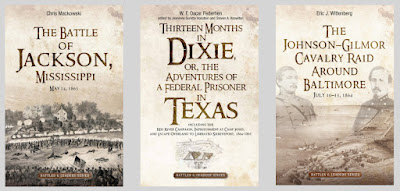
   This new project will be a part of Savas Beatie’s new Battles and Leaders Series, one that focuses on small battles and events that took place during the war. There are three titles so far in this series, and I encourage you to check them out here

Battles and Leaders Series from Savas Beatie

   What am I bringing to this project? Years of writing about the war, and years of writing about North Carolina to start with. I’ve already uncovered some little-used sources, and I am sure there are many more out there waiting to be found. Another aspect are some well-crafted maps that explore the battlefield. As far as the battlefield goes, there is really not much left today of the entrenchments that the Federals constructed during the war. There is a really good museum in town, the Port o’ Plymouth Museum, that I encourage you to check out. (We were there this past July.) This will be my 2022-2023 winter project, and it will allow me to explore some topics I’ve only written about briefly, like the CS and US Navies.

   I’m really looking forward to diving into a new project!