Friday, June 28, 2019

Visiting the Ox Hill Battlefield


   Over the years, I have had a chance to visit every battlefield where the Branch-Lane fought, walking the ground where they fought, save one: the battle of Ox Hill, or Chantilly. On a recent visit to Washington, D. C., I remedied that omission. I have checked that battlefield off my list and can say I've trod everywhere they fought, and marched, and camped.

    So why have I not visited the Ox Hill battlefield? Well, there is really nothing left. We'll come back to that.

   The battle of Ox Hill came at the end of the Second Manassas Campaign, and the beginning of the Maryland Campaign. Stonewall Jackson had swung around the flank and into the rear of the Federal army under John Pope. After capturing the Manassas Depot of August 27, Jackson fell back into a defensive position and waited for the Federals to attack. They did just that on August 29, and it was a hard fight for Jackson. Lee, with Longstreet's corps, came up later that day, and on August 30, attacked Pope's flank in the "largest, simultaneous mass assault of the war." The left flank of the Federals was crushed, and they started falling back towards Washington City. The battle of Second Manassas produced an estimated 22,000 casualties.

Monuments to the two Union generals killed.
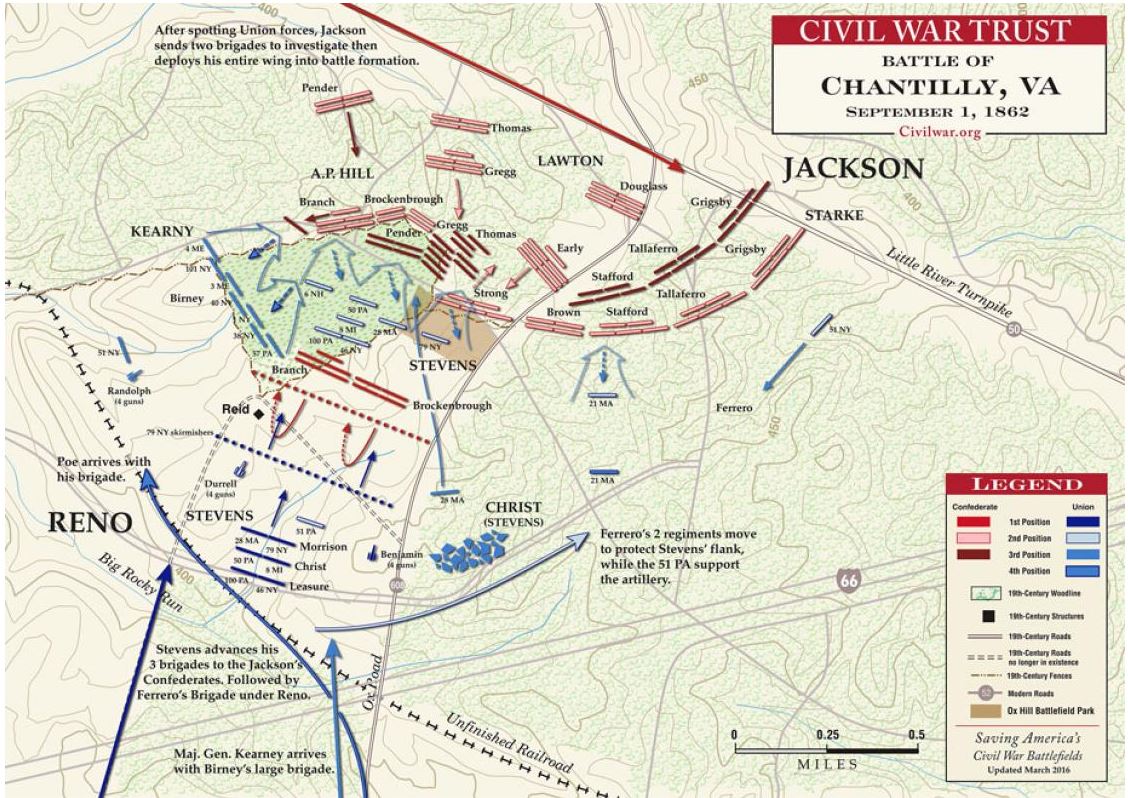
   Even though they had borne the brunt of the fighting, Jackson 's corps was sent to follow up the attack. He hoped to cut off the Federal retreat and destroy Pope's army in detail. According to the National Park Service, by  "Making a wide flank march, Jackson hoped to cut off the Union retreat from Bull Run. On September 1, beyond Chantilly Plantation on the Little River Turnpike near Ox Hill, Jackson sent his divisions against two Union divisions under Kearny and Stevens. Confederate attacks were stopped by fierce fighting during a severe thunderstorm. Union generals Stevens and Kearny were both killed. Recognizing that his army was still in danger at Fairfax Courthouse, Maj. Gen. Pope ordered the retreat to continue to Washington. With Pope no longer a threat, Lee turned his army west and north to invade Maryland, initiating the Maryland Campaign and the battles of South Mountain and Antietam."
   
American Battlefield Trust map of the Ox Hill battlefield.
   Branch's brigade was involved early on in the fighting. They were ordered to deploy (with Brockenbrough's brigade) about five that afternoon (September 1), and moved off to their right. Rain soon began to fall in torrents. Capt. James S. Harris, 7th North Carolina State Troops, wrote that the two brigades "scaled a high fence on the right of the road, advanced through an open field and body of woods to a fence near the foot of a hill where the battle was immediately joined. In front there was a meadow, and beyond that, a large field of standing corn which rendered the exact location of the enemy's line uncertain, until by the smoke of the battle and growing darkness, it could be outlined by the flashes of his guns.... Finding his ammunition was nearly out, Gen. Branch applied to Gen. Jackson for help, stating that his 'guns were wet,' to which Jackson curtly replied, 'tell Gen. Branch I have no troops to send him, the enemy's guns are wet, also, and if pressed he must hold his position with the bayonet.'" Of course, Branch did hold, and other troops came up. But the darkness and rain, after two hours of fighting, brought the battle of Ox Hill to an end. The Federals were to escape into the defensives of Washington. Lee, knowing he did not have enough men to lay siege or assault the Federal capital, and not really being able to supply his men so exposed, moved off toward Maryland.
Current image of the battlefield. 

   So, why have I never visited the Ox Hill battlefield? Probably because only 4.8 acres (out of 300) are preserved as a park. The rest of the battle was lost to development in the 1980s. And it was a fight to have those 4.8 acres secured from development.  It was that second fight at Ox Hill that led to the founding of the Association for the Preservation of Civil War Sites. This group later merged with the American Battlefield Protection Foundation to become the Civil War Preservation Trust, then renamed the Civil War Trust, and more recently, the American Battlefield Trust. Over 50,000 acres of battlefield land has been preserved. I've been a member for probably 20 years, and I am a charter member of the American Battlefield Trust.
   
   The position where Branch's brigade fought is in a condo development, probably along Sleepy Lake Drive. There is really not anything to see. But we were staying in Chantilly, and it was only a couple of miles away, on a late Saturday afternoon, and worth a visit to me so I could cross it off the list.
 
   In preserving 50,000 acres of battlefield land, the American Battlefield Trust is doing an amazing thing. I don't always agree with them (Danville was not the last Confederate capital), but I am proud to be a member. Let me encourage you to check them out (click here).

Thursday, May 30, 2019

Another type of courier


For the past several months, I posted several times on the role of couriers, mounted couriers, within the Army of Northern Virginia. Of course, this has coincided with my work on Lee's Body Guard, my new history of the 39th Battalion Virginia Cavalry. Recently, while reading a set of letters from William C. McClellan, a member of the 9th Alabama Infantry, I found another reference to couriers, a different type of courier.

Pamplin Historical Park
McClellan and the 5th Alabama were stationed near "Louis House" in January 1862. In a letter home to his father that month, McClellan talks about being on guard duty. Usually, every morning, several details were made from the troops in camp. Some were detailed to work on fortifications, others to gather wood, and yet others for guarding various structures. McClellan writes on January 22 that "we have 30 guards every day, guard mountain [mounting] at 8, o'clock. there is 2 orderlies selected from the guard who have the cleanest guns and present the most Soldierly appearance. one of the orderlies waits on the Col. the other reports to The Adjutant. I am almost certain to be one of the orderlies. I have nothing to do but sit by old [Col. Samuel] Henrys fire and chat [with] him during the day and make one trip to Wilcoxs head quarters a half mile off to carry the daily report." (John C. Carter, ed., Welcome the Hour of Conflict: William Cowan McClellan and the 9th Alabama, 130)

A few notes about guards, gleaned from the Confederate Regulations, are useful. Camp or garrison guards were to serve for twenty-four hours. They were often notified the evening before that they had been selected for guard duty. That morning, the fell in and were inspected by their company's first sergeant, then marched to the regimental parade ground. The guard detail was formed by the sergeant major, inspected, and then turned over to the adjutant. It is not just privates serving in this detail, but an officer and NCO's as well. The men are then inspected a second time, and the musicians paraded. The old officer of the guard then passes along old or standing orders to the new officer of the day. Then comes the process of visiting each post and replacing the old guard with the new guard. Guards are supposed to be replaced every two hours.

There are a few things to unpack from McClellan's letter. McClellan was on guard detail, probably the men who guarded the camp stockade or jail. This is different from being on picket detail, although the formation of the picket detail was probably done at the same time. As the war progressed, entire companies, or at times regiments, were detailed as pickets for several days at a time. McClellan tells us that out of the thirty guards, two are selected to serve as orderlies. He does not elaborate on further responsibilities (probably anything the colonel or adjutant needed them to do). McClellan's letter does not mention being rotated every two hours. After delivering the daily report to the general's headquarters (Cadmus Wilcox, in this case), McClellan simply sat by the colonel's fire and chatted with the colonel (and presumably, whoever else came along).

Regimental commanders do not typically have aides or couriers who are appointed to their staffs. Generals, on the other hand, do. Brig. Gen. James H. Lane used two of his younger brothers in this role during the war. I imagine that if the army was active, but still in camp, say preparing for a march, that the daily orderly could get tired trotting back and forth between regimental and brigade headquarters.

McClellan's story is just one more little piece of the story.

Wednesday, May 08, 2019

Brigade Medical Care

Mt Jackson Confederate Hospital 

   Over the past few months, I have noticed a interesting trend: people really seem to like the chapter on Brigade Medical Care in General Lee's Immortals, my history of the Branch-Lane brigade. Dr. Jonathan M. Steplyk, in his review in Civil War Monitor, wrote: " Hardy’s work in the chapters on medicine and prisons is especially commendable. In many unit histories, men are lost to death, wounds, and capture, but, almost by necessity, the focus tends to fix on those men remaining to do the fighting. Hardy’s approach ensures that the stories of wounded men and prisoners do not disappear from the narrative." Gary Lee Hall recently wrote in a review in Confederate Veteran: "The chapter entitled 'Brigade medical Care' is particularly moving and provides light into the experience of those wounded and ill." And, this past Saturday, while signing books at the Chancellorsville Battlefield Visitor Center, a patron told me the book/chapter was going to be used in the collection at Elmwood House as they build a new hospital exhibit.  

   So what about this chapter has captivated people's attention?

   When I sat down to write General Lee's Immortals, I wanted to write more than a brigade history: I wanted to not only write a history of the Branch-Lane brigade, but also to explain how a brigade worked or, at times, did not work (I explain that in the introduction).  That holds true for the chapter on brigade hospital care. While there are some great books on Civil War medicine and hospitals, I'm not really aware that anyone has ever tackled something on such a scale. Of course, I started with the regiment, explaining the roles of surgeon, assistant surgeon, and steward, examining how a person became a doctor in the mid-nineteenth-century South. The role of the regimental surgeon, et. al. is examined next, then sick call, followed by hospitals. Diseases come next, then an exploration of battlefield hospital care, battlefield burials, and PTSD. The best I recall, this chapter was somewhere around 10,000 words, before editing.

   Besides a plethora of personal observations from members of the Branch-Lane brigade who were doctors, or who were sick or wounded, I relied on a few good sources to build this chapter: Cunningham's Doctors in Gray; Humphrey's Marrow of Tragedy: The Health Crisis of the American Civil War; Calcutt's Richmond's Wartime Hospitals; and Schroeder-Lein's The Encyclopedia of Civil War Medicine. There are others, but this is what I used, besides a few period texts.

 Maybe, when I get Feeding the Army of Northern Virginia finished, it might be time to look at the medical history of the Army of Northern Virginia...


Tuesday, April 23, 2019

War Stuff, Scott's Military Dictionary, and the Articles of War.


   Recently, I acquired a copy of Joan Cashin's War Stuff: The Struggle for Human and Environmental Resources in the American Civil War. (Cambridge, 2018). Overall, it is a good read, a short introduction to the environmental aspects of the war. I guess my biggest objection was the overemphasis on the surrender of the Lee's army. Lee's surrender did not bring about the end of the war. While Lee's capitulation had much symbolic meaning, the Army of Northern Virginia was trapped and disintegrating.  Joseph E. Johnston's Army of Tennessee, three times the size of Lee's forces, was sitting on a wealth of supplies and had plenty of opportunities for escape. But, I digress. Cashin's tome has chapters on how the war affected people, timber, habitat, and the subject I'm most interested in at the present: sustenance.
   In the chapter on sustenance, Cashin compares three period books to the letters and reminisces of soldiers and civilians, both Blue and Gray, regarding provisions. Those three tomes are The Revised United States Army Regulations of 1861, Henry Lee Scott's Military Dictionary, and the Regulations for the Army of the Confederate States. The latter was published in 1863. Scott's Military Dictionary was published in 1861 (I have an 1864 reprint of this book). Cashin uses Scott's to define terms found in the Articles of War, terms like foraging, allowances, supplies, and the responsibilities of the quartermaster's department. Scott's is a great help in increasing our understanding of the way people in 1861 perceived certain terms or roles. However, since Scott's was not published until 1861, how many copies of this work made it into the hands of Federal officers during the course of the war? Furthermore, did any of those volumes ever make it into Southern hands?
New York Times April 1861
   The first reference I can find to Scott's Military Dictionary comes in April 1861, when the New York Times makes mention of the book in a list of military manuals being published by D. Van Nostrand. It simply lists the book as being "in press..." By June, Nostrand is advertising the book as being available in a few days. The Buffalo Commercial advertises it as available on July 18, at a cost of $5, while it is available for purchase at a book shop in Cleveland, Ohio, by the end of the month. (Cleveland Daily Leader July 21, 1861). Of course, it is not an issued manual, like The Revised United States Army Regulations of 1861. Scott's does not appear in any advertisements in Southern towns during the war, save Nashville and Port Royal (SC), after they have come under Union control.
   Since Scott's Military Dictionary might not be a viable option for defining terms found in the Articles of War for Southern officers, were could they turn? Of course, there is the regular dictionary. Webster's Dictionary (1828) defines foraging as "Collecting provisions for horse and cattle, or wandering in search of food; ravaging; stripping." Allowance: "to restrain or limit to a certain quantity of provision or drink." Supply: "to fill up, as any deficiency happens; to furnish what is wanted."
   A glance at a few advertisements in 1861 in Southern newspapers does not show any military dictionaries for sale. Beard's Book-Store, advertising in the The Yorkville Enquirer (SC) on January 3, 1861, had Hardee's Rifle and Light Infantry Tactics; McMomb's Militia Tactics; Cavalry Tactics, LaSal's School of Guides; Infantry Camp Duty; and The Rifle, and How to use it. J. W. Randolph, bookseller, advertising in the Richmond Dispatch on July 15, 1861, had available Science of War; Cavalry Out Post Duty; Volunteer's Manual; Volunteer's Handbook; Hardee's Tactics; and Mahan's Out-Post Duty. No military dictionaries.   There were other military dictionaries out there. Simes Military Dictionary (1776); Duane's A Military Dictionary (1810); Rose's Military Dictionary (1815); and possibly a few others. But just how many people would have had a military dictionary lying about at home on the mantel of the fireplace? Probably very few.  
   Cashin targets Articles 52 and 54. Article 52 states that "Any officer or soldier who shall misbehave himself before the enemy... or who shall quit his post or colors to plunder and pillage... being duly convicted thereof, shall suffer death, or such other punishment as shall be ordered by the sentence of a general court-martial." (493) Article 54: "  All officers and soldiers are to behave themselves orderly in quarters and on their march; and whoever shall commit any waste or spoil, either in walks or trees, parks, warrens, fish-ponds, houses or gardens, corn-fields, inclosures of meadows, or shall maliciously destroy any property belonging to the inhabitants of the United States unless by order of the then command-in-chief of the armies of the said States, shall (besides such penalties as they are liable to by law) be punished according to the nature and degree of their offense, by the judgement of a regimental or general court martial." (493-494, The Revised United States Army Regulations of 1861.) Of course, when the Confederate States printed its own versions of the Articles of War beginning in 1861, these were translated verbatim, save for the substitution of "Confederate States" for "United States."
 Cashin goes on to state that when the Confederate regulations were published in 1863, they were verbatim, except the "volume added the statement that the rebel army's 'wanton destruction' of private property was 'disgraceful' and on par with the enemy's behavior." (75) I wish Dr. Cashin had provided a better source for this, except Confederate Regulations pages 407-420. I cannot seem to find this phrase in my 1863 reprint. Also, one other little gripe: she writes on page 76: "They resurrected old ways of cooking, making molasses from maple trees as their grandmothers did." Um, we make maple syrup from maple trees. Molasses is made from sugar cane.
   In War Stuff, Cashin subdivides the chapter into sections looking at the Food Environment; New Things to Eat; New Foodways, Especially Meat; Civilians and their Provender; General Pope's orders of 1862; Confederate Regulation; Impressment; and Hungry People. Overall, it is an interesting read.

Friday, April 12, 2019

Black, but not Black enough?


   It seems that any time that documentation is presented regarding Free People of Color volunteering and fighting as Confederate soldiers, there are cries of "they must have been lighted skinned."   To me, it seems like when they are presented with facts, some folks want to change the playing field, to redefine what being black or a "free person of color" was for 19th century men and women.

   What was the definition of a free person of color? According to the 1855 North Carolina Revised Code, a free person of color is a "free negro, free mulatto, or free person of mixed blood, descended from negro ancestors to the fourth generation inclusive, (though one ancestor of each generation may have been a white person)..." (State Constitution, Section IV Cl. 3 (page 23)) Notice how the law did not describe the way a person looked. That was immaterial. It was based upon his ancestors, who his parents and grandparents, etc. were.

   My first encounter with free men of color enlisting, and serving, in the Confederate army, came more than twenty-five years ago. I was researching for my book on the 37th North Carolina Troops and stumbled upon the case of Franklin and William Cousins/Cozzens. Franklin was born ca.1832. William Henry was born ca. 1841. The latter is in both the 1850 and 1860 Watauga County, North Carolina, Federal Census. Franklin only appears in the 1860 census, with his wife and a young daughter. Both are listed as being mulatto. John Preston Arthur, in his A History of Watauga County (1915), tells us that the father of William and Franklin, along with their uncle, "came from near East Bend, Forsythe County, soon after Boone was formed, bringing white women with them. (149) William Lewis Bryan, later the first mayor of Boone, moved to town in 1857, and left a description of his new community. Among those living in Boone were "Ellington Cousins, colored." (Watauga Democrat June 23, 1949)

   I've told the story before, but here are the high points: in the early days of North Carolina's involvement of the war, Capt. George W. Folk, former representative in the General Assembly, was in town raising a company. When the company moved to Asheville, Folk kidnapped Franklin and William Henry, forcing them to serve as camp servants. Another former local representative, Mark Holesclaw, got involved, writing Gov. John W. Ellis, asking for the release of the two. Folk already had "ten or fifteen free negros to tend on them..." The two Cousins brothers were both of "good Caracter" and would pass for "white men." (The Papers of John Willis Ellis, volume 2, 844-845) Apparently, the Cousinses were released. On September 14, 1861, they voluntarily joined the "Watauga Marksmen," later designated Company B, 37th North Carolina Troops. Franklin was killed fighting in the battle of Second Manassas on August 29, 1862. William served as a wagon master part of the time. He was captured on April 2, 1865, confined at Point Lookout, and took the Oath on June 10, 1865.

   The next four Confederate soldiers we know less about. Probably related to Franklin and William Henry were Bloom and Lemuel Cuzzens. Bloom was born ca.1835 and is listed as a mulatto shoemaker in the 1860 Yancey County, North Carolina, census. Lemuel does not appear on the census, but I believe it was in one of the Yadkin County Heritage books that I read he and Bloom were brothers. Both Bloom and Lemuel enlisted in the Yadkin Boys in June 1861, which became Company F, 28th North Carolina Troops. Bloom deserted on or about June 30, 1862, and Lemuel died of typhoid fever in Richmond on July 18, 1862.

   William and "M.L." Townsend/Townsell, were also living in Watauga County in the 1860 census, although the area would be considered Avery County today. William was born ca.1840, and M. L. - Marion L., was born ca. 1841. Both are listed as mulatto on the census records. Both enlisted on July 15, 1861, in the "Hilbriten Guard,"  later Company F, 26th North Carolina Troops. Marion was killed on July 1, 1863, fighting at Gettysburg, while William was listed as a deserter on November 1, 1863.


   The final example is one I recently learned about: William T. Jones. From what limited information available, the six previous individuals were all born freemen. William T. Jones was born a slave and then, sometime prior to 1856, was freed. Jones is not listed as black or mulatto in the 1860 census, but he is listed as mulatto in the 1870 Moore County, North Carolina, census. Jones was a mechanic when he enlisted in the Moore County Scotch Rifleman in 1861. In fact, he was elected a 3rd lieutenant and rose through the ranks to become 1st lieutenant, prior to being captured near Petersburg on June 17, 1864. Jones was transferred from Fort Delaware, to Hilton head, to Fort Pulaski. Yes, he was a part of the Immortal 600. Jones survived the war and was paroled on June 16, 1865. Jones, in his Oath of Allegiance signed at Fort Delaware, is described as having a "Ruddy" complexion, with brown hair and hazel eyes. (You can read more of William T. Jones' story here.)
William T. Jones (findagrave)


   Many will say that since three of the seven cases presented here were cases of "light skinned" free men of color, they somehow slipped by the notice of Confederate authorities. But at the same time, the men in the ranks had no problem serving with, and in the case of Jones, under the authority of, these men. The census taker knew they were free men of color. Mark Holesclaw knew Franklin and William Henry Cousins were not white when he wrote Governor Ellis. Jonathan Horton, who became the first captain of Company B, 37th NC Troops, lived just a couple of doors down from Franklin Cousins. He knew they were not white.

   These seven are just a few of probably hundreds (I know of four others off hand, not mentioned here). The four I mentioned from Watauga County (there was a fifth free man of color that served in the 11th Battalion North Carolina Home Guard), all came from a free people of color population of just 32. How many more served from Moore County, with a free people of color population of 184? I think if more people were willing to dig deeply into the makeup of counties and regiments, then we could get a better understanding  of how racially integrated the Confederate army was. Instead, most of us take  one of  two easy routes at either end of the spectrum: there were 10,000s of black Confederate soldiers, or there were no black Confederate soldiers. I disagree with both extremes, as history, like people, is usually shaded with a variety of nuances.

Thursday, April 04, 2019

The Blalocks, again.


This article appeared in the Herald Dispatch from Huntington, West Virginia, on April 1, 2019. Overall, it's not a bad piece. My thoughts, like this introduction, are in red. You can read the original article here:
A walk through an Appalachian graveyard


    • West Virginia will forever be connected to the Civil War. It was created when it became the first and only state to secede from the Confederacy on June 20, 1863, after years of neglect by the plantation-owning aristocracy in greater Virginia that was determined to continue slavery instead of paying their southern brethren a living wage. That is how some would view the conflict anyway, as others fought for the South and what they viewed as their besieged homeland.
      West Virginia was also the perfect example of brother fighting brother and cousin fighting cousin during the War Between the States. The truth is that Union sympathizers and soldiers could be found in every Confederate state except for South Carolina. The Free State of Jones existed in Mississippi, the thousands-strong Hill Country Militia was located in Texas, the Mountain Feds were based in Arkansas, the Jayhawker fighters fought in Louisiana, the Winston County soldiers came out of Alabama, the Independent Rangers held court in Florida, the Pickens County brethren were from Georgia, and thousands of Eastern Tennessee fighters fought with the Union forces.
      Western North Carolina was no different, and that history includes the true story of Sarah Malinda "Sam" Blalock. "Sam" Blalock was one of only two female soldiers who disguised themselves as men and fought during the Civil War. Her story is well-documented throughout history.
      Only two? There are scores of others with well-documented histories, many even more interesting than Mrs. Blaylock's!
      Montezuma Cemetery is located on highway 181 in-between Linville, North Carolina and Newland, North Carolina, sitting up on a hill on the southern slope of Sugar Mountain. This area in the western third of the Tar Heel State features the highest mountains east of the Rockies. Just a few hundred yards from the cemetery is a turn in the road that unveils a beautiful view of nearby Grandfather Mountain, which is 5,945 feet in elevation.
      In the old cemetery is a tombstone that reads "Sarah M., wife of William Blalock, Born March 10, 1839 - Died March 9, 1903." Commonly known as Malinda Blalock, she grew up in a time period when life was very hard. The life expectancy in the 1800s was short, even during the times when there was no war. A few feet away from Blalock's grave are headstones that tell that story.
      A couple known as L.B. and E.L Townsend, for instance, lost a nine day old infant in 1892, lost a two year old daughter named Doshia in 1896, and they lost another infant in 1908. A few yards away are the tombstones of the Bumgarner family, which sadly includes four gravestones depicting the death of the infants born to W. and C.E. Bumgarner. Wife Celia E. Bumgarner, says her epitaph, was born in 1857 and died just 37 years later. The couple did raise a son into adulthood named Ira, but he died just a few months shy of his 20 birthday in 1892.
      As for Sarah Malinda Pritchard, according to an article by Kelley Slappie for northcarolinahistory.org, she met and married William 'Keith' Blalock in 1839, even though the Pritchard and Blalock families had been feuding for over 100 years. Keith was by all accounts a bit of a rough cob and ten years older than Malinda when they joined forces. Once married, they lived on and around Grandfather Mountain, where there was plenty of game and fresh water.
      So, Keith and Malinda got married the same year she was born? Also, according to the 1860 Watauga County, North Carolina, Federal census, they were exactly the same age: twenty-two. The 1870 Mitchell County, North Carolina, Federal Census, listsKeith as being 32, while Malinda is 29. His tombstone, right beside Malinda's, gives a birth date of November 21, 1837.
      As the Civil War approached, both Keith and Malinda Blalock became Northern sympathizers. What happened next has not only become a part of American lore, it is also a matter of historical fact. An important witness named James Moore recalled this true tale in The Morning Post newspaper in February of 1900.
      Moore was a Confederate soldier in charge of rounding up draftees as a member of Captain Rankin's Company F of the 26th North Carolina Regiment, and that was when he came across the Blalocks.
      It is interesting that Moore's record states something a little different. Moore was medically discharged from Company F, 26th North Carolina, on December 6, 1861. He re-enlisted in the company on March 20, 1862. Now, that's not to say that Moore and Colonel Vance were not talking about new recruits for the regiment, but Moore was not in the army until March 20, the same day that the Blalocks joined. Furthermore, everyone who joined on March 20 was a volunteer. No one was being drafted at this time. While there was  talk of a Conscription bill, it had not passed Congress yet, and would not be enforced until August-September of 1862.
      Keith Blalock had a plan. The goal was to join the Confederate forces and then defect to the Union troops once they were engaged in battle somewhere north. Joining him in the Army was his brother Samuel Blalock and they were now led by Colonel Zeb Vance, a future governor of North Carolina.
      As it turned out, "Samuel" Blalock was in fact Malinda Blalock, Keith's wife. She wrapped down her breasts and cut her hair short and successfully passed as a male soldier.
      Said Moore in his sworn newspaper account, "I was not present at the battle of New Bern, being absent on detail at home to get recruits. I brought back with me about 45 men, among whom was a young man who went by the name Samuel Blalock. It turned out that he was a woman, the wife of Keith Blalock, but no one in the company knew of it until she and her husband confided it to me in secret at Salisbury (NC) on our way to Kingston to join the regiment. They told me of this, as they said, because, from my remark that 'this recruit resembles Keith's wife so much,' that I suspected she was his wife, and they concluded it was best to make me their confidant so I would not tell anyone about it. I never told anyone about it except my brother-in-law, Isaac N. Corpening, who was also in the Company."
      It is safe to say that Malinda "Sam" Blalock was already well-versed in all things firearms and holding her own, probably both due to training with her husband and living the backwoods life of the 1800s. We know this because she was a soldier in good standing for at least two months in the company of men.
      Said Moore, 119 years ago. "Sam Blalock's disguise was never suspected. She drilled and did the duties of a soldier as any other member of the company and was very adept at learning the manual and drill."
      The Blalocks never found themselves near any Union troops, however, so they decided to find a way to leave the Confederate Army. Keith came up with an idea that was crazy and agonizing, yet it worked. He found some poison ivy, some say poison oak, and rubbed it all over his body. Once the welts and rash had become horribly obvious, he played it off as a disease along the lines of small pox and they quickly let him go. "Sam" wanted to leave as well so she could follow her husband, but her furlough was initially denied. It was then that she confessed to being a woman and proved it to Col. Vance.
      So why not slip just a few miles down the road towards New Bern, where the Federal army is in April 1862?
      This is a great story, and oft-repeated, but his military record says poison sumac and a hernia. It was the latter that really got him out of the army in April 1862. In February 1863, the Confederate government revised  its enlistment policy. It now said that if you had a "single reducible hernia" you still had to serve; you were not exempt for medical reasons.
      Once back home, the Confederate draft enforcers soon realized that the Blalocks were healthy as well as deceptive and they tracked them down near their hideout on Grandfather Mountain, a craggy and thick-wooded summit. The couple escaped, albeit with Keith getting a bullet wound for his troubles. It was then that they became guerilla fighters, known then as "bushwackers." Some say they crossed into Tennessee and joined another bushwacker group known as Kirk's Raiders." Michael C. Hardy, however, the author of the book "Kirk's Civil War Raids Along The Blue Ridge," says that there is no official record of the Blalocks and Kirk ever meeting each other.
      This paragraph kind of compresses a couple of different events. Keith and Malinda are thought to have been at their home in Coffey's Gap when someone (militia or home guard) arrived. They were forced up Grandfather Mountain to hide in a hog pen under an overhang (or rock house.) Keith's first wounding took place in August 1864, maybe a year later. He claims in his Federal Pension application that he was out scouting, alone.
      Either way, Keith and Malinda "Sam" Blalock engaged in lethal raids together all over western North Carolina during the second half of the Civil War. As fate would have it, one of their raids involved James Moore's family.
      Actually, their raids were confined to lower Southern Watauga and Northern Caldwell Counties, and maybe a little of Mitchell,  not all over western North Carolina.
      "One night while I was home on furlough from wounds received at Gettysburg, in the spring of 1864, her husband and his gang attacked my father's home at the Globe in Caldwell County," said Moore, 35 years after the end of the war. "We had a regular battle with them, in which my father was severely wounded. And, we wounded two of them, one of whom, it was said, was this one-time member of my Company who I enlisted, Malinda Blalock."
      Malinda was believed to have taken bullets to her shoulder. After Moore left to return to the war, the Blalocks raided his homestead again in the fall of 1864. This time, Keith had his left eye shot out of his head and the Blalocks soon left North Carolina for, as Moore remembers, 'either Colorado or Montana."
      I'd sure love to find where the story of Malinda's wounding starts. Usually it is during the battle of New Bern in March 1862. This time, it is during the raid on Moore's farm. Of course, the Blalocks were not actually with the 26th North Carolina during the battle. How much she was actually with Keith is a great mystery. They had a son in 1863 [Columbus]. I would hazard a guess that she was out-of-commission for at least part of that year.
      After the Civil War ended in 1865, the Blalocks came home to western North Carolina, settled down and started a family that included five kids. Malinda "Sam" Blalock died of natural causes in 1903 at 64 years of age. Her husband Keith died a decade later in Hickory, NC.
      Actually, Keith killed John Boyd on February 8, 1866. Keith blamed Boyd for the murder of his step-father during the war. Keith was put on trial for the murder, only to have the case dismissed. They were in Mitchell County in the 1870 and 1880 census. At some point after that, they went  to Texas for a while, and maybe Oregon.  
      How the folks of that area dealt with each other immediately after the end of the war is left to history. It was probably hard to b  e cordial to a couple that shot bullets at you just a few months earlier. One thing is for sure, however, no matter what side of the conflict you were on; Malinda "Sam" Blalock was a force to be reckoned with during a very dangerous time in our nation's history.
      I really appreciate the nod in this article. Overall, the article is not bad. It is much better than the piece that appeared in Our State during the sesquicentennial. What solid information we have about the Blalocks is extremely limited. Everything else comes decades after the war, like the piece by James Moore (1900), and John Preston Arthur (1915).

      Tuesday, March 19, 2019

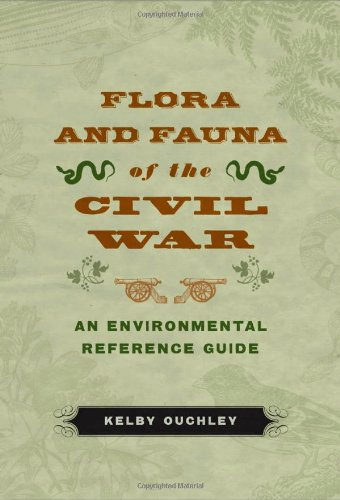
      Review: Flora and Fauna of the Civil War.


          One thing is for certain when dealing with literature of the 1860s: it's as deep as it is broad. Ever since the war ended, veterans, historians, amateurs, and academics have been exploring every angle of the times. (That's especially true during the past thirty or so years, the "Golden Age of Civil War publishing, as my publisher Ted Savas calls it.) Yet writers and scholars continue to find new ways to investigate the time period.

         A year ago, I ordered Kelby Ouchley's Flora and Fauna of the Civil War: An Environmental Reference Guide (LSU, 2010). Many of you know of our interest in native plants here in Southern Appalachia. While our interest has centered on the late 18th century, we're hopeful that one day we will get to expand into the mid-19th century with living history and interpretive programs. So there was that angle for our interest in the book. At the same time, I've been working on the Feeding the Army of Northern Virginia project, so there is another angle.

         Ouchley's guide is a part of the emerging field of examining the environment and the War. How did the environment affect combat operations? How about the transportation of supplies? How did the war affect the environment the soldiers passed through? (Think of the unexploded ordnance at Gettysburg or the trenches that cut through the farmers’ fields below Petersburg.) After an introductory chapter  and a chapter placing the subject in the "Civil War" setting, Ochley tackles flora first. He examines trees, like Ash, Dogwood, Elm, and Willow, providing some scientific background on the way that people used them during the war. For example: "A tonic made from shredded ash bark was used as an astringent, diuretic, and to treat arthritis, fever sores, and constipation." (19) Besides trees, Ouchley also looks at herbs, blackberries, grapes, and Mulberry. The next section focuses on fauna: alligators, bats, fish, honeybees, turtles, etc. After each entry, there are several excerpts from the letters or diaries of soldiers who reference the plants and animals Ouchley is referring to.

           My only real complaint are these references. There are plenty of Federal examples, but most of his Confederate sources come from the Army of Tennessee, or from soldiers stationed along the Mississippi River. There are plenty of Army of Northern Virginia accounts out there. It would have been nice to see a few more of those included. (Ouchley did cite from the Stilwell Letters [53rd GA], and from Col. William H. A. Speer [28th NC], two excellent sources.) In Ouchley's defense, his editor might have curtailed some of his examples. Publishers are known to do that.

         Overall, Ouchley's Flora and Fauna of the Civil War is an interesting read that adds just one title to a interesting and developing sub-genre in Civil War literature.

      Wednesday, March 06, 2019

      Black Camp Servants as foragers in the Army of Northern Virginia


         That's a big-sounding title for a post on my long-running blog, don't you think? When I submitted my proposal to Savas Beatie for "Feeding the Army of Northern Virginia," I included an appendix on the role of African-Americans in camp. I'm still hopeful that I can gather enough material to turn this into a whole chapter.  Overall, the historiography seems to be slim on the subject (if I am missing something, please drop me a line and let me know).  Even Glatthar's General Lee's Army only hints at the role of camp servants in relationship to food, devoting a small chapter to "Blacks and the Army."
      Camp Servant in Union Army. 

         An early-war portrait goes like this: every Confederate soldier who arrived in camp carried a shotgun, wielded a bowie knife, and had a manservant to facilitate his every need. That was, of course, far from the truth. The majority of Southerners did not own slaves, and an even fewer percentage of men who were serving in the army owned slaves. While the Confederate army apparently never kept a count of camp servants, there were probably thousands of them.

         Many, especially in the officer's corps, considered a camp servant as an essential element.  Being an officer taxed the limits of many men. They were taking care of the wants and needs of one hundred men, while also trying to learn their own positions. There was little time to attend to their own wants and needs. This was especially true when it came to food, and more than just food, the acquisition of foodstuffs. Captain Ujanirtus Allen (21st Georgia Infantry) wrote home in August 1862, "The fact is I have lived very hard for several months. If I had one [servant] he could get many things in the country." (1) Captain John M. Vermillion (48th Virginia Infantry) echoed Allen: "We need a great many things in camp we haven't got... I would like very much to have a servant to look up provisions and cook for me..."(2)

         Many of the servants did just that: they roamed the countryside looking for items to supplement the cook pot. At times they made it back home. Jed Hotchkiss, of Stonewall Jackson's staff, wrote in April 1863 that his servant William had just returned from home, bearing a box of provisions. (3) Robert E. Lee wrote in the latter half of the war of several times when his mess steward, Bryan, made trips from Richmond to Orange Court House or from Petersburg to Richmond. (4) William Dorsey Pender, then colonel of the 6th North Carolina State Troops, wrote to his family that when Harris came to the army, he wanted him to bring a box of sweet potatoes. (5) Camp servants, since they were not officially Confederate soldiers, could come and go. They had an enormous sense of mobility. Their masters, or employers, simply wrote them out a pass and sent them on their way. A soldier had to have a pass signed by numerous higher-ups. Only so many were granted at a time for the soldiers. Often, these camp servants were sent away with money to buy provisions. They held a certain level of trust for those who owned or employed them.

         Some men brought slaves from home to serve as cooks. Others hired slaves or free men of color and brought them from home, while a third group hired slaves or free men of color from the surrounding neighborhoods where they were stationed. Col. James K. Edmondson, 27th Virginia Infantry, wrote home in November 1861 of a servant he had hired: "I presume you did not know that I had gotten a servant. I sent a requisition to Lexington before I left Centreville for a free boy to cook for me..." (6)  

          Edmondson goes on to describe his living arrangements. While we might assume that the three or four camp servants might room and board together, not so witht Edmondson: "...I have gotten myself one of these little straight up and down tents, just large enough for myself and servant to stay in--his bed is on one side and mine on the other and in the middle I have a large oven of hot coals which keeps the tent very comfortable..." (7)

         Unless I am missing something, no one has ever really explored this topic. Jamie Amanda Martinez in Confederate Slave Impressment in the Upper South, focuses on enslaved peoples who were hired or impressed to work in Government facilities or on fortifications. Glatthaar, in General Lee's Army, focuses on "Blacks and the Army" (his chapter heading), instead of Blacks in the Army.  (Confession: I've not read Woodward's Marching Masters yet.) Even James E. Brewer, who wrote The Confederate Negro: Virginia's Craftsmen and Military Laborers, 1861-1865, devotes little space to the role of camp servants. Brewer laments the loss of the records of the Commissary General of Subsistence Office, devoured by the fire of April 2-3, 1865. But even Brewer was more focused on the Confederate government's use of Black Americans, and less on the soldiers/servants in the field. Maybe, in time, we can flesh out more of this story.


       Notes
      1 Allen and Bohannon, "Campaigning with 'Old Stonewall'," 145
      2 Chapla, 48th Virginia, 9
      3 Hotchkiss, Make me a Map of the Valley, 134.
      4 Dowdey and Manarin, The Wartime Papers of R.E. Lee, 679; Jones, Life and Letters of Robert Edward Lee, 348. Walter Taylor writes that Bryan was Benard Lynch, born in Ireland. See General Lee, 221.
      5 Hassler, One of Lee's Best Men, 122.
      6 Turner, My Dear Emma, 69.
      7 Turner, My Dear Emma, 69.

      Friday, February 08, 2019

      Robert E. Lee's cook(s)

      William Mack Lee
      Atlanta Constitution October 7, 1919
      (probably not R. E. Lee's cook)

         In the world of Confederate history, the story of Robert E. Lee's cooks is fairly well known. William Mack Lee claimed in a short biographical sketch to have been the "body servant" and cook for Lee from 1861 to 1865. The small booklet contains the story of Nellie, the laying hen that Lee kept around headquarters  to provide a daily egg for the General's consumption. Charged with cooking a meal for not only Lee, but Jackson, A.P. Hill, D.H. Hill, Hampton, Longstreet, Pickett and others, and not having anything sufficient for the meal, William fixed Nellie. It was the only time that Lee, according to William, scolded his cook. (You can read the account here.) Of course, if you have read the account, then you have also realized it has a lot of problems. Many believe that Mack Lee's account is a fabrication.  

          Robert E. Lee's first cook appears to be a man by the name of Meredith. Meredith was undoubtedly an enslaved man working at the White House plantation in June 1861, when he first appears in a letter from the General to Mary Lee. Lee had Meredith with him at Sewell's Mountain, and then Meredith followed to the east coast in December. On February 8, Lee, writing from Savannah, tells Mary that he has left Meredith at the headquarters at Coosawhatchie. But the reason is unknown. (Dowdey and Manarin, The Wartime Papers of R.E. Lee, 112, hereafter cited Wartime Papers.) The last time Meredith appears in Lee's letters is on February 23, 1862, when Lee writes that Meredith is well. (Wartime Papers,  118) 

         It is unclear just how long Meredith continues to cook for General Lee. However, Lee apparently has a new cook by February 1863. On that day, he writes Mary that "I have George as cook now." But something has changed: Lee is no longer a slave owner. He also writes, "I give him & Perry each 8.20 per month." (Perry has been with Lee as a body servant since the beginning of the war.) (Wartime Papers, 402) According to the terms of the will of his father-in-law George Washington Parke Custis, all the slaves at various properties owned by Custis, like Arlington and White House, were to be freed within five years. On January 2, 1863, Lee recorded the deed of manumission in Richmond, freeing not only the Custis slaves, but also the family of Nancy Ruffin, whom Lee had inherited from his mother in 1835, as well. Since Lee was now a non-slave owner, he did what so many others likewise did: he hired someone to take care of his cooking.

         Lee apparently never mentions George again in the surviving letters. A month later, Lee writes that Bryan [Lynch] has arrived. (Wartime Papers, 412) Bryan seems to fill the role of Lee's "steward" for the rest of the war. Bryan was probably Bernard Lynch, an Irish national. It is Bryan that divides a box sent to Lee and Colonel Corley in December 1863. (Wartime Papers, 632) In December 1864, Lee writes to Mary that Bryan is distressed over a missing "saddle of mutton." (Wartime Papers, 879)
      Lee's Camp Chest
      Museum of the Confederacy

         In A. L. Long's Memoirs of Robert E. Lee (1886), Bryan appears again. Long recalls that several of Lee's staff saw a demijohn being carried into Lee's tent. "The general well knew that several of his staff enjoyed a glass of wine, or even something stronger," Long wrote. At noon, Lee emerged and asked if they would like "a glass of something?" Bryan, "the steward of the mess," was sent by Lee "to carry the demijohn to the mess-tent and arrange the cups of the gentlemen." It was only after the liquid was poured that the staff discovered it was buttermilk. (240)

         It appears that it was Long who first broke the story of Lee's laying hen. Bryan was the one who had charge of the hen, a hen that accompanied Lee on the Chancellorsville and Gettysburg campaign. And according to Long, it was Bryan who killed and cooked the hen in the winter of 1864 "when the General had a distinguished visitor" for dinner. (242) 

         No one, including Lee or his staff, ever seems to have mentioned William Mack Lee. Was William Mack Lee lying, or stretching the truth? Possibly. He certainly used the accounts of cooking for Lee to his benefit and for the benefit of others, raising money for building Black churches. After 1900, Mack Lee was a frequent guest on the Veterans reunion circuit, telling of his adventures as General Lee's cook.

          It would be great if we had more information on each of these men, Meredith, George, and Bryan, and even William Mack Lee, and their lives and on the roles they played around the stewpot and mess table.

      Monday, January 14, 2019

      Not that "hegemonic": Washington County, TN


         Johnson City, Tennessee, is celebrating its 150th anniversary this year. There will be a wide variety of activities and events, and the Johnson City Press is coming out with some great articles! However, Brandon Paykamian's November 16 piece "Unionists in East Tennessee and beyond: the myth of Confederate hegemony in the South," disingenuously leads readers down a well-worn path that misses some very important steps. You can read the entire article here.

         Paykamian asserts that "Confederate hegemony during the Civil War is a historical revisionist myth." Just when did this myth begin? Jefferson Davis certainly knew that not everyone living in the South was a part of one big, happy family. He engaged in spirited correspondence with North Carolina's Zebulon B. Vance regarding the habeas corpus actions of Chief Justice Richmond M. Pearson; the election of 1863 ushered in several peace candidates into the Confederate Congress; and the September 29, 1864, letter from South Carolina Representative William W. Boyce claimed the President had created a "centralized military despotism" over constitution, state, and individual. Those are just a few examples. That's not to say that the North was also united in its prosecution of the war. Lincoln suspended the writ of habeas corpus in the first days of the war, authorizing military commanders to arrest those suspected of disloyalty between Washington, D.C., and New York City. At one time, one third of the general assembly in Maryland was under arrest. Historians do not know exactly how many people Lincoln's administration arrested during the war, but estimates vary from just over 13,000 to as many as 38,000 people.  "Copperheads" in the North were, in some areas, quite numerous and outspoken in their opposition to the war and to the Union and, of course, draft riots like the famous New York violence speak to the complexity of the period.

      Washington County from an 1865 map. 
         The idea that there were those in the South who were not supportive of the Confederate cause was evident early on in the historiography of the time period. Edward Pollard, writing in The Lost Cause in 1867, mentions "a certain Union party in some of the States of the Confederacy," and then comes down hard Governor Brown of Georgia. Joseph Denny, Story of the Confederate States (1898) and Henry Eaton, History of the Southern Confederacy (1966) both make mention of Southern Unionists. (This conversation could go on and on.) While there are undoubtedly some writers who gloss over the discord throughout the South during the war years, everyone understands that the South was not uniform in its support of the Confederacy, just as Northerners were also complex and diverse. 
       
         Paykamian continues: "During the Civil War, Washington County was a Union stronghold, much like other regions of Central Appalachia, where plantations were few and far between in comparison to the rest of the state." Wait... he just wrote about the "the myth of Confederate hegemony." Are we going to now lump all plantation owners, i.e., slave owners, as a hegemonous group fighting against the Union? That's problematic because there was a sizable chunk of Southern slave owners who fought against the Confederacy. Andrew Johnson owned slaves, as did T. A. R. Nelson and David Bell. In Washington County, Thomas Reeves, Federal recruiter, owned slaves. In fact, of all those counties in far eastern Tennessee, Washington County contained the most slaves: 1,268.

         "Washington County, in particular, was home to just as many — if not more — Unionists as it was to Confederates," Paykamian writes. And that may be true. But to my knowledge, no one has ever actually tried to count the number of Union and Confederate soldiers from Washington County. Washington County had a sizable pro-Confederate population. When the first Tennessee vote regarding secession was held on February 8, 1861, Washington County men cast 891 votes for secession, while 1,353 voted against. Research has shown that Lincoln's call for troops in April 1861 pushed many lukewarm Unionists over the edge and into the ranks of the Southern Confederacy. Company B, 19th Tennessee Infantry, Companies G and I, 29th Tennessee Infantry, and Company K, 63rd Tennessee Infantry were all made up of men from Washington County. There are probably others.

         As a sign of internal dissatisfaction with Confederate policy, Paykamian writes "In the same year of the conscription act, food riots broke out all over the south, when hordes of hungry rioters – some armed – ransacked stores and warehouses looking for anything to eat." Yes, food riots did break out, but not the same year that the Conscription Act was passed. It was passed in April 1862. The more famous food riots took place in Salisbury, North Carolina, in March 1863; Richmond, Virginia, in April 1863; and Burnsville, North Carolina, in April 1864. Despite much searching, I could find no food riots in Jonesborough or Washington County.

         Several years ago (2001), the Washington County Historical Association released a 1,290 page history of Washington County. In an era with fewer and fewer county histories being written, it is a superb book. My late friend Jim Maddox wrote the chapter on the War and Washington County. It is a great chapter. However, it would have been great to dig a little deeper into those numbers. Just how pro-Union was Washington County?


      Thursday, January 10, 2019

      Peas!


         One of my favorite stories I have uncovered over the past 25 years of researching and writing has to do with the lowly pea. I used the story in both my first book, a history of the 37th North Carolina Troops, and in General Lee's Immortals, my history of the Branch-Lane brigade. The person who told the story was Pvt. David Dugger, Company E. He was from the mountains of western North Carolina. Being shelled by the Federals was a new experience for the Confederate soldiers below New Bern, where in March 1862, this story takes place. Dugger and another private had been sent to the rear to cook food for the men manning the front lines.

         On the return [to the company] we had about a half dozen camp kettles full of peas.  The kettles were strung on a pole, with George [Lawrance] at one end and I at the other.  We had to go through a pine grove, and while going through there, we heard our first bomb shells, and we did not know what they were, and there we stood looking and wondering what on earth they could be as they went whizzing through the air.  Presently one cut the top out of a pine, and then we found out what they were and forthwith proceeded to hug the earth without getting our arms around it.  As soon as the sound of the shell died away we gathered our pole and started to the Fort.  When we got there we had peas all over us, so that we could hardly be told from the peas. (Watauga Democrat June 18, 1891)

         Recently, I re-read Berry Benson's Civil War Book. This is one of those volumes I read decades ago, and I had forgotten that Benson had his own pea story. Benson's story comes at the end of the war. He's experienced "bomb shells" a plenty, but was captured, held prisoner, escaped, and just seen a good deal of the war. Benson and his comrades have evacuated the entrenchments around Petersburg, and are on their way to Appomattox Court House.

      Cow peas
         As I ran up the low hill, the shells bursting all around, I came upon a camp fire abandoned by its maker, and upon it sat boiling a pot full of peas. The fear of getting killed was strong, I admit, but hunger was a match for it. I saw Lieut. Hasell running by and called to him to come quick. Running the barrel of my gun through the handle of the pot, I gave him the butt, took the muzzle myself, and off we went amidst the crackling of the shells, bearing to a place of safety our pot of peas. But alas for human endeavor! When we finally reached a place where we could stop, we found the peas but half done, so turned the pot over to Owens to cook while we went on to the picket line with the Sharpshooters. When i next saw the pot... there was not a pea left to tell the tale." (197)

         We here at Confederate History Headquarters had a discussion about what type of pea this might be. Several soldiers mention cow peas in their correspondence. These differ from the garden pea in that the cow pea could be dried more readily.  According to seed catalogs, a cow pea is also known as black-eyed pea, southern pea, yardlong bean, catjang, and crowder peas. There are several varieties of this staple food, which is more like a bean than a pea. The cow pea grows in "sandy soil" with low rainfall. Soldiers seemed to eat them by the bucket full any occasion they could get. Looking at Francis P. Porcher's Resources of the Southern Fields and Forest (1863), Porcher writes that "Great use is made of the varieties of the pea on the plantations... as articles of food for men and animals. The species called the cow-pea is most in use." (194) As I work on the Feeding the Army of Northern Virginia project, peas and cow peas are mentioned frequently. Only once, in the reminisces of Col. William Poague, has someone mentioned black-eyed peas. (150). It could be that different areas had different names for the same pea. Certainly, none of the black-eyed pea-eaters I know (myself included) use the name cow peas.
         

      So the next time you set down to a meal with cow peas (or black-eyed peas), remember for a moment David Dugger and Barry Benson, and all the other Confederate soldiers who ate these peas! Happy New Year!

      Monday, December 31, 2018

      "Almost" Christians: Stonewall Jackson and Robert E. Lee


         Recently, I finished reading A Frenchman, A Chaplain, A Rebel: The War Letters of Pere Louis-Hippolyle Gache, S. J. (1981). Goche was born in France and later became a Jesuit priest. He immigrated to the United States in 1847, leaving behind a region smoldering in anti-Jesuit sentiment. Gache was recruited to work at Spring Hill College near Mobile, Alabama. However, he also served in various parishes in Louisiana. When the war came, Gache was assigned as a chaplain in the 10th Louisiana Infantry, and soon found himself on the Peninsula below Richmond. After a year of service, Gache was reassigned as a hospital chaplain in Lynchburg, Virginia. (His compiled service record, listing his last name as Guache, stated he was assigned to a hospital in Danville on August 29, 1862. However, all of his subsequent letters come from Lynchburg.)


         Without going into centuries' worth of religious history, it will suffice to say that Gache had no use for Protestants. Writing in January 1862 from a camp near Yorktown, Gache described to those back at Spring Hill College his encounter with a local pastor: "The Baptist minister visits me every time I stay at the Ewells. He tries to get me to come and visit him, offering me the use of his library and, if it had not been converted into a hospital, his church. He truly treats me as a brother, but I'm not going to give him any encouragement. I take advantage of every occasion to tell him and the others of his ilk that I don't see them under any other aspect than as gentlemen, but that certainly I don't consider them as ministers of the Gospel." (95)

         In another exchange between himself and Father Philip de Carriere, Gache chides Carriere for using the term "Catholic chaplain." "And what do you mean by 'the Catholic chaplain?' Are there any other chaplains than Catholic chaplains? Is it your intention to acknowledge an ecclesiastic character on the souls of the so-called Protestant ministers? If you do, you are simply a heretic..." (155)

         The death of Stonewall Jackson obviously presented a challenge to Gache. He had recently bemoaned the death of "Four or five" young men who had died "without making any express profession of Catholicism." (162) Jackson was a member of the Presbyterian church. Gache wrote that Jackson, "in his own way... was a very good Christian. The face of this austere Presbyterian expressed all the characteristics of a devout member of that sect; yet, he was not a bigot--at least so far as I have heard. He often remarked publically that it was in God that he put his confidence, and after each victory he always ordered the chaplains under his command to offer prayers of thanksgiving." Jackson, after his wounding, and being told that he would die, "expressed sorrow for his sins. Since he was probably in good faith, one can hope that his pious sentiments must have led him to an act of perfect contrition. Surely, He who so loves to bestow mercy, must have bestowed it abundantly on this man."

          Likewise, Gache took time to write about Robert E. Lee: "General Lee is also very religious, not in an ostentatious and wordy manner, but sincerely and genuinely... The general is an Episcopalian, but at the same time he is, as are almost all of the men of his class, very favorable toward Catholics and he has the greatest esteem for them." Gache goes on to talk about the Catholic leanings of Joseph E. Johnston, former secretary of War George W. Randolph, and Varina Davis. (176-180)

         Gache's disdain for Protestants never seems to fade after the mercy he almost shows for Jackson and Lee. He talks of "dethroning a Presbyterian minister" in June 1863, a man trying to work with wounded soldiers in Lynchburg hospitals.  (190) In December 1864 he makes mention of the two Catholic and four Protestant chaplains at work in the Lynchburg hospitals. The Protestant chaplains "have filled the hospital with an assortment of sectarian books and newspapers which are used by the sisters and myself for lighting our fires..." (210) In this same December 1864 letter, he speaks of a Protestant minister who invited himself to preach to the wounded and sick men. It was apparently against post regulations to preach in the wards. The post commander, a man Gache believed was "far from being a Catholic, but who is nevertheless a man who despises all Protestant ministers," agreed to allow the Protestant chaplain the use of the courtyard at 4:40 pm on Wednesday. After starting the service at 4:45, he was interrupted by the dinner bell at 5:00 pm. All "of the congregation was at the table and the preacher was left alone, his arms outstretched and his mouth gaping, still standing on the grassy mound. You ought to have seen the dismay and astonishment of that disciple of Calvin as he picked up his books, put on his hat and walked away." (211-212)

         It is not my purpose to reignite in this post the great schisms that have taken place over the centuries between the Catholics and Protestants. For generations, Catholics were treated with a great degree of skepticism in this country, and it was not really until the election of John F. Kennedy in 1961 that some of that skepticism began to fade. To be honest, save for the work of the Sisters of Charity, I'm really not very familiar with much of the role of the Catholic church in the South during the war. This is the first set of war-time letters that I have read from a Catholic priest. Are there others? (Yes, there are a few.) I am much more familiar with the works of Protestant chaplains such as Alexander Betts, Basil Manly, J. William Jones, and W. W. Bennett. It is interesting to note that Gache never makes mention the great revivals that swept through the Army of Northern Virginia in the winter encampments of 1862-1863 and 1863-1864. But then again, Jones, in Christ in the Camp, never makes mention of Gache or Catholic chaplains.

         Gache survived the war. He served in a number Jesuit colleges and parishes until 1904, but he never returned to the South. He died in 1907, at the age of 91, in the hospital of Saint Jean-de-Dieu, Montreal, and is buried at St. Andrew-on-Hudson near Hyde Park, New York.