Thursday, January 06, 2022

Feeding the Confederate Garrison at Fort Clinch

   In 1861, as various Southern states left the Union, they seized and assumed control of various forts in Southern ports. As in the case of Fort Sumter, it took a battle for the facility to switch hands. A handful of forts were never captured, like Fortress Monroe in Virginia and Fort Pickens in Pensacola. However, many other forts only had a caretaker, usually an ordinance sergeant, and a few workmen. This is true with Fort Caswell, Fort Macon, and Fort Clinch.


   Fort Clinch was not even close to being completed at the start of the war. Sitting on Amelia Island on Cumberland Sound, the fort was begun in 1847, and the construction was slow Only two walls were completed, and no cannons were mounted. On January 7, 1861, Fort Clinch was seized by state troops. Over the next couple of months, various Confederate organizations rotated in and out of the area until the fort and island were abandoned on March 3, 1862. Among the Confederates stationed on the island during this period of time were the 3rd Florida Infantry, 4th Florida Infantry, Marion Light Artillery, 24th Mississippi Infantry, and the Marion Dragoons.[1]

Feeding this new influx of men on a remote island was a challenge. In December 1862, they numbered over 4,500. At the same time, there were a couple of advantages. Foodstuffs could be brought up the St. Mary’s River, could come up the Amelia River, or, they could come from the interior via the Florida Railroad.  Records from the Florida Railroad mention freight such as “Substance Store” in reports filed in January 1862. The garrison commander contracted with C. L. Holbrook to provide pork, dry goods, and vegetables from Fernandina and St. Marys, Georgia. It is unclear just who Holbrook was. M. Wood and Company were contracted to supply beef rations. Wood lived in Callahan, Florida. Callahan was roughly 25 miles from Fort Clinch. However, it would have been easier to deliver the supplies elsewhere and have the quartermasters on the Island take charge. “M. Wood” is probably Michi Wood, a wealthy Prussian immigrant, 43 years old and a merchant, who listed his place of residence as Fernandina.[2]

   One of the soldiers stationed on the island, T.M. Broome, wrote home that “The rations which we receive each day are of the best quality available to us; we have beef three times a week with pork and fish, oysters, clams and crab, along with rice, onions and yams. The corn are right fine; our bread ration comes from the many bakers of the town, with our own mess providing biscuits and sweet bread. Wild game is abundant… the weather allows for us to fish when not posted to duty… the citizens are always offering biscuits, sweet bread and cookies. My friends and neighbors are always visiting the men of the volunteers with treats and goodies.”[3]

   Finding more information on this subject is a challenge. None of the regiments listed above appear to have regimental histories. The Washington Ives letters have been published (4th Florida), but begin in June 1862. There is a history of the 1st Florida Special Battalion and 10th Infantry Regiment, by Don Hillhouse, but copies are scarce. The 1st Florida Special Battalion was stationed on the island and at Fort Clinch. There is no history of the 24th Mississippi Infantry, either. Ofeldt’s new history of Fernandina and Fort Clinch does not go into much detail on the subject, unfortunately .


[1] Ofeldt, Fort Clinch, Fernandina and the Civil War, 51.

[2] 1860 US Census, Nassau County, Florida; Confederate Citizens File, Business, M346, RG109, NARA; Ofeldt, Fort Clinch, Fernandina and the Civil War, 37.

[3] Ofeldt, Fort Clinch, Fernandina and the Civil War, 37.

Sunday, December 19, 2021

Robert E. Lee’s Christmas Letters Home


   Confederate general Robert E. Lee spent all four of the war-year Christmases away from his wife Mary. Three of his Christmas Day letters home survive.

   Lee’s first letter was written while the general was stationed South Carolina. Writing from his headquarters on the Coosawhatchie, Lee told Mary that he could not let the day pass without writing to her. He was “thankful for the many among the past that I have passed with you. . . For those on which we have been separated we must not repine.” Lee mentioned about where Mary needed to go. She had been forced to flee from Arlington early in the war and had become a refugee. Lee mentioned Fayetteville, Richmond, Charleston, and Savannah. Mary obviously wanted to come to Coosawhatchie, but Lee did not approve of the idea. They were in a somewhat exposed area and, if attacked, it would be too hard to move her. Lee then mourned the loss of Arlington, and wished he could purchase Stratford, the place he had been born. Lee also counselled Mary not to put too much stock in rumors of a war between the United States and Great Britain. “We must make up our minds to fight our battles & win our independence alone. No one will help us.” We require no extraneous aid, if true to our selves. But we must be patient. It is not a light achievement & cannot be accomplished at once.”[1]

   The second Christmas of the War Lee spent in camp near Fredericksburg.  The battle was fought just twelve days before. He spent part of the day at a dinner with Jackson, Stuart, and Pendleton at Moss Neck.[2] Lee considered the day a “holy day” and his heart was “filled with gratitude to Almighty God. . . What should have become of us without His crowning & protection?” Lee believed that “if our people would only recognize it & cease from their vain self boasting & adulation, how strong would be my belief in final success & happiness to our country.” Lee regretted that his position at the top of the Army of Northern Virginia prevented him from seeing Mary and those of his children still at home. He also regretted how cruel war was and prayed for peace. He wrote a little of the battle of Fredericksburg, and regretted that his recent victory was not more complete. But then he turned to his losses. “My heart bleeds at the death of every one of our gallant men,” Lee wrote.[3]

   Lee spent Christmas Day 1863 at St. Thomas’s in Orange Court House. He then penned a letter home dated “Xmas night, 1863”.[4] It was a short letter. “I am filled with sadness dear Mary at the intelligence conveyed in your letter of last evening.” Lee’s daughter-in-law, Charlotte, was gravely ill, dying the next day. “The blow is so grievous to us’” he wrote. The only personal note not reflecting on Charlotte came at the end of the letter: “I received today two boxes you sent. Distributed the socks & am much obliged for the turkey.”[5]

   The last Christmas of the war for Lee was spent in camp Near Petersburg. Lee attended church that morning, and then went to the Bannister home for dinner.[6] Lee apparently did not write Mary until December 30. Lee thanks Mary for a previous note and for the fur robe from the Lyons and talks of food and clothes. Concerning Christmas Day, Lee wrote that he was “grateful to be able to attend church on that day & offer my feeble praise to our Merciful Father for the precious gift of his Holy Son,” Lee then describes his dinner and a writes couple more personal notes.[7]


[1] Dowdey and Manarin, The Wartime Papers of R.E. Lee, 95-96.

[2] Knight, From Arlington to Appomattox, 230.

[3] Dowdey and Manarin, The Wartime Papers of R.E. Lee, 379-380.

[4] Knight, From Arlington to Appomattox, 346.

[5] Dowdey and Manarin, The Wartime Papers of R.E. Lee, 644-45.

[6] Knight, From Arlington to Appomattox, 460.

[7] Dowdey and Manarin, The Wartime Papers of R.E. Lee, 879-880.

Monday, November 22, 2021

Jefferson Davis and Proclamations of Thanksgiving

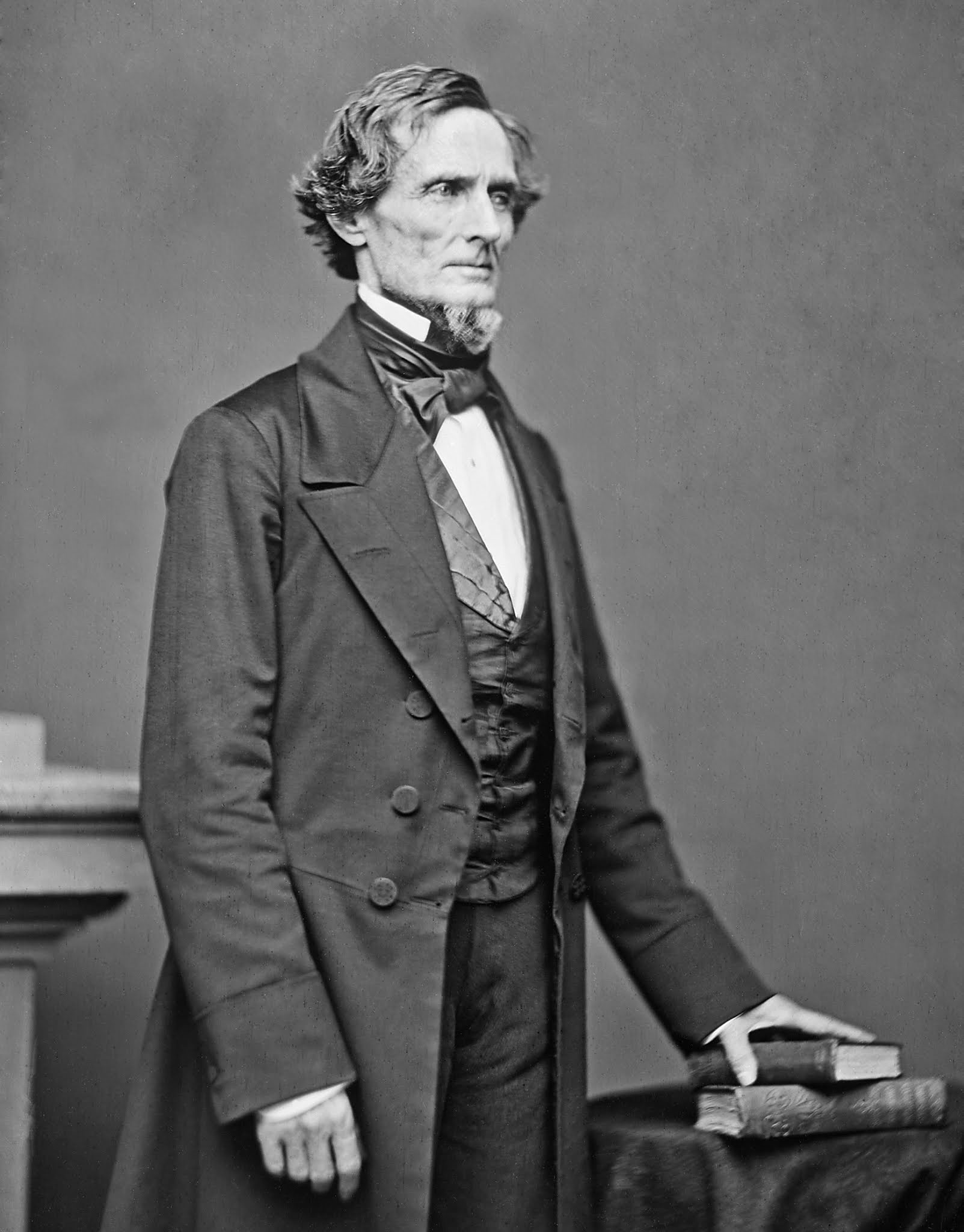
Jefferson Davis 
    During the war years, it was fairly common for presidents, or army commanders, or a congress to call for days of thanksgiving after a military victory. Braxton Bragg called for such a day on September 18, 1862, following the surrender of 4,000 Federal soldiers at Munfordville, Kentucky, the previous day.[1] Robert E. Lee, following Braxton Bragg’s victory at Chickamauga, called on his men to render “to the Great Giver of Victory… our praise and thanksgiving for this signal manifestation of His favor…”[2] Nathan Bedford Forrest, writing from Tupelo, Mississippi, declared “Chaplains in the ministration of the gospel are requested to remember our personal preservation with thanksgiving and especially to beseech the Throne of Grace for aid in this our country’s hour of need,” on May 14, 1864.[3] There were calls for the governor of South Carolina to have a public day of Thanksgiving following the battle of Fort Sumter in April 1861.[4] This was followed by a call from the Confederate Congress for a day of Thanksgiving on the Sunday following the battle of First Manassas.[5] There are undoubtedly others. 

   Jefferson Davis would issue at least ten such calls for prayer, fasting, and/or thanksgiving during the war.[6] June 13, 1861 was one of the first, a call for a day of prayer and thanksgiving.[7] On February 20, 1862,  a proclamation on the “termination of the Provisional Government offers a fitting occasion to present ourselves in humiliation, prayer and thanksgiving before that God who has safely conducted us through the first year of our national existence.”[8]


   On September 18 came another proclamation, this time thanking “Almighty God for the great mercies vouchsafed to our people, and more especially for the late triumphs of our arms at Richmond and Manassas.[9] The text is copied below:


THANKSGIVING DAY 1862 for victory in battle BY JEFFERSON DAVIS

To the People of the Confederate States:

Once more upon the plains of Manassas have our armies been blessed by the Lord of Hosts with a triumph over our enemies. It is my privilege to invite you once more to His footstool, not now in the garb of fasting and sorrow, but with joy and gladness, to render thanks for the great mercies received at His hand. A few months since, and our enemies poured forth their invading legions upon our soil. They laid waste our fields, polluted our altars and violated the sanctity of our homes. Around our capital they gathered their forces, and with boastful threats, claimed it as already their prize. The brave troops which rallied to its defense have extinguished these vain hopes, and, under the guidance of the same almighty hand, have scattered our enemies and driven them back in dismay. Uniting these defeated forces and the various armies which had been ravaging our coasts with the army of invasion in Northern Virginia, our enemies have renewed their attempt to subjugate us at the very place where their first effort was defeated, and the vengeance of retributive justice has overtaken the entire host in a second and complete overthrow. To this signal success accorded to our arms in the East has been graciously added another equally brilliant in the West. On the very day on which our forces were led to victory on the Plains of Manassas, in Virginia, the same Almighty arm assisted us to overcome our enemies at Richmond, in Kentucky. Thus, at one and the same time, have two great hostile armies been stricken down, and the wicked designs of their armies been set at naught. 

   In such circumstances, it is meet and right that, as a people, we should bow down in adoring thankfulness to that gracious God who has been our bulwark and defense, and to offer unto him the tribute of thanksgiving and praise. In his hand is the issue of all events, and to him should we, in an especial manner, ascribe the honor of this great deliverance.

   Now, therefore, I, Jefferson Davis, President of the Confederate States, do issue this, my proclamation, setting apart Thursday, the 18th day of September inst., as a day of prayer and thanksgiving to Almighty God for the great mercies vouchsafed to our people, and more especially for the triumph of our arms at Richmond and Manassas; and I do hereby invite the people of the Confederate States to meet on that day at their respective places of public worship, and to unite in rendering thanks and praise to God for these great mercies, and to implore Him to conduct our country safely through the perils which surround us, to the final attainment of the blessings of peace and security.

   Given under my hand and the seal of the Confederate States, at Richmond, this fourth day of September, A.D.1862.[10]


   Davis would submit other days for official days of thanksgiving. One came in January 1863, following the victory at Fredericksburg the previous December.[11]  Another came in March 1863. “In obedience to His precepts, we have from time to time been gathered together with prayer and thanksgiving, and he has been graciously pleased to hear our supplications, and to grant abundant exhibitions of His favor to our armies and our people,” Davis wrote.[12]   


   Even though there were Confederate victories in 1864, such as Olustee, Kenesaw Mountain, Brice’s Crossroads, and Monocacy, there were fewer calls for days of thanksgiving. There were calls for days of prayer, humiliation, and fasting. One of these latter decrees came from the Confederate Congress in March.[13] Another came in February 1865.[14] It would be one of the last.


[1] Official Records, Vol.16, pt. 2, 842.

[2] Official Records, Vol. 29, pt. 2, 746.

[3] Official Records, Vol. 39, pt. 2, 597.

[4] The Charleston Daily Courier, April 29, 1861.

[5] The Semi-Weekly Journal, (Raleigh), July 24, 1861.

[6] Allen, Jefferson Davis, Unconquerable Heart, 312.

[7] Newbern Weekly Progress, June 11, 1861.

[8] Southern Confederacy (Atlanta) February 21, 1862.

[9] Southern Confederacy, September 6, 1862.

[10] McGuire, Diary of a Southern Refugee, 154.

[11] The Tarborough Southerner (North Carolina), January 17, 1863.

[12] The Abington Virginian, March 6, 1863.

[13] The Daily Dispatch, March 24, 1864.

[14] Richmond Dispatch, January 12, 1865.

Monday, November 15, 2021

Confederate Hospitals in Alabama


Marker for the Confederate Hospital in Greenville, Alabama

   In the past, I have written about Confederate Wayside and General Hospitals (read here), Confederate Hospitals in North Carolina (read here), and Support Staff at Confederate Hospitals (read here). The information about Confederate general and wayside hospitals outside those in Virginia is rather slim.

   Cunningham, in his foundational 1958 book Doctors in Gray: The Confederate Medical Service, lists only four wayside hospitals: Demopolis, Eufaula, Selma, and Talladega. Wayside hospitals were usually located beside railroads and were charged with feeding soldiers, re-dressing their wounds, and providing other services for wounded men in transit. They were usually staffed by women, with a doctor, surgeon, or assistant surgeon in charge.

   Cunningham goes on to list the regular Confederate hospitals in Alabama. Added to this is an article from the Mobile Daily Advertiser, January 9, 22, 1861.  The list of Alabama hospitals includes:


Auburn             Texas Hospital (Old Main Hall), Asst. Surgeon L. A. Bryan

                          Langdon Hall, East Alabama Male College

                          Chapel, East Alabama Male College

Greenville         Miller Hospital, Surgeon G. Owen, 170 beds

                          General Hospital, Surgeon R. B. Maury, 150 beds

Mobile              Heustis Hospital, Surgeon J. M. Paine, 90 beds

  Nott Hospital, Surgeon G. A. Nott, 51 beds

                          General Hospital (Ross), Surgeon S. L. Nidelet, 250 beds

                           General Hospital (Moore), Surgeon W. C. Cavanaugh, 123 beds

                           General Hospital (Cantey). Surgeon W. Henderson, 150 beds

                           General Hospital (Le Vert), Surgeon R. H. Redwood, 30 beds

Montgomery       Ladies Hospital, Surgeon T. F. Duncan

                            Madison House, Surgeon C. J. Clark

                            Stonewall Hospital, Surgeon W. M. Cole

                            St. Mary’s Hospital, Surgeon J. H. Watters

                             Concert Hall Hospital, Surgeon W. J. Holt

                             Watts Hospital, Surgeon F. M. Hereford

Notasulga            General Hospital (Camp Watts), Surgeon U. R. Jones

Selma                    General Hospital, Surgeon A. Hart

Shelby Springs     General Hospital (Camp Winn), Surgeon B. H. Thomas

Spring Hill           General Hospital, Surgeon G. Owen

Tuscaloosa          General Hospital (University of Alabama), Surgeon R.N. Anderson

Uniontown         Officer’s Hospital, G. C. Gray

   Are there others? Over time, I hope to flesh each of these places out with descriptions and possibly photographs.  


Wednesday, November 03, 2021

Robert E. Lee’s Wartime visit to Florida

    It is hard to fathom, but in 1861, the Confederacy’s most celebrated general was shunted to a seemingly backwater command. Of course, after the debacle in western Virginia in late 1861, Lee was not yet the most celebrated general. Those accolades fell to Joseph E. Johnston and P.G.T. Beauregard, the heroes of First Manassas and Fort Sumter. It was not until after the Seven Days battles that “Granny Lee” was promoted in the minds of the press and general population. But still, Lee’s engineering skills were present in the minds of those who mattered, and Jefferson Davis sent Lee to command the department of the Military District of South Carolina, Georgia, and Eastern Florida. 

Robert E. Lee

   Lee’s task was to protect the railroad and ports of entry along the lower east coast. Like most generals in command of an army or department, he had too few troops and too much territory.  He arrived in Charleston on November 7 and assumed command the following day. This was not Lee’s first trip to the area. As a young engineer, he had worked on Fort Pulaski in Savannah in 1829-1830, and was in Florida examining coastal defenses in Pensacola, Fernandina Beach, and points south in 1849. [1]

   While serving as departmental commander, Lee made many inspection trips. His headquarters were located on the Coosawhatchie River in South Carolina, using an abandoned house owned by the Mackay family. Lee was frequently in Savannah, Charleston, and near the Port Royal Sound, working on coastal defenses. Twice, he visited the defenses on Amelia, spending November 20, 1861, and January 13, 1862, on Amelia Island.[2]

 What was so important about Amelia Island? Florida was the third state to leave the Union. It contains over 1,300 miles of coastline with many harbors. However, Florida lacked railroads connecting it to other Southern states. Just two lines crisscrossed the northern section of the state. The Florida Railroad went from Fernandina to Cedar Key, while the Florida, Atlantic, and Gulf Central ran from Jacksonville to Lake City and the Pensacola and Georgia ran to Quincy. It was not until March 1865 that the Atlantic and Gulf Railroad stretched south to Live Oak and Florida gained a small connection with railroads outside the state.

   Fernandina Beach was the eastern terminus of the Florida Railroad. The community sat just south of where the St. Mary’s River, dividing Florida and Georgia, emptied into the Atlantic Ocean. Any troops or supplies coming out of Florida could use this railroad to access the port. Above Fernandina Beach, on the northern end of Amelia Island, sat Fort Clinch. Construction began on the small brick missionary fort in 1847, but the fort was unfinished when the war began. Only two walls had been finished to their complete height, and the only buildings were the guardroom, prison, and carpenter’s shop. And there were no cannons. Fort Clinch was seized by state forces in January 1861. Those state forces moved cannons from the recently captured Fort Marion in St. Augustine to Fort Clinch on the ship Everglade. Batteries for the cannons were constructed in the surrounding sand dunes, as Fort Clinch was unable to support the cannons.[3]

   Lee wrote General Samuel Cooper on November 21, a day after his first war-time visit to Florida. He makes no real mention of the defenses save that he had been to Fernandina. However, in a letter to two of his daughters written on November 22, he stated that he had been as far south as “Amelia Island to examine the defences. They are poor indeed & I have laid off work enough to employ our people a month. I hope our enemy will be polite enough to wait for us.”[4] 

  On his second visit on January 13, Lee followed up with a letter to the “commanding Officer, Fernandina, Fla.” (Lee did not address this person by name, although he had been to the site two days earlier. It appears that Col. Edward Hopkins, 4th Florida Infantry, was in charge.)  Lee’s letter dealt with rifles, accouterments, powder, and the shipment of additional cannons to strengthen the armament in the area. Lee also wrote home regarding his visit, this time addressing his January 19 letter to his son George Washington Custis Lee. “I have just returned from a visit to the coast as far as Fernandina. Our defences are growing stronger, but progress slowly, The volunteers dislike work & there is much sickness among them besides. Guns too are required, ammunition, & more men. Still, on the whole, matters are encouraging & if the enemy does not approach in overwhelming numbers we ought to hold our ground.”[5]

Fort Clinch 

   Lee’s time as commander of the department came to an end in early March 1862. He was in Charleston on March 4, and then worked his way north. General John C Pemberton replaced him. Two weeks earlier, Lee ordered that Fort Clinch, Fernandina, and all of Amelia Island were to be abandoned by Confederate forces. [6]

    Robert E. Lee visited Florida once more, just a few months before he died. His ship docked in Jacksonville, and he was on on his way to Palatka and an old friend. One wonders if he was able to catch a glimpse of Fort Clinch and Amelia Island as he sailed past. After the island was abandoned by the Confederates, Federal forces reoccupied the fort and finished its construction. Fort Clinch is now a state park and open to the public.[7]


[1] Freeman, R.E. Lee, Vol. 1, 304.

[2] Knight, From Arlington to Appomattox, 82, 92.

[3] Ofeldt, Fort Clinch, Fernandina, and the Civil War, 21-23.

[4] Official Records, Vol. 6, 327;  Dowdey and Manarin, The Wartime Papers of R.E. Lee, 89.

[5] Official Records, Vol. 6, 327; Dowdey and Manarin, The Wartime Papers of R.E. Lee, 89. 

[6] Knight, From Arlington to Appomattox, 102; Official Records, Vol. 6, 93-95.

[7] Johnson, In the Footsteps of Robert E. Lee, 164-195.

Tuesday, October 12, 2021

Biographies on Confederate governors


     Knowing what is available is an important thing to both the reader and the researcher. That is why I create these lists: to see what is available and to know where the holes in the scholarship are. W. Buck Years, in 1985, released The Confederate Governors, a collection of essays on the role of governors of each state during the war. There is also Malcolm C. McMillan’s The Disintegration of a Confederate State: Three Governors of Alabama’s Wartime Home Front, 1861-1865 (1986). Several (all?) states have general histories of governors. For example, North Carolina has Crabtree’s North Carolina Governors, 1585-1958: Brief Sketches (1958). This list does include published papers. North Carolina’s John W. Ellis has two volumes of published papers, including a biographical sketch, but he does not have a traditional, full-length biography. If you see anything I missed, please drop me a line.


Alabama

John Gill Shorter (1861-1863)

Andrew Barry Moore (1857-1861)

Thomas H. Watts (1863-1865)

Arkansas

Henry Massie Rector (1860-1862)

Thomas Fletcher (acting 1862)

Harris Flanagin (1862-1864)

Florida

Madison Starke Perry (1857-1861)

John Milton (1861-1865)               

     Hughes, Civil War Correspondence of Florida’s Governor John Milton (2015)

Abraham K. Allison (1865)

Georgia

Joseph E. Brown (1857-1865)

     Fielder, A Sketch of the Life and Times and Speeches of Joseph E. Brown (1883)

     Hill, Joseph E. Brown and the Confederacy (1972)

     Parks, Joseph E. Brown of Georgia (1977)

     Roberts, Joseph E. Brown and the Politics of Reconstruction (1973)

Louisiana

Thomas Overton Moore (1860-1864)

     Moore, Thomas Overton Moore: A Confederate Governor (1960)

Henry Watkins Allen (1864-1865)

     Cassidy and Simpson, Henry Watkins Allen of Louisiana (1964)

     Dorsey, Recollections of Henry Watkins Allen (1866)

Mississippi

John Jones Pettus (1859-1863)

     Dubay, John Jones Pettus, Mississippi Fire-eater (1975)

Charles Clark (1863-1865)

Missouri

Claiborne Fox Jackson (1861)

     Phillips, Missouri’s Confederate: Claiborne Fox Jackson and the Creation of  Southern Identity (2021)

Thomas Caute Reynolds (1862-1865)

     Reynolds, Letters of Thomas Caute Reynolds, 1847-1885 (1943)

North Carolina

John Willis Ellis (1859-1861)

     Ellis, The Papers of John Willis Ellis (1964)

Henry Toole Clark (1861-1862)

     Poteat, Henry Toole Clark: Civil War Governor of North Carolina (2009)

Zebulon Baird Vance (1862-1865)

     Dowd, Life of Zebulon B. Vance, (1897)

     Yates, Zebulon B. Vance as War Governor of North Carolina, 1862-1865, (1937)

     Adler, Zebulon B. Vance and the “Scattered Nation” (1941)

     Yates, The Confederacy and Zeb Vance (1958)

     Camp, Governor Vance: A Life for Young People. (1961)

     Shirley, Zebulon Vance, Tar Heel Spokesman. (1963)

     Tucker - Zeb Vance: champion of Personal Freedom. (1966)

     Szittya, Man to Match the Mountains: the Childhood of Zebulon Baird Vance. (1980)

     Cooper, Zeb Vance: a Leader in War and Peace. (1985)

     Weinstein, Zebulon B. Vance and “The Scattered Nation.” (1995)

     Vance,  My Beloved Zebulon: the Correspondence of Zebulon Baird Vance and Harriett N. Espy. (1971)

     McKinney, Zeb Vance, North Carolina’s Civil War Governor and Gilded Age Political Leader. (2004)

     Mobley, “War Governor of the South” : North Carolina’s Zeb Vance and the Confederacy.(2005)

     Johnston, Zebulon Baird Vance Letters, 1843-1862 (1963)

     Mobley, The Papers of Zebulon Baird Vance, 1863 (1995)

     Mobley, The Papers of Zebulon Baird Vance, 1864-1865 (2013)

South Carolina              

    Francis Wilkinson Pickens (1860-1862)

    Milledge Luke Bonham (1862-1864)

    Andrew Gordon Magrath (1864-1865)

Tennessee

    Isham G. Harris (1857-1862)

         Elliott, Isham G. Harris (2009)

Texas

Edward Clark (1861)

Francis Lubbock (1861-1863)

     Lubbock, Six Decades in Texas (1900, autobiographical)

Pendleton Murrah (1863-1865)

Virginia

John Letcher (1860-1864)

     Boney, John Letcher of Virginia, (1966)

William “Extra Billy” Smith (1864-1865)

     Mingus, Confederate General William “Extra Billy” Smith (2013)


Tuesday, October 05, 2021

Is my library complete?

    Many decades ago, in an old Dixie Gun Works catalog, I gained a bit of wisdom. The editor was writing about building a library. A library was more than a large group of books, he claimed. A library was a group of books that permitted a person to answer the questions that he or she had. To be honest, I write books (and blog posts) because I can’t find the answers to the questions I have. Having a good library at my fingertips allows me to access what information is available.

   Over the past forty years, I have sought to build a collection that permits me access to much of the information out there. I have my own set of the Official Records, Confederate Veteran, Battles and Leaders, Rebellion Record, and the Southern Historical Society Papers. Yes, many of these sets are online, but I really prefer turning papers. My library is Confederate specific. Yes, there are biographies on Federal generals, like Grant, Sherman, McClellan, and Burnside, and politicians, like Lincoln, Seward, and Stanton. And there are some Federal regimentals; I think Beatie’s first three volumes on the Army of Potomac a masterful work, and I wish he had lived to do more. But the vast majority of the library is Confederate in nature with numerous biographies on Lee, Jackson, Davis (along with Davis’s papers). While some people have more books on the battle of Gettysburg, my forty or fifty volumes suffice for the questions I have. There are biographies on other Southern politicians, like Stephens, Cobb, Benjamin, Yancey, and Vance. There are numerous regimentals, published letters, diaries, and reminiscences.


   Earlier this week, I picked up a set I had always wanted. In 1993, Simon and Schuster released the four volume Encyclopedia of the Confederacy. The price in 1993 was about $450 for the set, well beyond my means. I had not really thought much about the set over the years, but I found this set for $50 on an online site and added it to my collection. These volumes cover generals, politicians, battles, the roles of various church denominations, just a host of events and people. It is wealth of information right at the fingertips. It will look perfect right beside Long’s The Civil War Day by Way, Boatner’s The Civil War Dictionary, Eicher and Eicher’s Civil War High Commands, and The Library of Congress Civil War Desk Reference.

   Is my library complete? Well, not really. But I am comfortable in my collection, and it is much closer than in the past. Thanks to the work of Savas Beatie, I have been able to add the Bachelder Papers, the Carman manuscript, and will soon add Bearss’s three volumes on the Vicksburg campaign. I’d like to add biographies on each of the war-time Southern governors (I think I only have the biographies on Vance, but there are a lot of them). Of course, some of these men do not have biographies. But by and large, I have a good, solid, Confederate library. If a question can be answered by turning to a book, I might just have that book. Honestly, much of my collecting these days has turned to 18th and 19th century Southern politicians and jurists. That is the topic for another post.