Monday, December 18, 2017

Frazier's Farm or Frasier's Farm?

While working on my images for General Lee's Immortals, I made an interesting discovery. There is inconsistency on the spelling of Frazier's farm. Ok. There are a lot of inconsistencies on spellings in that time period. But this inconsistency happens to be on battle flags.

In December 1862, Branch's brigade received new Army of Northern Virginia battle flags.  These flags had their battle honors painted in white paint, in a very distinctive pattern. Of the five flags issued, four survive. The fifth flag, belonging to the 7th North Carolina State Troops, was cut up at the end of the war near Lexington, North Carolina. A scrap of this flag survives at the North Carolina Museum of History in Raleigh. On this particular issue of flags, the June 30, 1862, battle (a part of the Seven Days Campaign), is spelled "Fraziers Farm."


However, in a later issue of Army of Northern Virginia flags to the 28th North Carolina Troops (May 1864), it is no longer" Fraziers Farm," but it is now "Frasiers Farm." This flag was captured on July 28, 1864, near Malvern Hill, Virginia. A replacement was issued shortly thereafter. This 28th North Carolina flag has been further modified. Now, the battle honor reads "Frasers Farm." This flag was surrendered on April 9, 1865, at Appomattox Court House.

 Being the inquisitive soul that I am, I pulled out my copy of Glenn Dedmondt's The Flags of Civil War North Carolina, and started to look at just the spelling of Frazier's Farm. It would appear that the odd spelling on the flag of the 28th North Carolina was an odd occurrence. Eight other flags bear the name "Frazier's Farm." (I also checked Dedmondt's books on Alabama and South Carolina, and once again the spelling is consistent.)

So our next question is why? Why did the lettering on two different flags issued to the 28th North Carolina, get misspelled, once with "Frasier's Farm," and the next time with "Frazier's Farm." Just who was painting these flags on these two different days?

Of course, these are questions I cannot answer. There is not even a consistent spelling of the family who lived on the farm during the 1862 battle. Is it Frayser's Farm? Frazier's Farm? Or, Frasier's Farm? (Or, maybe Glendale...)

Wednesday, December 13, 2017

Now taking pre-orders for General Lee's Immortals!

   Ladies and Gentlemen, boys and girls, I am happy to announce that General Lee's Immortals: The Battles and Campaigns of the Branch-Lane Brigade in the Army of Northern Virginia, 1861-1865, has gone to the printers! The expected release date is January 12, 2018!

   I am now taking pre-orders for signed copies! Hardcover copies of the 400+ plus page book (with maps by Hal Jespersen) are $35.00. This is the first edition, first printing, and they are hardback, with dust jackets.  If you pre-order, I'll cover the shipping, and I'll throw in a limited edition Branch-Lane brigade book mark. The hardback books will sell out fast, and once they are gone, well, they're gone. You can order by visiting my web page:  Order Here!   Or, you can send a check or money order to P.O. Box 393, Crossnore, NC   28616

   My first regimental, a history of the 37th North Carolina Troops, came out 15 years ago. I never thought I would get the opportunity to write about the brigade itself. But four years ago, I took a chance and dropped a note to Ted Savas, asking if his company would be interested in publishing such a book. He said yes, and we will all see the finished product in just a few weeks.

   Writing a brigade history is hard - you cannot put in every example you might come across in your research, only the best one or two. And trying to decide which stories are the best is a challenge. I did something different in General Lee's Immortals than what I  did previously in my histories of the 37th North Carolina and 58th North Carolina. Not only does General Lee's Immortals follow a chronological history of the Branch-Lane brigade, from their creation right after the battle of New Bern to the surrender at Appomattox, but I also created themed chapters as well. There are chapters on brigade medical care; camp life; prisoners of war; and military discipline. Instead of having that material spread out over the text, I was able to concentrate on these topics, showing how brigade medical care (for example) changed over the course of the war. This was something new for me, and I do not recall seeing it in any other brigade history.

   That brings me to another point: I wanted this history of the Branch-Lane brigade to be more than a brigade history. I wanted to try and show how a brigade worked (or sometimes did not work) throughout the war. I'm quite certain a book like that does not exist.

   So much of my writing life seems to have been wrapped up in the Branch-Lane brigade. A regimental history, a battle history (Hanover Court House), articles for magazines and newspapers. I've blogged about it, spoken in cemeteries when grave markers have been dedicated, and participated in living histories at national parks. You could also say that books like Civil War Charlotte: Last Capital of the Confederacy and Watauga County, North Carolina, in the Civil War are products of my research into the Branch-Lane brigade.

   General Lee's Immortals: The Battles and Campaigns of the Branch-Lane Brigade in the Army of Northern Virginia, 1861-1865... I look forward to signing a copy for you next month, and I really look forward to continuing the discussion about a remarkable group of men that served in Robert E. Lee's Army of Northern Virginia. Please pre-order a copy today!


Tuesday, December 05, 2017

Blog post 1,000

A milestone - this marks my 1,000th blog post! It took me eleven years to reach this post. What a journey! And, thanks for sharing it with me!

Eleven years ago, I set out in the blogging world. Blogs were not new then, and with all the material out there, I wondered how I might contribute something new. So, I decided to focus my blog on what I knew the most about: North Carolina's role during the Late Unpleasantries. At times, I've used the blog to share where I am traveling, or what I am writing about. At other times, I've shared questions, looking for answers to some of history's mysteries. (Trust me, after 20+ years of researching and writing, I still have more questions than answers). One thing I am still sure about is this: we still know so little about our own history. Time after time I have stood in the great libraries of our state and not been able to find the answer to some little question that I have.


So what is in store? I'm still researching and writing away. I have two new books coming out in the next twelve months. I'm continuing my research into the life of Chief Justice Richmond M. Pearson. And, I plan to continue letting you have glimpses into my world through the pages of this blog. Many blogs that I once followed have grown dormant over the years. But I believe that I still have something to say, something to share, and I look forward to getting your feedback as we share this journey together.

Tuesday, November 28, 2017

Books on North Carolina and Reconstruction


A few days ago, I saw a poll on facebook, asking people what areas still need coverage regarding the war. Well in front of the pack was the subject of Reconstruction. It had always been my conclusion that the subject, at least dealing with North Carolina, was pretty well covered. Of course, there is always room for a new book or two. I personally would like to see a book on the role of North Carolina's courts and/or the General Assembly during the time period.


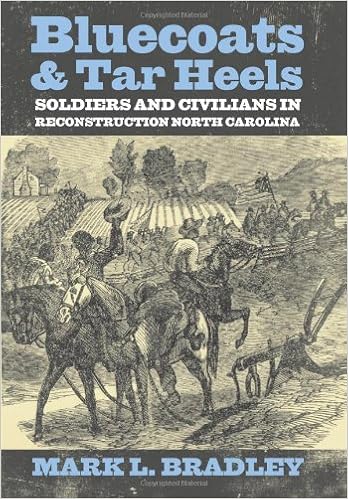
There have been (to my knowledge), three books published on Reconstruction in North Carolina, and another that covered the era (think general history). The first was J. G. de Roulhac Hamilton's Reconstruction in North Carolina (1914). This was followed by Richard L. Zuber's North Carolina during Reconstruction (1969). Then came Paul D. Escott's Many Excellent People: Power and Privilege in North Carolina, 1850-1900 (1985). Finally, Mark Bradley's Bluecoats and Tar Heels: Soldiers and Civilians in Reconstruction North Carolina (2009). The last book is a superb treatment of the time following the war.


There are also several biographies of various people involved. Richard Zuber's Jonathan Worth: A Biography of a Southern Unionist (1965) is a good read, as is William C. Harris's William Woods Holden: Firebrand of North Carolina Politics (1987). Gordon McKinney's Zeb Vance: North Carolina Governor and Gilded Age Political Leader (2004), is, in my opinion, the best biography on Vance published to date.


Biographies I must confess that I have yet to read, but that might hold promise, are Donald Connelly's John M. Schofield and the Politics of Generalship (2006) and Otto H. Olsen's Carpetbagger's Crusade: The Life of Albion Winegar Tourge (1965).


Also in the line up are Roberta Sue Alexander's North Carolina Faces the Freeman: Race Relations during Presidential Reconstruction, 1865-1867 (1985), and Richard Reid's Freedom for Themselves: North Carolina's Black Soldiers in the Civil War Era (2008).


So, what have I missed? What would like add to this list? Is the coverage of North Carolina during Reconstruction adequate?

Tuesday, August 29, 2017

Looking for Pearson's slaves.

Lately, I've been doing quite a bit of digging into the life of North Carolina Supreme Court Chief Justice Richmond Pearson. Like most people from the past, he is a complex person. Pearson is best known (during the War years) for his refusal to go along with Governor Vance's decision to use the North Carolina militia to enforce Confederate conscription law.


Richmond Pearson
Was Pearson a Unionist? Hmm... I've not really uncovered a personal statement from him on the subject. Maybe I'll find one. At the same time, many of the state's Unionists kept quiet on the matter while the war was being waged. Pearson did become one of the leading Republicans in North Carolina after the war ended.


According to the 1860 Yadkin County Census, Pearson owned 37 slaves. Of these, 13 were female, 24 male; the oldest ones were 45 (two males), and 26 were 16 years old or younger. Of course, the slave census tells us nothing about them or their lives. (It is interesting to note that Pearson's neighbor was David Cozzens, a lower middle-class free person of color who was also a farmer. Several of the Cozzens family from Yadkin and Watauga Counties were Confederate soldiers.)


Turning to the 1870 Yadkin County Census, there are two black Pearson families. I am going to speculate that these are some of the former slaves of Richmond Pearson. Family one is the Winnie Pearson family. She is 56 years old, and there are five other members of the family: George (19), Nancy (18); Nicholas (14) Henry (12), and Jane (3). Two other black Pearsons are living in the Sylvester Speer (white) family, and list their occupations as laborers. They are Charles (23) and Sandy (24). It is possible that they are a married couple, and Sandy may have a different surname. There are no other black Pearsons in Yadkin County. There are a few others in Wilkes and Davie counties.


So what happened to these enslaved men and women? How did they get the news of the Emancipation Proclamation, and more importantly, the 13th Amendment? Like other enslaved peoples, did they chose to stay on working for Richmond Pearson after the war ended, or  did they simply walk away, looking to begin a new life elsewhere? I'm not sure I'll ever be able to answer those questions. 

Sunday, August 27, 2017

New exhibit at Mars Hill University

It today's anti-Civil War craze, it is nice to see a good quality exhibit on local aspects of the troubles of the 1860s. Mars Hill University has done just that, putting together exhibits and material on the War in the mountains.

Madison County is a prime place to explore the topic. From early war violence, when the sheriff took a shot at a local Unionist, and was then killed, to the numerous raids into and out of the Shelton Laurel, the area had more than its fair share of conflict. Except in places like Bentonville or Fort Fisher, where large-scale battles took place, Madison County just might be the bloodiest ground in the state.


Much of the exhibit focuses on the life of James Keith, lieutenant colonel of the 64th North Carolina Troops. Some of his regiment were the men sent into the Laurel area to deal with the dissidents after the January 1863 salt raid into Madison. In the course of the exhibit and the accompanying video, a different theory is advanced that just maybe, Keith was not responsible for the thirteen killed that cold January morning.


There are plenty of texts and documents to peruse, along with several artifacts from the area.


I do wish the documentary and exhibit had gone a little further in their explanations. There are many period letters and newspaper pieces stating that gangs of men and boys were coming out of the Laurel area of Madison County and robbing people in the surrounding environs blind. A mention or two of those accounts would have carried the conversation even further.


"The Civil War in the Southern Highlands: A Human Perspective," at the Rural Heritage Museum is well worth your time, and admission is free. It is always great to be on the campus of Mars Hill University. The exhibit runs through March 4, 2018. 

Wednesday, August 23, 2017

No room for nuance in NPR's narrative?

In reading a piece on NPR on how "Confederate Statues were Built to Further a 'White Supremacist Future,'" it is clear that Miles Parks only wants to further widen the divisions that have always existed in the United States and which the media, unfortunately, exploits. Parks, and the others he quotes, miss one key element in their anti-monument pep rally : Economics 101.

The chart accompanying  the article shows peaks in when monuments were erected. The majority of the Confederate monuments were erected between 1905 and 1920. (It would be interesting to see a comparable chart regarding Union monuments, but who cares about them, right? They don't fit the narrative. )

Enter the Second Industrial Revolution. In the last couple of decades of the 19th century, and the first 20 years of the 20th century, the United States entered a phase of rapid industrialization. There were numerous new discoveries and inventions, like the automobile. It boggles the mind to think of all the related industries beyond those of the plants of Ford, General Motors, and Chrysler that the automobile created. Oil had to be refined (and shipped), and gas stations, roads, dealerships, and repair shops had to be constructed. All of this would lead to the rise of inns for travelers to stay, and restaurants in which they could eat. Added to this were advances in machinery, tools, electricity and lights, etc., etc. By 1895, the United States had outpaced Great Britain for first place in manufacturing output. Economic growth between 1890 and 1910 was above 4%. People had jobs, had money to spend, and had money to give to civic projects.

There were over 50 Confederate monuments raised in the 1910s and 1920s in North Carolina. The economy could support it. When the stock market crashed in 1929, followed by the Great Depression, the erection of monuments slowed to a crawl. Parks quotes Jane Daily, an associate professor at the University of Chicago as saying "Most of the people who were involved in erecting the monuments were not necessarily erecting a monument to the past, but were rather, erecting them toward a white supremacist future." Hmm. Professor Daily, can you actually prove that, or is that just an assumption? Which people? Where is the documentation?  I've looked into the erection of North Carolina monuments for the better part of twenty years. First, there is no treasure trove of material, usually just little snippets of the past found in newspapers of the time. I've never seen an article, letter, or diary state "Oh, we're against African-Americas. Let's put up a monument so these people know who is still the master, no matter what year it is." Never.  Maybe someone was thinking that , but historians cannot get into the mind-reading business without supporting evidence.  Parks's article also seems to lead readers into thinking that these monuments just magically appeared overnight. The truth of the matter is that it took years for the groups that erected these monuments (mostly women and many of them widows and children of veterans) to raise the necessary funds. In Stanley County, it took ten years to raise the first $6,000. That was in 1880. The monument was not actually finished and dedicated until 1925. In Burke County, the base of the monument was dedicated in 1911, but the bronze soldier on top was not dedicated until 1918.

Economics is not the only subject that gets left out the discussion. What about the African-Americans in North Carolina who also participated in the fundraising or dedication of the Confederate monuments? There is a great picture of the dedication of the Unity Monument at Bennett Place in 1923 that shows an African-American man front and center, sitting on a platform, apparently listening to something going on that we cannot see. Whatever is going on has his attention, unlike the row of politicians, or veterans, behind him, who appear to be mostly asleep. I wish we knew his story. There are other well-known photographs of black men, proudly bedecked in Confederate Veteran reunion ribbons and medals. Their story is complicated, and it needs to be told. 


Certainly, there is no doubt that life for African-Americans in the Jim Crow era was horrible.  Even until quite recently, ridiculous and humiliating rules and assumptions were firmly in place, and they were as appalling and wrong then as they would be now. Not long ago, as our family watched Hidden Figures (an amazing  movie that I highly recommend both for its treatment of the space program and of social issues), our younger child was stunned that anyone would expect someone to use a different coffee carafe because of her race. She had trouble grasping that such nonsense was ever perpetuated in our country, and kept asking "Did that really happen?"  We should all be horrified that anyone could be treated the way African-Americans  (along with many other ethnic groups) have been treated. Perhaps somebody in the process of putting up a monument somewhere did have nefarious intentions, but we do not know that for certain, and if we make assumptions about those people, judging them by our standards, we are not only misunderstanding the past; we are misunderstanding actual people, whose complex lives cannot be boiled down to a slogan or shoved into a box that suits our narrative, whatever it may be.  We should recognize that the past is just as complicated as the present, that people are complicated, and that every era, like every person, is a mixed bag of both good and ill.

In the end, I think just as strong of a case can be made for economics being a driving force behind the erection of Confederate monuments in the nation as the one for the era of Jim Crow. Very likely, some of both motivations, along with others, were part of the mix; people are complicated. At least with economics, it is easier to prove. Just look at the numbers. Perhaps Dr. Dailey's remarks have been taken out of context or truncated.  It is possible her original words were more complicated, reflective of a more complex view of the past than the article demonstrates. While we cannot quantify how good or bad people are, how pure or evil their hearts may have been, we can look at their finances. Unfortunately, early twentieth-century economics doesn't grab readers and viewers, but if the media were more focused on telling a whole picture than on promoting division and fomenting conflict, maybe we would all view ourselves, and our past, with more nuance, and maybe we would be more interested in hearing those complicated stories than in calling names and making assumptions. 


You can read the original article here

Thursday, August 10, 2017

Colonel Hargrove, the 44th NCT, and the 1863 battle of South Anna Bridge.

I was doing some research recently, and I came across this story. Sometimes, pieces like this make me want to dive in and write about a particular regiment or battle. This came from the Oxford Public Ledger September 24, 1908.

Tazewell Hargrove
   During the battle of South Anna Bridge, on June 26, 1863, Lt. Col. Tazewell Hargrove was commanding two companies of his regiment, the 44th North Carolina Troops, "about 80 men" against 1,500 "Yankees," engaging them for 4 hours - was himself knocked down twice, wounded in two places by sabre, in two places with bayonet, and after firing all the loads from his pistol, threw it at a Yankee and knocked him down, causing him to swallow several of his teeth. He [Hargrove] had sworn never to surrender and never did, but was captured by several Yankees who seized him and threw him down and held him, they were too thick around him to sabre or pistol him. Private Cash of Co, "A," stood upon the abutment of the Bridge, and ran a sabre bayonet through a Yankee, the bayonet sticking half a foot out behind his back, and had drawn his weapon for another thrust, when he was shot by two Yankees through the head. Private Cates of Co. "G," stood on top of a breastwork for an hour amid a storm of bullets, he was posted there to see when the enemy, who were formed beyond a little rising ground should advance. I [William H. Harrison, maybe] stood myself at the other end of the work, for a like purpose, and the Yankee who guarded me asked me if I was man who was standing at the other end of the work, with sword and pistol on, I said yes, and he good humouredly replied, 'well you are hard to hit. I took four deliberate cracks at you hardly 150 yards, but I am glad I missed you.'"


According to the NC Troop books, Volume X, Hargrove's coat was found after the battle with "eight sabre cuts." He was taken to Fort Delaware, and later was a part of the Immortal 600. Hargrove survived the war, taking the Oath of Allegiance on July 24, 1865.

Wednesday, August 02, 2017

Visiting the Condor.

Once a year, I make the trip from the mountains to Fort Fisher, to speak at during the "Beat the Heat" speaker series. It is usually the last weekend in July that I go, which was last weekend. My family often tags along, looking forward to a quick trip to the beach before school starts. We were at Fort Fisher about noon and pulled into the parking area overlooking the beach. It was storming at the time, and we really had no other place to go.


As the rain subsided, we could see two buoys off the coast. A little online research showed that these buoys mark the final resting place of the blockade runner Condor. The Condor was originally a steamer, 270 feet long and built in Scotland, with a crew of forty-five.  On September 7, the Condor steamed into Halifax. She was reportedly loaded to the gunwales with war supplies. Before long, she was on her way to the port at Wilmington. The US Navy was alerted to the Condor's  mission, and the North Atlantic Blockading Squadron was always on the lookout for ships trying to run into the Cape Fear River.

Hamilton Cochran, in his 1858 book Blockade Runners of the Confederacy, painted this picture of what happened next: The U.S.S. Niphon was the first to sight [the Condor's] long, gray hull, a mere shadow in the darkness. Up shot the warning calcium flares and the chase was on... The Condor was thrashing towards the Inlet with every ounce of steam her boilers could produce A cloud of black smoke belched from her triple stacks. The Niphon's bow chasers barked and shells tore through the Condor's sparse rigging, then plunged into the sea in white geysers of brine.

Ridge [the Captain] knew that he could outrun the Niphon, for the bar was close. To starboard loomed the Mound Battery at Fort Fisher. It would be only a matter of minutes now before the Condor would plunge within the protective range of those big Confederate guns. Just then, out of the blackness ahead, loomed a vessel's hull and spars. To the Condor's pilot that meant only one thing - "a damned Yankee" gunboat barring the way. In an instant response to his cry of "Hard a-starboard," the Condor heeled and swung away. Seconds later the keel struck the treacherous shoals to the right of the channel. She lurched, scraped, then came to a jarring halt... In the misty dawn those aboard the stranded Condor saw that it was not a Federal man-of-war that had loomed in their path, but the wreck of the British blockade runner Night Hawk... the Niphon moved in for the kill. More calcium flares soared skyward as the Union cruiser again fired at the helpless Condor. Instantly Fort Fisher replied and drove off the eager Niphon with a barrage of shells.

The Condor later broke up in the relentless surf.

Among the cargo and passengers was the famous Rose O'Neal Greenhow. She was a Confederate spy, who had been captured, imprisoned, released, and then sent to Europe to help build support for the Confederacy. On August 19, 1864, Greenhow left Europe, bound for Richmond, carrying dispatches. When the Condor ran aground, she transferred to a rowboat, determined to reach the shore. The boat was swamped in the surf, and Greenhow drowned, possibly weighted down by dispatches and gold sewn into her skirt. She is buried in Wilmington.

The Condor was recently declared a North Carolina Heritage Dive Site by the North Carolina Department of Natural and Cultural Resources. The ship is roughly 700 yards off the beach, in 25 feet of water. Much of the Condor's infrastructure, like the boilers and engines, paddle wheel shafts and hubs, and other hull plating are still visible.

The story of the Condor is just one story of the many stories of the blockade runners that are sunk in and around the Fort Fisher area. In the area between Wrightsville Beach and the southern tip of Bald Head Island are the wrecks of at least nineteen blockade runners, and three US vessels. There are more in the Cape Fear River, and along Oak Island, Holden Beach, and Ocean Isle Beach. Each of these also has stories to be told.


I did not get to dive the wreck of the Condor. Maybe one day that opportunity will present itself. For now, I must be content on gazing off into the surf, wondering what treasures lie beneath the waves. 


The two buoys on the right mark the final resting place of the Condor.

Monday, July 17, 2017

David Parker and food's connection to morale in the Army of Northern Virginia.

I've been reading a lot of Confederate letter collections the past few weeks, and I have discovered something interesting in the letters of David Parker. Parker, from Yancey County and a member of the 54th North Carolina Troops, writes home about food (many soldiers did that), but ties in the morale of the army. We know that morale was tied to food, but it does not get mentioned very often.

In November 1862, Parker writes that all they are getting to eat is "dry crackers and beaf meat." He then confesses that he has lost weight in the past few months, and
David Parker
concludes: " I don't think I can stand the scarcities much longer." (45) Parker became lucky in January 1863. He was detailed to cook for the officers in his company. "I get plenty to eat. Thank god that is one good consolation and that is more than any of the rest of the Privates can say," he wrote home in February. (62)

It is unclear just how long these arrangements lasted, but by late summer 1864, Parker appears to be back in the ranks. His command was in the Shenandoah Valley and while rations were scarce, there were opportunities to supplement with apples and other fruits just coming ripe. In December of 1864, things were not so good. Writing from the trenches around Petersburg, Parker believed that "It is the hardest time in this army that I have saw since I have been out in the service and if it does not get better the soldiers will not stand it long. They are all threatening to run away if they don't give them more to eat." A few days later he wrote that the rations were a little better. We are faring very well at this time though I do not know how long it will last. What we get now we can live on very well. If it will only continue. I have not thought to run away yet though when I wrote last I was very much tempted. If they had not given me more to eat I do not know what I should of done though I do not expect to run away while I can help it for it never was my notion to run away. You know that I all ways was opposed to it but hunger will make men do that they do not want to do. So long as Jefferson Davis does feed me as he is at this time I will stay with him." (136)

Of course, we know that the North cut off supplies coming from the Deep South, and from the Shenandoah Valley, and that thousands did run away. David Parker held out until the end. He was wounded, probably on April 2, 1865, and admitted to a hospital in Richmond the next day. Parker succumbed to his wounds on April 14, 1865; he is buried in Richmond, a long way from his home in the mountains of western North Carolina.


If you want to learn more of David Parker's story, check out Pen in Hand: David Parker Civil War Letters, edited by Riley Henry. 

Wednesday, July 05, 2017

Tar Heels buried with Stonewall Jackson.

A few weeks ago, on my return from the living history in Maryland, we stopped by Lexington and spent a few moments with Stonewall Jackson. We also stumbled over to the Confederate monument in the cemetery, and found the names of several Tar Heels chiseled on it. That got me to thinking - who were these men and how did they wind up so far from the front lines of the War? (Yes, the war visited Lexington in June 1864.)

So, who were these men?

On one side is the name of J. C. McKinney, Co. B, 34th N. C. John C. McKinney was from Cleveland County and was 39 years old when he mustered in as a private in February 1863. Four months later (June 17-19, 1863), he died of typhoid at a hospital in Lexington.

Below McKinney was G H B Huggins, Co.I, 2nd N. C. There are no Hugginses in Company I, but I did find a Henry B. Huggins in Company G. Huggins enlisted in Northampton County on July 18, 1861. He was wounded sometime around July 1, 1861, by the "explosion of a bomb shell at Camp Wyatt." Huggins was detailed as a nurse in Lexington on February 15, 1863, and died there of "typhoid pneumonia" on June 16, 1863.

On another side of the monument were the names W. G. Gilbert and A. T. Gilliam, both listed as having served in the 23rd North Carolina. There was a Willis Gilbert in Company D. His records state he was born in Caldwell County and enlisted at the age of 28 in September 1862. He died at or near Lexington around February 6, 1863, of "chr[onic] gastritis."

A. T. Gilliam is proving a challenge. There are no A. T. Gilliams in Company A, 23rd North Carolina Infantry. I tried looking on Soldiers and Sailors for A. Gilliam, and T. Gilliam, but I could not identify this soldier. I also looked at the compiled service records for the 23rd NC, but I did not really see anything there that matched. It could be that the inscription is totally wrong, or maybe this poor lad died of some disease after he enlisted but before he was mustered into the regiment.

I did a little online searching , but I did not find a whole lot about a war-time hospital. The Stonewall Jackson house was used as a hospital, but it is unclear if this happened during the war. Maybe someone has that answer as well.


I wonder how many other Tar Heels are tucked away in places, seemingly forgotten. 

Tuesday, June 27, 2017

On the field at Sharpsburg

The battlefield at dusk. 
Over three decades, this crazy life I live has taken me to some pretty remarkable places. The archives and libraries hold special treasures, but the fields themselves often hold the keys to whatever it is that I am writing. For years and years, I reenacted. There are still a few places, like Olustee in Florida, or Reseca, Georgia, where reenactors get to take the fields on the actual sites where the boys in Blue and Gray fought. A few years ago, I "retired" from reenacting. Yep - I hung up my sword. Instead, I became a volunteer interpreter. Instead of leading weekend warriors on some distant field, portraying for the masses what a Civil War battle might have looked like, I decided to get a little more personal. For several years, I (and my family) have volunteered at historical sites, trying to work closely with the public and interpret the events. And as a rule, we try to stay within two hours of our home here in the mountains of western North Carolina.  

Tarheels at the Dunker Church. 
Every once in a while, some event comes along that pulls me out of the mountains. When the opportunity came to portray elements of Branch's brigade at Antietam, and to talk about the General on the very ridge where he died, well, it was an event too good to pass up. So my son and I loaded up and headed to Maryland. We were able to camp behind the Dunker Church (and even slept in the church Friday night due to the rain), march onto the field, fire vollies from the Sunken Road, and interact with the public in a very special way.

Our camp for the weekend.
The highlight came on Saturday evening as I had a chance to stand by the cannon marking the site of Branch's death, which occurred on the evening of September 17, 1862. I had planned to speak on the life of General Branch, but my friend John Baucom read a brief biographical sketch of his life before it came to my turn. So just a couple of minutes before my turn came, I changed my talk, focusing on the men of the brigade as they came up from Harpers Ferry, the loss of Branch, James H. Lane's promotion, and the rest of their war. Some probably thought that it was all planned out. No, not really.  But 20 years of research into the Branch-Lane brigade can come in handy.

Camping on the ground where they fought, and marching over the fields where so many died, can give one a perspective very few others can get. It will be an event that I will always treasure, right up there with sleeping on Snodgrass Hill and in the Petersburg trenches. Three cheers for my friends in the 28th North Carolina Troops. It was a fantastic event! 
General Branch's memorial. 

Wednesday, June 14, 2017

Was it really Witcher's Cavalry?


In November 1863, a group of dissidents left Wilkes County, bound for Knoxville, and the 10th Tennessee Cavalry (US). As the story goes, the group of fifty-seven men were being piloted by Wilkes County resident John Bryant. They passed through Watauga County, and on into Tennessee. In an area of present-day Unicoi County (then Carter County) they stopped at the home of Dr. David Bell, for breakfast. As the waited under some trees, "rebels... suddenly came insight, and the alarm was instantly given. The poor fellows tried to save themselves by flight, being closely pursued by the rebels, who were shooting at them and charging on them with their horses at a terrible rate."

According to this account, written by Daniel Ellis in 1867 (he was not present), eleven did not escape. Those killed were:

Calvin Catrel - shot in breast, knocked in the head and then bayoneted.
John Sparks - shot in head
Wiley Royal - shot in shoulder and back and then beaten to death with a fence rail.
Elijah Gentry - shot and killed.
Jacob Lyons - shot and killed.
B. Blackburn - shot in shoulder and then beaten to death.
Preston Pruett - shot in shoulder and then beaten to death.
James Bell - dragged from house and beaten to death.
____ Madison - wounded, but survived.
After killing Doctor Bell, the attackers burned down his house.

Ellis places the blame for the murder of these men on a Witcher, whose first name Ellis could not remember, but believed that it was either James or Samuel. Ellis wrote that Witcher came from Virginia, and had 400 men under his command. A whole host of later writers and historians believe that the man leading the attack was Col. Vincent A. Witcher, commander of the 34th Battalion, Virginia Cavalry, also known as Witcher's Battalion. There are, or course, many who dispute the claim that Vincent Witcher and his men were involved.

Vincent A. Witcher is an interesting soldier. He gained the praise of J.E.B. Stuart. The famed cavalry leader wrote a letter of recommendation for Witcher, on November 26, 1863, stating that he had witnessed Witcher's "personal gallantry and the good fighting qualities of his command. These were particularly exemplified at Gettysburg, at Hagerstown, Funkstown, and subsequently at Fleetwood in Culpeper." However, there was also a dubious side to Witcher's battalion. The Bristol Gazette reported in early 1864 the capture of a Yankee in Lee County accused of rape. It was the prayer of the editor of the Richmond Sentinel, commenting on the Gazette story, that the man "may fall into the hands of Colonel Witcher." Clearly, the battalion's reputation was a fearsome one.

Vincent Witcher 
Were Witcher and the 34th Battalion Virginia Cavalry even in the area of east Tennessee in the fall of 1863? On October 20, 1863, Maj. Gen. Samuel Jones wrote from Abington, Virginia: "Colonel Witcher had a spirited skirmish yesterday 2 miles south of Zollicoffer, with enemy's rear guard." (OR vol. 29, pt. 2, 796.) Zollicoffer was an earlier name for Bluff City. Two miles south would put the skirmish near Piney Flats, Tennessee, in Sullivan County. As the crow flies, that is about twenty miles from Limestone Cove, probably a day's ride through the mountains. Edward Guerrant, a Confederate staff officer who left behind a diary, also makes mention of Colonel Witcher arriving in camp three miles west of Blountville on October 27, 1863. (Bluegrass Confederates 358)

One newspaper in Knoxville republished an order that Witcher issued on November 23, 1863: "Headquarters 34th VA Bat. Cavalry... To all whom it may concern: "Notice is hereby given to the people of Carter and Johnson counties that the Union men will be held responsible, in person and property, for all plundering and bushwhacking of Southern soldiers and citizens. Whenever deserters, bushwhackers, and marauders, are known to assemble or whenever they may steal or plunder, the house and barns of Union men shall be burned to the ground. Citizens may appeal to, to organize and destroy the gangs of scoundrels who are infesting the country. The above order will be executed to the very letter. By order of Lt. Col. Witcher." (Brownlow's Knoxville Whig and Rebel Ventilator, August 19, 1864)

So, that places Witcher's battalion in the area.

Unfortunately, the trail runs cold at that point. There is a history of the 34th Battalion Virginia Cavalry, by Scott Cole (H. E. Howard, 1993), but it is silent on the matter.
Parson Brownlow, in his Brownlow's Knoxville Whig [Knoxville] April 16, 1864, published this account five months after the events took place: "Hundreds of men have actually been hanged and shot in upper East Tennessee by Longstreet's thieves and assassins... Witcher's company of cavalry, piloted by Nathaniel [Benson], of Washington county, took James Bell, the brother of Dr. Bell, of Greene county, forced him to lay his head on a chunk in the road and with stones and clubs they beat his brains out. They took some of the blood and brains and rubbed them under his wife's nose, cursing her, and telling her to smell them! They then burned the house down, and its contents with it, allowing her and her children to look on at the flames. The notorious Wesley Peoples and his brother, son of old Bill Peoples, were in this crowd."

There are several interesting points here. One: Brownlow does not make mention of the ten others killed that Daniel Ellis lists in his 1867 account. Only James Bell, the brother of the doctor, is mentioned. Since Brownlow had heard of the death of Bell, the burning of the house, and of Witcher, then surely he had heard of the deaths of the ten.

Next, he makes mention of "Witcher's company of cavalry," not Witcher's battalion, which had several companies. That could simply be a mistake on Brownlow's part - I mean, there is a war going on and information is (probably) coming to him third or fourth parties. There is, however, another Witcher running around the mountains. James Witcher was forty-three years old when he enlisted June 13, 1863. Witcher was born in Virginia, but was living in Sullivan County, Tennessee. His command was known as the Zollicoffer Mounted Rifles, or the Sullivan County Reserves. We know next to nothing about the Sullivan County Reserves. It appears that there were six companies, and the Civil War Soldiers and Sailors database shows 343 men on the roster. James Witcher's folder in the Compiled Service Records from the National Archives contains just three cards. One is a muster and descriptive roll dated June 30, 1863, in Zollicoffer; the next states that he is present from June 13 to December 31, 1863; and the final card states James Witcher's name appears on a report dated Bristol, September 5, 1864. It is doubtful that Capt. James Witcher had 400 men with him, as claimed by Daniel Ellis.

In the end, it is really not clear just who attacked the party at Doctor Bell's home in November 1863, or even who was actually killed.

Maybe there are other documents out there. Maybe we should have a better book on the 34th Battalion Virginia Cavalry (Witcher's Battalion). Maybe we should do some research into the Sullivan County Reserves. Once again, I am confronted with a whole lot of questions, and very few answers.


Thursday, May 18, 2017

William Wallace Rollins: Confederate Captain - Yankee Major.

   He probably started off as a Confederate soldier, deserted, joined the Union army, and even had a fort named for him. But when it comes to the life of William W. Rollins, plenty of questions remain.
   It appears that Rollins was born in Spartanburg, South Carolina, on July 14, 1838. He was the son of a L. J. Rollins, listed as a preacher in the 1860 census. By 1860, the family was living in Madison County, North Carolina.  From available online resources, it is unclear if Reverend Rollins was connected to the new Mars Hill College prior to the war. In the same census, William Rollins was listed as having $1000 of real estate and $250 of personal property.  
W. W. Rollins, in Federal uniform. 
  On August 13, 1861, Wallace W. Rollins enlisted in Company D, 29th North Carolina Troops. I believe that William W. Rollins and Wallace W. Rollins are the same person. There is no other Rollins with similar initials in the 1860 Madison County census. The enlistment cards list Wallace W. Rollins as being 23 years old when he enlisted in 1861, consistent with an 1838 birthday. Rollins was mustered in as a First Sergeant. On an unknown date, he was promoted to sergeant major of the 29th Regiment and transferred to the field and staff. On May 2, 1862, Rollins was elected captain of Company D and transferred back to the company (Capt. John A. Jarvis was defeated for reelection when the regiment reorganized.)
   It is really unclear what happens next (the records of the 29th North Carolina are some of the worst. One card lists that he was in the hospital in Atlanta on August 20, 1864. Another card reads "By Presdt G. C. Martial this man was on furlough and was ordered to remain in N C to attend the Court Martial." In a letter written on January 17, 1865, Maj. Ezekiel H. Hampton, 29th North Carolina,  asked that Rollins be dropped from the rolls of the regiment. "Capt W. W. Rollins... who deserted from Hospital in August, GA on or about the 12th of Aug. 1864... went to the enemy [and] took (20) twenty men with him, and is now commanding troops in the enemey's lines in East Tenn." Rollins is listed as being dropped as an officer in the 29th North Carolina on February 17, 1865.
   On March 14, 1865, William W. Rollins was appointed major in the 3rd North Carolina Mounted Infantry (US). His compiled service record tells us that he was 26 years old in 1865. The cards do not tell us where he was from. When Col. George W. Kirk ordered part of the regiment to Blowing Rock in Watauga County in April 1865, the earthworks they constructed were named Fort Rollins in his honor. Rollins did get a leave of absence in July 1865 to return to North Carolina and help the Governor (W. W. Holden) reorganize the civil government. Rollins was mustered out on August 8, 1865. One item I do not have that might clear up a question or two is his pension application, which was filed on January 23, 1893.

   In the 1870 Madison County, North Carolina, census, there is a "Wm Wallace Rollins" age 31. He is listed as a lawyer, with considerable wealth ($12,200/20,500). He is married to Elizabeth and they have one son, Wallace, and three servants. He is listed as living in Marshall, Madison County, in the 1880 census. Rollins is a farmer and lawyer. Eliza is listed as his wife, with four children, one nephew, and three servants. By 1890, Rollins has moved to Asheville. He is listed in the 1890 veterans census as a major, but no regiment is given. The 1900 census lists him as widowed, living in Asheville, and working as the postmaster. Wallace Rollins appears in the 1910 census in Asheville as a postmaster. And finally, W. W. Rollins, 1920 census, retired, still living in Asheville.
   Rollins ran for the state senate in 1866, representing the counties of Buncombe, Henderson, Madison, and Yancey, but appears to have been defeated by Leander S. Gash of Henderson County. (Arthur, Western North Carolina, 449)
   According to William C. Harris's bio on William Woods Holden, Rollins was first tapped to lead the force that Holden wanted sent into Alamance and Orange and surrounding counties. Rollins declined, and upon Rollin's recommendation, George W. Kirk was given the job. This would eventually lead to Holden's impeachment.
   Looking through local newspapers, one can find that Rollins was involved in the railroad, serving as president of the Western Division of the Western North Carolina Railroad (Asheville Weekly Citizen April 11, 1878); some of his dealings with the railroad wound up in litigation for years (Asheville Weekly Citizen April 22, 1880); there were other court cases as well - "W. W' Rollins vs. Eastern Band Cherokee Indians (Asheville Weekly Citizen January 5, 1882); Rollins was one of the organizers of the Western North Carolina Fair (Asheville Weekly Citizen October 23, 1884); he was one of the directors of the First National Bank of Asheville (Asheville Citizen-Times December 15, 1885); a stockholder in the Asheville Gas and Light Company (Asheville Citizen-Times June 15, 1886); president of the Asheville Tobacco Association (Asheville Citizen-Times September 3, 1889); president of the Asheville Branch of the Building and Loan Association (Asheville Democrat March 27, 1890); collector of internal revenue for the fifth North Carolina District (Asheville Weekly Citizen October 2, 1890);
   Rollins was also very involved in local Republican politics, was a member of the G. A. R. Post 41; and was considered one of the largest growers of tobacco in Western North Carolina.
    When he died in 1925, his obituary mentioned his service as major of the 3rd North Carolina Mounted Infantry (US), but failed to mention his three years of Confederate service.
    So that is my question: is the Wallace W. Rollins, captain in the 29th North Carolina Troops, the same as Maj. William W. Rollins, 3rd North Carolina Mounted Infantry? Maybe that pension application will tell.

Tuesday, May 02, 2017

Was William Blalock imprisoned?

There are a half dozen people from the 1860s whom I have spent a great deal of time researching: Lawrence O'Bryan Branch, James H. Lane, John B. Palmer, Collett Leventhorpe, Richmond M. Pearson, and..... William M. Blalock. I'm not sure why I'm so drawn to the story of Blalock. There are a great many details that we just simply don't know about his life.

This evening, while reading through his pension application, I came across an interesting turn of phrase. In this affidavit, dated November 1874, Blalock states that he was "arrested by Maj. Harvey Binghams command[, had his] hands tied behind him, and sent to head Quarters in Watauga Co., N.C. and there put in the Guard House for a term of 8 days, and on the 9th day took said affiant [Blalock] out of guard house, tied his hands behind him and started with him to Castle Thunder, to wear the "Ball and Chain." Blalock later claims to have escaped.

When doing research for the Grandfather Mountain book (2014), I came across this anonymous riff:
     I'd ruther be on the Grandfather Mountain
          A-taking the snow and rain
     Than to be in Castle Thunder
         A-wearin' the ball and chain.

The late Frances Casstevens, in her book George W. Alexander and Castle Thunder, stated that it was a popular ballad of the time period. I have found the quotation in many other places, like Radley's Rebel Watchdog and Thomas's The Confederate States of Richmond: A Biography of the Capital. The fragment appears in 1952 in one of Frank Brown's Collection of North Carolina Folklore  and in 1951 in the Southern Folklore Quarterly in 1951 (volume 199). On an online search, I don't see it prior to 1951.


How many people, in the 1860s, actually knew of Grandfather Mountain? Probably just a handful. Was the phrase popular enough to be used in Blalock's Pension application? I wonder if he ever made it to Castle Thunder? Do the Castle Thunder records survive? (It appears that they do, at the National Archives.) Just something to ponder. 

Friday, April 21, 2017

Project Updates

How about a few updates!
General's Lee's Immortals: The Battles and Campaigns of the Branch-Lane Brigade in the Army of Northern Virginia is set for release on December 3, 2017. I'm really looking forward to getting the proofs this summer. More details about ordering signed copies and maybe about scheduling a visit to your area, will come later this year. I am really looking forward to seeing this project in print. The story has been part of my life for over 20 years.


Kirk's War: The Civil War Along the North Carolina-Tennessee Border (proposed title) is what my winter (and now spring) project has been. It's been interesting diving into some local history and folklore, trying to capture the War as it raged across the border area. I hope to wrap up the battle of Red Banks next week and move on to 1865. This book is being published by the History Press.


And then there is project X - which I'm not talking about yet, but which concerns the Army of Northern Virginia.  


And lastly... earlier this year, I submitted a grant proposal to the North Caroliniana Society for assistance for a new project, one focusing on the life of North Carolina Chief Justice Richmond M. Pearson. It is my belief that he is the most influential North Carolinian of the 19th Century. The number of governors, US Congressmen, fellow judges, state representatives, etc., who studied at his Richmond Hill Law School is staggering.  The North Caroliniana Society awarded me the travel grant, and I'll be hitting the libraries this summer. This project will take a while to complete, as there is a wee-bit of a learning curve. Thankfully, I started reading law and researching the subject a year ago; I even have my own set of Blackstone's Commentaries.


Friday, April 07, 2017

Has Paul Cameron been lost to history?

Paul Cameron
Do you even know who Paul Cameron is? In 1860, he was considered the wealthiest man in North Carolina. He reportedly owned 30,000 acres, and up to 1,900  slaves. According to the 1860 census, his real estate was valued at $195,000, and his personnel property at $72,000 (which is probably low). He also had plantations in Alabama and Mississippi. Cameron was born in 1808 in Orange County  and inherited a considerable fortune. But he was not an idle aristocrat.  He attended the University of North Carolina and eventually graduated from Trinity College in Connecticut. Cameron studied law, but according to one bio, never practiced. He devoted himself to managing his plantations. He was also interested in railroads,  helping to promote the North Carolina Railroad, and was a director of the Raleigh and Gaston Railroad and the Augusta Air Line. He also owned considerable stock in two different banks, and in several textile miles. Cameron married Anne Ruffin in 1832. She was the daughter of Thomas Ruffin, chief justice of the North Carolina Supreme Court. Only once did Cameron run for office, serving in the North Carolina Senate in 1856 and 1857.

If you have ever visited Historic Stagville, near Durham, you might have heard of Cameron. It was the house in which he was born, and one of several that he later owned.

Recently, I visited Stagville for the second time. It was on a Friday afternoon, and according to the sign, we had just missed the last tour of the day. I had been to the site a year earlier, and the tours were running a little later, and had managed to catch the better part of that tour. On this trip, we had to content ourselves with looking over the displays in the visitor center and walking the grounds about the house.

Stagville
In the visitor center, there was not one single mention of Paul Cameron. Now, having caught most of the tour last year, I know that he is mentioned there, as owner of the house, but every single exhibit in the visitor center was about his slaves. Now, don't get me wrong, slavery is an important part of our National story. Without slaves, who would have built out courthouses and universities, or provided the counties and states where their masters lived the money from taxes to take on these capital projects? Without slaves, who would have picked the cotton the fired the industrial revolution in the North? Without slaves, there would not have been the need for the massive amount of textile mills, who were turning out "negro cloth" in huge numbers to clothe the slaves in the South. Slavery is, unfortunately, a part of the history of us. And it needs to be interpreted and understood as a complex and many-faceted academic topic as well as a real human concern that affected the lives of real people with their own unique, often tragic, stories.

However, in my opinion, to totally expunge the story of Paul Cameron (and his ancestors) out the equation, is inexcusable. What were Cameron's contributions to the War? I see a brief mention of some of his slaves being conscripted to work on costal fortifications. And there is a mention of Federal forces raiding the Stagville (and others, I assume) for supplies towards the end of the war. Give us one board (with photos) tell us about his life, and the role of the community during the War years. Did Cameron sell foodstuffs to North Carolina or to the Confederate government? While Cameron himself did not serve (too old), and his sons were too young, how about other people in the community? Or, other members of his extended family? Did he have overseers who resigned and headed off to the war? I read someplace that Cameron was a Whig prior to the war. Did he even support secession and the Southern Confederacy? The Southern Historical Collection has the Cameron family papers. Surely somewhere in those 33,000 pieces are the answers to a few of those questions. The general public wants to know more.

PS: If you work at Stagville, it is usually common courtesy to break away from the computer and at least acknowledge visitors when they show up. Yes, it was about 3:30 on Friday. But, well, you never know who might walk through that door.   It might just be a family killing time between science fair competitions, or it might be an award-winning author and historian hoping to ask questions and learn more about your site. It our case, it was both, which you might have noticed if you had bothered to say hello or even make eye contact while we were in your visitor's center.

Tuesday, April 04, 2017

Richmond Pearson and the Twisted History of North Carolina in the Civil War.

Friends - I'll be speaking at Lees-McRae College this Thursday evening, April 6, at 7:00 pm, in the Evans Auditorium. Topic is Richmond Pearson and the Twisted History of North Carolina in the Civil War.  Please come on out and join us! (Free!)

Friday, March 31, 2017

The "Old Red Fox" (No, the other one).

If you go to Google, and type in Old Red Fox, the image and story of East Tennessee Unionist Dan Ellis pops up. The Carter County native piloted dissidents through the mountains for most of the war, only joining the 13th Tennessee Cavalry in the last months of the conflict. He wrote about his exploits in a widely quoted book The Thrilling Adventures of Daniel Ellis. The book was published in 1867, just two years after the war ended. Many of the events were still fresh. However, many of the events that Ellis write about cannot be substantiated through other period sources.

Ellis was often called the "Old Red Fox." The Carter County Historical Marker talking about his life is even listed as "The Old Red Fox."

This past week I stumbled upon a North Carolina version: John Quincy Adams Bryan. He was also known as "The Old Red Fox."

Bryan's obituary (he died in 1905) states that he was "one of the most interesting characters that ever figured in the political history of the State." Bryan was born in Wilkes County, North Carolina, on October 10, 1833. There is not much to go on regarding his pre-war life. I believe I did find him in the 1860 census, still living at home and working as a farmer, but with $500 in real estate and $450 in personal property. Bryan was undoubtedly conscripted into Confederate service, but given the commonness of his name "John Bryan," I was not able to find him (yet).

The other "Old Red Fox": John Quincy Adams Bryan.
We know that Bryan was serving as a guide through the lines. In early November 1863, he was in Wilkes County recruiting for the 10th Tennessee Cavalry (US). It was Bryan who started with the group and wound up in the front yard of Doctor Bell's home in then Carter County on November 19, 1863. Confederate cavalry burst upon the scene, and out of the group of 57 men, seven were killed, plus Doctor Bell's brother James. Bryan escaped, and the party continued to work their way west. Bryan was officially enrolled in Company H, 10th Tennessee Cavalry, on February 12, 1864. He was mustered in as a first lieutenant. He is listed as present on all but one of the remaining muster roll sheets. At the end of the war, he was promoted to the rank of captain. An account from 1897 states that Bryan was "severely wounded and was for some time confined in the officer's hospital at Nashville." His wounding was placed in the battle of Nashville time period, but his compiled service record says nothing about the matter. Bryan was mustered out on August 1, 1865.

After the war, Bryan was elected to serve in the 1865 Constitutional Convention, and again in 1868. He also served under Kirk during the Kirk-Holden War, was an officer in the Grand Army of the Republic, and was assistant assessor in the Revenue Department and deputy collector. He also served in the General Assembly.

But how about the claim that he was "The Old Red Fox"? Turning again to his General Assembly biography, we find these details: "In 1863, when piloting recruits to the Federal lines, they disobeyed his commands and ventured into the valley near Lime Stone, Tennessee. Here they encountered a band of Confederate scouts (cavalry) and were quickly surrounded and most of his men captured and put to death on the spot. Seeing that he would not be treated as a prisoner of war, he cut his way through the ranks of the enemy and retreated to the mountains near by, pursued by several cavalrymen. Fighting doggedly as he retired, several saddles were emptied and more than one 'boy in gray; bit the dust as a result of too close contact with the desperate Unionist. During the war the soldiers of both armies gave him the sobriquet of "Old Red Fox," because of his skill in eluding the Confederate spies and Home Guards, who were hunting him down, and in the successful piloting of recruits through the mountain fastnesses to the Federal lines."

I could find no other mention of Bryan ever piloting men through the lines.


Bryan died in 1905 and is buried in Wilkes County. Unlike Dan Ellis, there is no state historic marker commemorating the life of John Quincy Adams Bryan.


Monday, March 27, 2017

Fleeing to Statesville

We don't seem to talk much about Statesville and the War. And to be honest, not that much went on there during the conflict. Or, maybe we have just not researched it out that much. Stoneman's cavalry visited the town on April 13, 1865, and set fire to the military stores stockpiled near the railroad depot, along with the depot itself.

Statesville's other claim to fame, in the grand scope of North Carolina and the War, deals with Governor Zebulon Baird Vance. As Sherman approached from the South, Vance sent his family to Statesville. When Stoneman's men approached, Hattie and the children fled to Lincolnton, but returned after the crisis had passed. Vance arrived on May 4. He had attempted to surrender himself, but was told that there were no orders concerning governors. That changed on May 8, when Grant issued orders to General Schofield to arrest Zeb. Federal troops, some 300 of them, as the story goes, arrived in Statesville on May 13, Vance's thirty-fifth birthday, surrounded the house, and arrested the governor. The following day, Vance was on his way to the Old Capital Prison in Washington, D.C.

Landon Carter Haynes
Vance was not the only official to flee to Statesville. Confederate Senator Landon Carter Haynes was also there. Haynes was elected to the Confederate senate in 1861. He was from Carter County, a Tennessee county containing a large number of Unionist and overrun with violence. When the Confederate government fled Richmond following the breakthrough of lines below Petersburg, Haynes fled as well, eventually making his way to Statesville. Unlike Vance, he was not arrested, but after President Johnson's amnesty proclamation of May 29, 1865, Haynes submitted his letter asking for a pardon. Haynes would eventually relocate to Memphis, Tennessee.

So who else was in Statesville? A quick search of North Carolina and Tennessee Confederate Congress and Senators showed no other applicants from Statesville. That's not to say that other officials were not with Haynes, and then decided to move further on, or maybe back to their homes, where they wrote their own letters to Andrew Johnson.


It would be nice to be able to track the individual Confederate senators as they left Richmond and made their ways back to someplace else. Given the tight grip that the Federals had on the land, I'm pretty sure that most of them would have passed through the Piedmont section of the Tar Heel state.