Tuesday, February 28, 2017

On a personal note

Not long ago, I was listening to a podcast, and the host confessed that he had yet to watch any of the PBS series Mercy Street. The host stated that he really didn't "do history" when he left his office and headed home. Isn't that odd? I do history all the time, not only in my office, but I find people wanting to talk history at the post office, at the gym (yes, I go almost every day), at the grocery store. And to be honest, I love the banter and the questions, and I'm always learning something.

For the past twelve years (or maybe more), I've served on the board of the Avery County Historical Society and Museum (the Avery Museum). I've seen the Museum grow, adding a Depot and Caboose, and I've seen the quality of the exhibits improve. Hopefully, I've been able to contribute, helping people both local and from around the nation understand just a little bit about what makes Avery County great. Two and a half years ago, I became chair of the board. Tonight, I submitted my resignation as chair. I've come to the conclusion that I really don't have the time to devote to the administrative side of being chair. I want to research, and write, and share pieces of the past. It's what I am good at doing. It is what I enjoy. I'm not leaving the Avery Museum - I'll still be there from time to time, sitting at that desk, ready to answer your questions, or maybe point you in the right direction. I'm also going to continue to write my bi-monthly column in the Avery Journal-Times. To date, I've written somewhere around 160 articles, and there are still pieces of the local past that I want to explore.

For the first time in, I don't know how long, I'm not actually serving on any board for any museum or history-related organization. I've had the opportunity to work with some fine folks over the years at a number of sites or groups.

So what am I going to do with all of this "free time?" Dig deeper, write more, and share more history. It's what I love to do, and thanks to you, it is what I am blessed to do every day. My history of the Branch-Lane brigade (General Lee's Immortals: The Battles and Campaigns of the Branch-Lane Brigade in the Army of Northern Virginia) is scheduled to be released this fall, and I continue to work on a book about the War as it repeatedly crossed the North Carolina-Tennessee border. There are several historic sites where we plan to volunteer this year. History has always been more than words on a page for me, and I believe that historic interpretation is a vital tool for getting young people interested in our past.

So there is the scoop.  I look forward to sharing more history and meeting you in the field.


Tuesday, February 21, 2017

Confederates beyond the War - Governors


One of those questions floating around my mind on Sunday as I drove to Raleigh was how many governors in North Carolina had Confederate service behind them: several, it turns out. An even greater question is how the military experience of these men influenced their lives and hence the direction of the state. We'll save that one for another post.

Brogden
William W. Holden (1865) was appointed military governor at war's end by US President Andrew Johnson. He was a newspaper editor and had no military experience.

Jonathan Worth (1865-1868) was elected in late 1865. He was a strong Unionist and never really supported the war. Worth was appointed state treasurer by the General Assembly in 1862, and he held the post until elected governor.

William W. Holden (168-1871) was elected to serve a regular term, but was impeached in 1871.
Tod Robinson Caldwell (1871-1874) took over after the impeachment of Holden. The new state constitution of 1868 provided for a lieutenant governor, and Caldwell was the first to hold the position. Like Worth, Holden was a Unionist, but had served as a solicitor of Rutherford County during the war years.  

Curtis Hooks Brogden (1874-1877) was state comptroller during the war years. He was a Democrat at the start of the War and supported Vance for governor, but like Holden and Worth, moved toward the Republican party once the war ended. Brogden was Caldwell's lieutenant governor, and took over the governorship when Caldwell died in office.

Jarvis
Zebulon Baird Vance (1877-1879) was the first Confederate military officer to hold the position of governor after the War ended. Vance had served as a company officer in the 14th North Carolina State Troops, and as colonel of the 26th North Carolina Troops, before being elected governor in 1862. He was reelected in 1864, but arrested in May 1865, and unable to hold political office for a number of years after the end of the war. His third term as governor only lasted a couple of years, he was sent to the United States senate in 1877.

Thomas Jordan Jarvis (1879-1885) was originally a private in Company L, 17th North Carolina Troops, joining on May 4, 1861. Two weeks later, he was appointed a lieutenant in the 8th North Carolina State Troops and transferred. Jarvis was captured when Roanoke Island fell on February 8, 1862, but was back with the army by November 1862. In April 1863, he was promoted to captain of Company B. He was wounded in the right shoulder at Drewry's Bluff in ay 1864, and reported absent wounded the rest of the war.

Scales
Alfred Moore Scales (1885-1889) was elected captain of what became Company H, 13th North Carolina Troops on April 30, 1861. In October, he was elected colonel of the same, replacing William Dorsey Pender, who was appointed colonel of the 6th North Carolina State Troops. Scales was wounded in the right thigh at Chancellorsville, and then promoted to brigadier general on June 13, 1863.  Scales was again wounded at Gettysburg, then fought through the Overland Campaign, but appears to have been sick the last months of the war.

Daniel Gould Fowle (1889-1891) was appointed lieutenant colonel of the 31st North Carolina Troops on September 19, 1861. He was also captured when Roanoke Island fell in early 1862. Fowle was defeated for reelection when his regiment was reorganized in September 1862. Fowle served in the General Assembly, then as adjutant general, then was back in the General Assembly after a disagreement with Vance. He also died in office while serving as governor.

Thomas Michael Holt (1891-1893), lieutenant governor, filled the unexpired term of Fowle. Holt does not appear  to have served during the war. Instead, he stayed and managed part of his family's textile interests, namely the Granite Mill on the Haw River.

Elias Carr (1893-1897), as the story goes, was a private in Company G, 3rd North Carolina Cavalry, serving from September 1861 through June 1862. He was then called back to North Carolina to manage his very large farm. It appears that Carr later served as a sergeant in Company K, 67th North Carolina Troops, and possibly as a private in Company A, 8th Battalion North Carolina Partisan Rangers.

Daniel Lindsay Russell (1897-1901) was appointed a 1st lieutenant in the "Lamb Artillery" on May 5, 1862. The battery was also known as Company G, 2nd North Carolina Artillery. He was promoted Captain in January 1863, but was court martialed for assaulting another officer. He was later restored to his command, but resigned in February 1865. He was also a Republican.

Russell was the last Confederate veteran to serve as governor of North Carolina.


Thursday, February 16, 2017

Quakers and Salt

   No discussion about salt and the War is complete without some mentions of the Quakers, Moravians, and Wesleyan Methodists in central North Carolina.
   All of these were religious sects that were pacifist in their beliefs. They believed that war and violence were wrong, and refused to serve in the Confederate army when the war came. This of course, created a problem when the Confederate government passed the Conscription Act in early 1862. The Convention Committee adopted a resolution early in May 1862 that exempted the Quakers. It read: "That members in good standing in the Society of Friends, commonly called Quakers, who shall produce a regular certificate of membership, shall be exempt from performing militia duty and military service: Provided, That as an equivalent for such exemption from military service, when called for by the proper authorities, they shall pay sums of one hundred dollars, to be collected by the Sheriffs of the several counties, as the other State taxes are collected, to be for paid into the State Treasury for the general purposes thereof, and in case they shall be unable to pay the same, the governor shall have power to detain them to assist in the manufacture of salt or to attend in the hospitals in the State." (The Raleigh Register May 31, 1862)
   In October of that year, the government enacted a $500 exemption fee. If a Quaker paid this fee, he was exempt from military service. Some Quakers paid, some did not. Some refused to pay the exemption tax, believing it was "the price exacted of us for religious liberty." By the end of the war, the superintendent of the Bureau of Conscription reported that 342 men from North Carolina had been exempted as conscientious objectors. The aforementioned John M. Worth, state salt agent, allowed Quakers to work at the state salt works near Wilmington, according to William A. Auman.
   Quakers were originally told that there was little danger while working at the salt works, and that the sea breezes were healthy. Anyone who has spent time in the Wilmington area in the summer knows that it can actually be very stifling hot, and at dark, the mosquitoes and sand fleas are unbearable.
   Records of individual Quakers are scattered. Calvin G. Perkins of Kinston made salt in New Bern until he was captured. J. M. Prevo worked at the state salt works in Wilmington. James Newlin, Abner Lamb, and Nathan Pearson reportedly worked in the salt works. Michael Cox, Thomas Hinshaw, Amos Hinshaw, and Clarkson Allen were also assigned to salt-making duty. Each chose instead to pay someone else fifteen dollars to take his place. Clarkson Allen and Amos Hinshaw then escaped to the west.
   There were many opposed to the Quakers and their not being in the army. General William Whiting, in charge of the defenses around Wilmington, complained in July 1864 to the Confederacy’s  Secretary of War:
   I have at length positive information that at least two thirds of the Conscripts at the State Salt works, belong to the treasonable organization called "H. O. A." [Heroes of America] Their mode of communicating with the Enemy has been ascertained... I recommend strongly that the whole force be turned over to the Conscript Camp for distribution in the Army and their places be supplied by free negro or slave labor. (Salt, That Necessary Article, 143)
   The State salt works in Wilmington employed somewhere around 250 men in 1864.
   There is undoubtedly more to learn about this subject. I feel that this short piece has just scratched the surface. (Or maybe I've exhausted it, who knows?) For sources, I examined:
William, Isabel M. and Leora H. McEachern Salt: That Necessary Article (1973)
Auman, William T. Civil War in the North Carolina Quaker Belt (2014)
Zuber, Richard L. "Conscientious Objectors in the Confederacy: The Quakers of North Carolina." Quaker History, vol. 67, Issue 1 (1978)
Cartland, Fernando G. Southern Heroes or, the Friends in War Time. (1895)


Sunday, February 12, 2017

Restoring a North Carolina flag

Preserving old textiles is no easy feat, especially when they are made of silk. My friends in the Yadkin Gray Eagles Camp, Sons of Confederate Veterans, decided back in the fall to tackle the preservation of a company-level Confederate silk flag now located at the North Carolina Museum of History.

The Yadkin Gray Eagles was the local designation of group of men who enlisted in Yadkin County in May 1861, before North Carolina had even left the Union. John K. Connally was the first captain. The Yadkin Gray Eagles was mustered into service as Company B, 11th North Carolina Volunteers, a designation that was changed to the 21st North Carolina Troops in 1862. The flag was made by local women, and Miss L. M. Glenn presented the flag to the men before they marched away. The flag resembles a First National, and on the observe is the phrase "We Scorn the Sordid Lust of Self & Serve Our Country For Herself."

The flag was supposedly carried throughout the war, but not surrendered at Appomattox. Instead, it was returned to Miss Glenn. The flag was eventually donated to the North Carolina Hall of History.
For decades, the flag had been in storage, and no one was quite sure what to expect when it was unrolled in 2016. But the great folks at the North Carolina Museum of History believe that it can be conserved. So many times, the silk flags from the time period are found in little pieces.

The price tag is $30,000, far more than the cost to conserve a bunting (wool) flag. I do not know of a web page or gofundme page, but if you are interested in helping, please contact my friend Greg Cheek at ghcheek@earthlink.net.


To learn more, check out this article

Thursday, February 09, 2017

Trying to find the Shelton Laurel Officers

For the past couple of weeks, I've been poring over the various accounts of the Shelton Laurel event in January 1863.


A little background: in late 1862 and early 1863, there was a band of rogues based in the Laurel community of Madison County. They were rooming the countryside, robbing and shooting at will. On January 8, 1863, they attacked Marshall, then moved back to the Laurel community. Something had to be done. The militia from surrounding counties were mobilized and sent into the area. Then, Henry Heth, commanding the Confederate district East Tennessee, sent Brig. Gen. William Davis to the area with some troops to clean the tories out. Davis set up his headquarters at Warm Springs. With Davis came 200 members of the 64th North Carolina Troops (three companies), a company of cavalry under Capt. Thomas N. Nelson, and thirty Indians from Thomas's Legion mission. Later, William H. Thomas was dispatched to the area with an additional 200 Cherokee to work in Madison, Haywood, and Jackson counties. The three companies of the 64th North Carolina Troops were under the command of Maj. William N. Garrett. 

According to the Official Records, the three companies of the 64th North Carolina are not the ones that entered the Laurel community. It is the cavalry, and Nelson is credited with killing 12 tories on his sweep.

Do you know who is never mentioned in the official accounts? Col. Lawrence M. Allan and Lt. Col. James A. Keith. Allen's participation in the events is very suspect. He was undergoing a court-martial in Knoxville at the time. Keith, on the other hand, is largely blamed for the tragedy. THEORY ON MY PART: is it possible that Keith was acting beyond the limits of authority with a small band of picked men? Some of them might have been in the 64th NC; some of them might have been from other regiments. 

After the elements of the 64th NC returned to east Tennessee, several officers were called before a board for examining officers. Phillip Paludan, in Victims: A True Story of the Civil War, writes: "As the investigation began, it appeared that the officers of the Sixty-fourth were feeling justice hurrying near. Governor Vance had asked Seddon to begin the investigation in late February, and by the end of the month Captain Deaver of the Sixty-fourth had been relieved of command. By mid-April three more junior officers had appeared before investigatory boards. Two of them offered their resignations; the other was relieved of command. For a time, all four of these men remained in the army awaiting action by their superiors." (104)

Paludan, in a note, gives the names of those men as: A. M. Deaver, William Keith, Thomas Keith, and S. E. Erwin. 

So, let's take a look. First, Paludan writes: "For a time, all four of these men remained in the army awaiting action by their superiors." That is actually not unusual. When Lt. Reuben M. Deaver submitted his resignation, it had to go up, through the chain of command, all the way to the Secretary of War, before it was finally approved. I've actually written about this in the past, and you can check it out here. Deaver submitted his resignation on July 15, 1863, and it was accepted on August 6, 1863. I assume that Paludan's A. M. Deaver is Lt. Adolphus E. Deaver, who submitted his resignation also on July 15, 1863, and it was likewise accepted on August 6, 1863. Captain William Keith resigned on April 20, 1863, and it was accepted on May 2, 1863. Lt. Thomas Keith resigned on August 14, 1863, which was accepted on August 29, 1863. Captain Samuel Erwin resigned on July 15, 1863, which was accepted on August 4, 1863. We can infer that Paludan believed these four were involved in the incident on Laurel in some way.

 Let's look at Erwin first. He was actually from Washington County, Tennessee, and enlisted in September 1862. His company, Company K, was stationed at Jacksboro in Tennessee, and is not believed to have been involved in the Laurel incident. There is no muster roll record for January and February 1863, so it is not possible to say where he was. In his resignation, Erwin writes that when he appeared before the officer examination board in Knoxville in April 1863, he was "relieved from further attendance before the board and allowed to report to my com'd. for duty whare I have been ever since..." Erwin then adds on odd statement: He considered it "my duty and [in my] interest to have the service rid of all incompetent officers (according) to the [examining] board's opinion."

Company G was one of the three companies sent to Madison County. Two of those mentioned by Paludan, who supposedly lost their positions due to the Laurel incident, do not appear to have been with Company G at the time. Adolphus Deaver was originally a private in the 16th North Carolina Troops, but did desert in August 1862. He does not reappear until he is appointed a lieutenant in the 64th NC in March 1863. Deaver resigned July 15, 1863, which was accepted on August 6, 1863. He stated in his resignation letter: that like Erwin, he had to go before the examination board. While there, he was "relieved from further attendance before the Board and was allowed to report to my Co for duty where I have been ever since. On Yesterday, July 14th I received a copy of Special Order No 71, suspending me from command... feeling it my duty as a friend to the cause to vacate the position I hold (if not competent to discharge the duties of the Office) I .... most respectfully tender my resignation..." 

The case is likewise with Thomas W. Keith, a 2nd lieutenant. He was also with the 16th NC, until he deserted in September 1862. He was appointed a lieutenant in the 64th in April 1864. And he also resigned on August 14, 1864, because he had failed the examination before the officer examination board and was "unprepared to take it a second time."

Lastly, Capt. William M. Keith. He resigned on April 24, 1863, stating he really did not feel confident in taking the test whom Paludan singled out, we can't actually place three of them in Madison County as a part of the Laurel incident. It is entirely possible that they truly were not qualified to be Confederate officers, hence their resignations. And William Keith refused to even stand for the examination. Or, maybe all four were on Laurel Creek in late January 1863, and were given the opportunity to resign, under the context of being incompetent. We'll probably never know. 

Tuesday, January 31, 2017

Bridge Burners in North Carolina

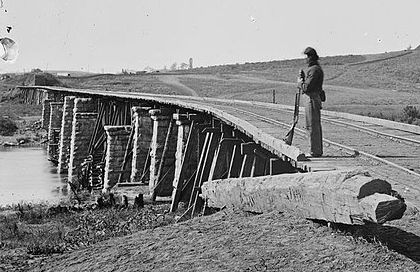
In November 1861, a group of dissidents/Unionists burned several bridges in East Tennessee. They had been told that Federal soldiers were on their way, and by destroying these bridges, the Federal soldiers could quickly capture key points. Unionists in East Tennessee then could mobilize and help hold the area, creating a stumbling block for the new Confederate nation. Of course, we know that it did not work out this way. The bridges were burnt, but regular Federal army forces never materialized (for a variety of reasons).

Reconstructed bridge, Strawberry Plains
While looking for something else (how often does that happen?), I came across a list entitled "List of Political prisoners made in obedience to call of the Confederate Congress" (Found in Louis Brown's book on Salisbury Prison). The list is dated February 17, 1863, and there are 131 names on this list. Among those 131 names are thirteen who are listed as "One of Fry's bridge burners in E. TN." They all have a date of March 22, 1862, which I assume is an incarceration date. 

The majority of the bridge burners that they caught were sent to Greeneville and then on to Alabama. A few were hanged. What are the stories behind these thirteen? Why were they taken to Salisbury? Were they captured in North Carolina? Questions like these just serve to remind me how little we know about some of the aspects of the time period.

Those below are listed as being incarcerated at Salisbury Prison in February 1863, and listed as bridge burners. I assume the county behind the names is the county where they were from. I could list a bevy of questions: who were these men? Where were they captured? Were they tried in a civilian court someplace? What happened to them - did they survive the war?

Beals, J. H. --Greene County
Cogburn, N. J.---Greene County
Collins, Charles--Virginia
Cox, David ---Greene County
Elder, W. R. ---Greene County
Gahayan, ----- Madison County, TN (North Carolina?)
Jones, J. --Hancock Co.
Keller, Wm --Greene County
Kelly, A. ---
Kelly, D. H.--- Greene County
McGee, Lemuel---Greene County
Triplett, William---Greene County

Woolsey, C.---Greene County

Friday, January 27, 2017

Salt

This week, I am writing about the Shelton Laurel Massacre. Traditionally, this story starts with the Unionist-leaning Shelton Laurel people being refused salt from the government for their personal use. This led a group to break into some type of government facility in Marshall and take salt. As with most stories, there is a whole lot more to this one, but that's another post.

Arguably, salt was the most important commodity to rural people across the United States. While it had many uses, the most important would be to preserve hog meat for future use. It took 10 pounds of salt to preserve 100 pounds of pork. If you are feeding a large family, 100 pounds does not go far.
Prior to the war, North Carolina salt came from the coastal area, and from Saltville, Virginia, and appears to be a private venture.

Realizing the importance of salt, North Carolina took steps in late 1861 to ensure domestic supply. On December 6, the North Carolina Convention ratified "An Ordinance in Regards to the Supply of Salt." The state pledged at least $100,000 to the manufacture of salt on the along the coast. At the same time, the article stated that Dr. John Milton Worth, brother to future governor Jonathan Worth, was appointed North Carolina Salt Commissioner.

Salt Raid in Florida
An article in the Semi-Weekly Standard, December 18, 1861, made note of "private parties" making salt on Currituck Sound, Bouge Sound, Topsail Sound, in Carolina City, and soon, near Morehead City. It was the editor's suggestion that "farmers should not be hasty in killing pork this season."
The state government set up salt works at in Currituck County but they were lost when Roanoke Island fell in February 1862. There were salt works at Morehead City as well. After the place fell to Union forces in March 1862, the government salt works were moved to Wilmington. In August 1863, the Wilmington Salt Works produced five thousand bushels of salt. The state also chartered the Chatham Salt Mining and Manufacturing Company in 1862. The plans for the Chatham County site were to drill a well. Also in 1862, Governor Clark sent Nicholas Woodfin and George W. Mordecia to Saltville, Virginia, with instructions to negotiate a contract to purchase cast iron pots and enough brine to produce 300,000 bushels of salt per year.

Each county appointed a salt agent. In 1862, the Buncombce County salt agent was John A. Burin. In Forsyth County, E. A. Vogler; T. G. Whitaker, Wake County; W. S. Gunter, Chatham County;
At least in Buncombe, the county was divided into sub-districts, with a sub-agent responsible for the distribution of salt. They were supposed to sell the salt to citizens at cost. It must have been a thankless job. After the war, a citizen in Yancey County complained that they had four different salt agents over the duration of the war.

There were numerous raids and assaults against North Carolina's salt-making industries during the war years. In October 1862, Federals destroyed the salt works at Bogue and Currituck Inlet. In February 1863, the salt works at Wale's Head, Currituck Beach, were destroyed. On Christmas Eve 1863, portions of the 158th New York Infantry and 9th Vermont Infantry, with sailors from the USS Daylight  and Howquah, moved against salt works near Bear Inlet. On April 21, 1864, Federal forces raided the salt works at Masonboro Inlet, near Wilmington.

Probably better known are the raids taking place against Saltville, Virginia, one taking place in October 1864, and another that same December.


The raid on Marshall in January 1863 was supposedly because local residents, who were not pro-Confederate were not getting salt. I wonder, was this Confederate policy, state policy, or simply the policy of the local salt agent in charge of Madison County? 

Wednesday, January 25, 2017

Speaking of 2017

Time to start putting that 2017 calendar together. I am still out stumping the Capitals of the Confederacy/North Carolina as the Last Confederate Capital until late in the year, when the Branch-Lane book will be released. If you are interested in having me coming to speak to your Round Table, SCV Camp, historical society, library, etc., on any of my books, please drop me a line.

February 11-12, Malcom Blue Farm and Battle of Monroe's Crossroads (Weather permitting).

March 13, Mecklenburg Historical  Association, Charlotte

May 8, Raleigh Civil War Round Table

May 16, UDC Greensboro, NC

May 20, North Carolina Civil War Round Table, Durham

June 3, Twin Lakes Retirement Community, Burlington

July 20, SCV Wilson, NC

July 29, Ft. Fisher State Historic Site

October 7, Longstreet Society, Greeneville, TN


October 11, Lynchburg Civil War Round Table, Virginia

Thursday, January 19, 2017

My take on Blood and Fury

Last night was the premiere of the Petersburg episode on Blood and Fury. So how did I become involved? Here's my story.

In May of 2016, I received an email from Randy Chase, a researcher/associate producer with Cream Productions, regarding this new series. Their final episode was going to be, in part, telling the story of the 37th North Carolina Troops and the Petersburg breakthrough on April 2, 1865, and they wanted to know if we could chat. I'm not sure how they got my name. Maybe it was a simple search online, but I'm always happy to talk history, and I do know one or two things about the 37th Regiment.
After a couple of phone calls, I was scheduled to meet the crew in Nashville, or Fredericksburg, or maybe even Washington, D.C. After a few more phone calls and email messages, the crew decided that I was close enough for them to shoot locally while they traveled between Nashville and Fredericksburg. But I had to find a place. The Avery Museum really doesn't have the space needed for the cameras, so I shot a note to a friend about using one of the rooms at Lees-McRae College. We wound up using the Alumni House at Lees-McRae (thanks Michelle Scott!). This all transpired in a frenzied 48-hour period. First, I was on my way to Fredericksburg, then they were coming here, and I had to secure a site: a wee-bit nerve-racking, as you might imagine.

They arrived in Banner Elk before I did, and I discovered that they had moved every bit of furniture in the room we were using. That made me a wee-bit nervous as well. We were the guest of my friend and the college. They had promised to put everything back.

It took about an hour for them to finish setting everything up, and in that time, we conversed freely. When it came time for the interview, I was in front of the bright lights for at least three hours while they fired off question after question. I guess, after spending twenty years studying the 37th Regiment and the Branch-Lane brigade, I was as ready as a person could be. Needless to say, I had to come home and take a nap after that grilling. And yes, they got everything put back in the room, and Michelle was delighted with how it looked!

It always makes me nervous when I am interviewed for something. This was not my first "rodeo," of course. I've been on TV before, on the radio, and interviewed several times. But still, when the final product is released, I'm always wondering what they used, how did I come across, (did I really say that?), and hoping I didn't look odd (dang my beard is getting gray!).

My take on the episode? Yes, they could have used a better wardrobe department, and yes, they needed some skilled interpreters/reenactors. Why was Nicholson in a cavalry uniform? To be honest, I would have preferred the story of Lt. Octavius Wiggins to Capt. William T. Nicholson’s. As the Federals came over the works, Wiggins was shot in the face, blinded, knocked unconscious by the concussion, and captured. He survived, and his fellow prisoners of war picked the grains of black powder out of his face. On the train ride to Johnson's Island, Wiggins jumped from the train, surviving the fall. He concealed his identity and worked his way south, only to arrive in Richmond and learn that the war was over. I think that was a better story.


Overall, I think the Petersburg episode was one of the better ones. The overarching mission of the series was to tell some lesser-known stories of the war. I guess that is kind of like my own mission, to research and write the lesser known stories. The role of the 37th North Carolina Troops is just as important as that of any other Tar Heel Regiment (and Confederate, when it comes to it). I'm just glad that I got to tell that story. 

Tuesday, January 17, 2017

Books on North Carolina's Confederate Generals

You've probably figured out that I like lists of books. For several years, I've kept a list of North Carolina counties and their published histories of the War. Well, below is a new list, a list of North Carolina-born general officers of the Confederacy (with one exception). There are several names not on this list, like James H. Lane or William Henry Chase Whiting. They were associated with North Carolina, but came from other states. There are also a couple who are buried in the Tar Heel state but who are not on this list, like William R. Boggs. He came after the war. The only exception that I have made is for Collett Leventhorpe. He was born in England, but when he moved to North Carolina (prior to the war), he never really lived any other place, and is buried in Caldwell County. I have also not included state-appointed generals, like John W. McElroy. These men are only Confederate-appointed generals.

Of the 46 men on this list, 26 have no material published on them, save brief pieces in Warner's Generals in Gray, Powell's Dictionary of North Carolina Biography, or Davis's The Confederate General (6 volumes). Of the 18 who do have biographies, three of those are just sketches, usually presented at a monument dedication or a memorial service. For me, that leaves 16 who have bios. Of that number, six have multiple biographies. Braxton Bragg has eight, William Dorsey Pender, Leonidas Polk, and Stephen Dodson Ramseur have four each, and James Johnston Pettigrew has three. Bryan Grimes had two, and the rest, one each.  

As always, this is a work in progress. If I missed someone, or some book, please let me know. At some point, I will probably update this list to include theses and dissertations, and then maybe articles.

Anderson, George Burgwyn, Brig. Gen.  (1831-1862)
            "A Private" Brigadier-General George Burgwyn Anderson (19--?)
Armistead, Louis Addision, Brig. Gen., (1817-1863)
Baker, Laurence Simmons, Brig. Gen. (1830-1907)
Barringer, Rufus, Brig. Gen. (1821-1895)
            Barringer, Fighting for General Lee (2016)
Barry, John D., Brig. Gen. (1838-1867)
Bragg, Braxton, General (1817-1876)
            Bragg, Braxton Bragg: Military Strategist (1998)
            Hallock, Braxton Bragg and Confederate Defeat, Vol. 2 (1991)
            Hay, Braxton Bragg and the Southern Confederacy (1925)
            Hess, Braxton Bragg: the Most Hated Man of the Confederacy (2016)
            Martin, General Braxton Bragg (2011)
            McWhiney, Braxton Bragg and Confederate Defeat Vol. 1 (1969)
            Seitz, Braxton Bragg, general of the Confederacy (1924)
            Stout, Reminiscences of General Braxton Bragg (1942)
Branch, Lawrence O'B., Brig. Ben. (1820-1862)
Bullock, Robert, Brig. Gen. (1828-1905)
Clingman, Thomas L., Brig. Gen. (1812-1897)
            Jeffrey, Thomas Lanier Clingman: Fire Eater from the Carolina Mountains (1998)
Cox, William R., Brig. Gen. (1832-1919)
            Spruill, A Sketch of the Life and Service of General William Ruffin Cox (1921)
Daniel Junius, Brig. Gen. (1828-1864)
Dockery, Thomas P., Brig. Gen. (1833-1898)
Forney, John H. Maj. Gen. (1829-1902)
            Daugette, The Life of Major General John H. Forney (1925?)
Forney, William H., Brig. Gen. (1823-1894)
Garrott, Isham W., Brig. Gen. (1816-1863)
Gatlin, Richard C., Brig. Gen. (1809-1896)
            Daddis,  Richard C. Gatlin and the Confederate Defense of Eastern North Carolina (2015)
Gilmer, Jeremy F., Maj. Gen. (1818-1883)
Gordon, James B. Brig. Gen. (1822-1864)
            Hartley, Stuart's Tar Heels (1996)
Govan, Daniel C., Brig. Gen. (1829-1911)
Grimes, Bryan, Maj. Gen. (1828-1880)
            Allen, Lee's Last Major General: Bryan Grimes of North Carolina
            Cowper, Extracts of Letters of Maj. Gen Bryan Grimes to his Wife (2014)
Hill, Daniel H., Lt. Gen. (1821-1889)
            Bridges, Lee's Maverick General: Daniel Harvey Hill (1991)
Hoke, Robert F., Maj. Gen. (1837-1912)
            Barefoot, General Robert F. Hoke: Lee's Modest Warrior (1996)
Holmes, Theophilus H., Lt. Gen. (1804-1880)
            Hilderman, Theophilus Hunter Holmes: A North Carolina General in the Civil War (2013)
Johnston, George D. Brig. Gen. (1832-1910)
Johnston, Robert D., Brig. Gen. (1837-1919)
Kirkland, William W., Brig. Gen. (1833-1915)
Leventhorpe, Collett, Brig. Gen. (18815-1889)
            Foley and Cole, Collett Leventhorpe, the English Confederate (2006)
Lewis, William G., Brig. Gen. (1835-1901)
MacRae, William, Brig. Gen. (1834-1882)
Martin, James G., Brig. Gen. (1819-1878)
McNair, Evander, Brig. Gen. (1820-1902)
Pender, William D., Maj. Gen. (1834-1863)
            Hassler, One of Lee's Best Men: The Civil War Letters of Gen. William D. Pender (1999)
            ----The General to His Lady: The Civil War Letters of W. D. Pender to Fanny Pender (1965)
            Longacre, General William Dorsey Pender: A Military Biography (2001)
            Willis, Confederate General William Dorsey Pender: The Hope of Glory (2013)
Pettigrew, James J., Brig. Gen. (1828-1963)
            Bauer, The Long Lost Journal of Confederate General James Johnston Pettigrew (2001)
            Wilson, Carolina Cavalier: Life and Mind of James Johnston Pettigrew (1990)
            Wilson, The Most Promising Man of the South... (1998)
Polk, Leonidas, Lt. Gen. (1806-1864)
            Parks, General Leonidas Polk, CSA (1992)
            Polk, Leonidas Polk; Bishop and General 2 volumes (1915)
            Robbins, The Bishop of the Old South: (2006)
            White, Confederate General Leonidas Polk: Louisiana's Fighting Bishop (2013)
Polk, Lucius E., Brig. Gen. (1833-1892)
Rains, Gabriel J. Brig. Gen. (1803-1881)
Ramseur, Stephen D., Maj. Gen. (1837-1864)
            Cox, Address on the Life and Character of.... Ramseur (1891)
            Gallagher, Stephen Dodson Ramseur: Lee's Gallant General (1995)
            Kundahl, The Bravest of the Brave: The Correspondence of Stephen D. Ramseur (2014)
            Schenck, Sketches of Maj. Gen. Stephen Dodson Ramseur (2015)
Ransom, Matt W., Brig. Gen. (1826-1904)
            Marlow, Matt W. Ransom, Confederate General from North Carolina (1996)
Ransom, Robert, Jr., Maj. Gen. (1828-1892)
Richardson, Robert V., Brig. Gen. (1820-1870)
Roberts, William P., Brig. Gen. (1841-1910)
Scales, Alfred M., Brig. Gen. (1827-1892)
            Conner, Address on Alfred Moore Scales (1907)
Toon, Thomas F., Brig. Gen. (1840-1902)
Ticker, William, Brig. Gen. (1827-1881)
Vance, Robert B., Brig. Gen. (1828-1899)
Wilcox, Cadmus M., Maj. Gen. (1824-1890)

            Patterson, From Blue to Gray (2001) 

Saturday, January 14, 2017

Ft. Fisher anniversary


This weekend, our friends at Ft. Fisher are holding their anniversary events. If you live in the area, please drop in and check out the living histories and special speakers. Two years ago, I was there, with thousands of others, including Ed Bearss and Governor McCory. It was a great event and I really enjoyed being a part of it. Above is the video of my presentation on the 150th anniversary weekend. I'm really looking forward to seeing my spot on Blood and Fury this upcoming Wednesday. At least I will not be in a big thick coat with gloves - kind of cold at Fort Fisher two years ago.

Wednesday, January 11, 2017

Why do people think Zeb Vance was in the Klan?

A couple of months ago, I was reading a new biography on a North Carolina Confederate general. In this book, the author claimed that North Carolina Governor Zebulon Baird Vance was a member of the Klan, eventually elected to "Grand Dragon" of the Realm of North Carolina. That kind of took me aback, and led me to dig a little further.

Most of the entries I found are like this one from Invisible Empire: The Story of the Ku Klux Klan, 1866-1871, by Stanley Fitzgerald Horn in 1969: "Ex-Governor Zebulon Baird Vance was generally supposed to be the Grand Dragon of the Realm; and the testimony of the confessed Ku Klux was to the effect that within the Klan Vance was generally looked upon as the chief of state." (194) Horn, however, gives us no source for his vague notion regarding Vance's involvement. It is quite possible that Horn got his idea about Vance's involvement from a 1924 book by Susan Lawrence Davis. She writes in Authentic History Ku Klux Klan, 1865-1877 that "The Ku Klux Klan, led by Zebulon B. Vance, Grand Dragon of the Realm of North Carolina, succeeded in driving from their soil the 'carpet-bagger' and all other kinds of invaders, and impeached W. W. Holden from the office of Governor." (236) Once again, no documentation. But the words "Realm of North Carolina" appear in all three works. I dug a little further, but I found no reference to Vance and the Klan prior to 1926. I did finds lots of references to Vance being in the Klan referencing Davis or Horn.

Maybe this all stems from a letter that appears in the Testimony Taken by the Joint Select Committee to Inquire into the Condition of Affairs in the Late Insurrectionary States, Volume 2 (1872). Thomas A. Hope, from Lincoln County in an affidavit, stated that he had "frequently heard it talked among the members that Z. B. Vance was the chief of the State; do not know this of my own knowledge, have only heard it talked of." (400) This was the only mention of Vance I could find. Vance was not called to testify.

So what do the Vance biographers say about the matter? Dowd, published in 1897, is silent on the matter. Weinstein's Zebulon B. Vance and The Scattered Nation makes no mention. Cooper's Zeb Vance: Leader in War and Peace makes no mention.

Gordon McKinney in his 2004 biography on Vance, does discuss Reconstruction-era Klan violence and Zeb Vance. In 1870, when word arrived in Raleigh of outrages committed in Orange County, Vance issued this statement: "I opposed the Ku Klux from the start[.] Refusing to have anything to do with such an organization on the grounds that it was a secret society... I not only refused to approve of it but made a speech in a certain county against such organizations." (287-288)

I checked several other sources, and looked for references to Vance in various US Congressional documents related to the Klan, but I could never find Vance's name. It is interesting to note that Milton Ready, a retired UNC-Asheville history professor, came to the conclusion in an article in 2015 in MountainXpress, that Vance "loathed the Reconstruction-era Ku Klux Klan, condemning its members as cowards and 'ruffians,' its intimidating methods as unlawful."


Maybe, just maybe, it is time to stop putting Vance in the Klan since he was probably never involved with it in the first place.

Saturday, January 07, 2017

Charlotte and Stonewall Jackson's LeMat

   In the January issue of America's Civil War, there is an interesting piece on the LeMat revolvers, written by Michael G. Williams. The LeMats are fairly rare nine-shot .42 caliber revolvers that also had a small 20-guage shotgun barrel underneath. Imported during the war, they were owned by the likes of J.E.B. Stuart, Braxton Bragg, Richard H. Anderson, and P. G. T. Beauguard (Serial #8). The article has a sidebar about Stonewall Jackson's LeMat. But as the sidebar states, we don't actually have any proof that Jackson owned a LeMat. Maybe J.E.B. Stuart gave him one, about the same time that he presented him with a new coat, right before Chancellorsville.

The article includes a picture from the collection of the Virginia Military Institute. The photo is of a sitting room or parlor at the home of Mary Anna Morrison Jackson, taken in Charlotte, North Carolina. Mary Anna was from the area and lived in Charlotte twice after the war (she died there on March 24, 1915). In post-war newspaper accounts, she is frequently mentioned exhibiting some of Stonewall's personal effects. A visitor coming to the annual bazaar held each January to raise money for indigent Confederate soldiers could see Jackson's sword and other mementos.  When the national reunion of the United Confederate Veterans was held in Charlotte in 1929, visitors could stop by the home of Jackson's granddaughter and see these same relics.

Pictured in the image are a clock, field classes, epaulettes, sword, and two pistols. One pistol is identified as a British Tranter. The other bears striking resemblance to a LeMat, with its shotgun barrel under the main barrel, ornate trigger guard, lanyard, and "subtle slope atop the gun's frame..." Williams poses the question: "If Jackson owned a LeMat, where is it?"

Jackson's cased Beaumont-Adams revolver, his Lefaucheaux pin-fired revolver, field glasses, and Model 1850 US Field and Staff sword are all held at the former Museum of the Confederacy in Richmond. But where is Jackson's LeMat?

Is this Jackson's LeMat? (VMI/America's Civil War)


As a side note, Williams describes the  sitting room as being in Jackson's former home in Charlotte; however, Jackson never actually lived in the home where Mary Anna resided after his death.

Tuesday, January 03, 2017

Calling for North Carolina's Troops

Leroy Pope Walker,
Confederacy Secretary of War
For the past few days, I've been reading Denis Peterson's Confederate Cabinet Departments and Secretaries (2016). Peterson does a good job detailing the various cabinet officers’ positions, and covering the men who filled those offices. There were several of these men about whom I really did not know much. However, I have now twice come across sections that I feel are wrong. The first was dealing with the last days of the Confederate government in Charlotte. I will not go into the details, since I have written two books on the subject.

The second deals with this statement: "After the Confederate peace commission failed to convince Lincoln to negotiate and in preparation for possible conflict over the fort [Sumter], Walker called on each of the seven states that made up the original Confederacy to supply 3,000 volunteers to meet any military necessity, for a total of 21,000..... Walker immediately ran up against the doctrine of states' rights. Each state wanted its troops to defend their own state... North Carolina's concerns were Forts Hatteras and Clark. Those states did not like the idea of having their troops sent to defend other states." (134)

Two things I see wrong here. 1): North Carolina was not one of the original seven seceding states. It was the last, not leaving the Union until May 20, 1861. The earliest call for troops that I can find is on March 9, 1861. Walker asked for troops from Alabama, Florida, Mississippi, Louisiana, and Georgia (No South Carolina. See Official Records, Series IV, vol. 1, 135). Walker made a second call for troops on April 16, 1861, this time mentioning the states of Alabama, Florida, Georgia, Louisiana, Mississippi South Carolina, Texas, and Florida. There is no mention of North Carolina, Virginia, Tennessee, or Arkansas - they had not left the Union! (Official Records, Series IV, vol. 1, 221-222.)

2): Peterson writes that North Carolina could not send troops because they were concerned with Forts Hatteras and Clark. Construction of these facilities does not begin until North Carolina leaves the Union on May 20, 1861. But, North Carolina is sending troops. On May 17, 1861 (three days before secession), Governor Clark telegraphs Walker, requesting him to accept four regiments of 12-month men. Walker sends word back to Clark, directing that the regiments be sent to Richmond. The 1st North Carolina Volunteers transfers to Virginia between May 16 and May 21. The 2nd North Carolina Volunteers leaves for Richmond on May 22, 1861, the 3rd North Carolina Volunteers leaves for Suffolk, Virginia, on May 29, and the 4th North Carolina Volunteers leaves for Suffolk on June 11. This is all about the same time that the construction of Forts Hatters and Clark begins. While North Carolina would want some of these troops back to defend their state in late 1861 and early 1862 (battle of New Bern), I would argue that the Tar Heel state does not have a problem sending troops to join the regular Confederate army.

I'm not one-hundred percent sure, but I think Peterson is relying upon some older, secondary sources. For the Charlotte problems, he cites Patrick's Jefferson Davis and His General, published in 1944. For the above citation, it is Harris's bio on Walker, published in 1962.


No printed text is perfect, or, as I often say, I am only as good as the material that I find. However, it makes me wonder what I am not catching, because I am not as well read in the lives of people like Walker, or Reagan, or Benjamin. 

Friday, December 09, 2016

Lincoln had a what?

Have you ever been reading something and a word or two, or a sentence, kind of pops out at you? That was me a couple a days ago. I was reading Glenn LaFantasie's "The Paradox of the Gettysburg Address" in the Summer 2013 issue of Civil War Monitor. LaFantasie writes, in reference to the
Gettysburg Address, "None of Lincoln's other speeches--either as president or in his long political career leading up to the election of 1860--leaves more frustratingly inconsistent evidence than the Gettysburg Address." Lincoln had a long political career? I guess if you count when he first entered office, it was long, but not really.

Ok, Lincoln's political career was longer than Washington's and Trump's, and about the same length's as Obama's, but he had not actually been elected to hold any state or national office since 1849. From 1834 to 1842, Lincoln had served in the Illinois House of Representatives, and from 1847 to 1849, in the United States House, but that was it. Ten years, eight of which on the state level. He actually had a longer list of political failures. Lincoln was defeated for the State Legislature in 1832, lost a bid to become speaker of the State House in 1838, lost a nomination for Congress in 1843, was not re-nominated in 1848, defeated for the US Senate in 1854, lost a nomination for Vice President in 1856, and was defeated again for the US Senate in 1858.

For me, a long political career might be someone like Andrew Johnson. Born in North Carolina (see, I worked it in), He had moved to Tennessee as a young man. Prior to being elected Vice-President of the United States in 1864, Johnson had served in the United States House (1843-1853), as the governor of Tennessee (1853-1857), in the United States Senate (1857-1862), and as military governor of Tennessee (1862-1865). That's twenty-two years of public service.

Jefferson David
How about John Bell, also from Tennessee and who was running against Lincoln on the Constitutional Union Party ticket in 1860? He had years of political experience behind him: Tennessee Senate (1817-1819); United States House (1827-1841, speaker 1834-1835); Secretary of War (1841); United States Senate (1847-1859). That's thirty-two years of public service.

How about Jefferson Davis? Davis had served in the United States House (1845-1846); in the United States Senate (1847-1851); as Secretary of War (1853-1857); and then back in the United States Senate (1857-1861). That's sixteen years.

In my opinion, Lincoln was not a long serving political figure. He'd didn't have the experience to back up the job he got. Why else put someone like Simon Cameron in as Secretary of War (Lincoln didn't believe there would be a war - see new Cameron biography). After Lincoln fired George B. McClellan as general-in-chief, Lincoln formed a "War Board" to govern the movements of Federal armies. Lincoln later admitted he didn't have a clue as to what he was doing, and Henry Halleck was brought in as General-in-Chief in late July 1862.

I don't think Lincoln was a long-serving politician and I'll even go a little further: I believe Lincoln's lack of political experience really hurt the country and helped propel us into civil war. You might disagree with my assessment, and that is ok. That's just what my years of reading and research has led me to believe.

If you want to discuss something, how about this: what if Lincoln had failed to win the Republican nomination in May 1860? What if it had gone to Sen. William H. Seward, who won the first and second ballots? Had Seward won the nomination, would he have carried the election? Would South Carolina still vote to leave the Union?  These are questions we can never truly answer, but they are interesting to ponder!

Wednesday, November 30, 2016

Best book I've read this year - The Yankee Plague.

It should not come as any surprise, but I read lots of books every year. They are for research, for reviews, even for fun. A couple of weeks ago, I picked up Lorien Foote's The Yankee Plague: Escaped Union Prisoners and the Collapse of the Confederacy. This is the best book I have read in 2016.

The Yankee Plague focuses on the last few months of the war - from September 1864 until the end - and documents how escaped Federal prisoners of war, largely from South Carolina, changed the war in both of the Carolinas. No longer was there a home front. The escaped Union POWs, along with those who helped them and hunted them, collectively made the area a new front of a multi-faceted war. Thanks to a bevy of writers, some publishing  their accounts while events were still fresh in their minds, Foote examines men who managed to escape Confederate prisoner camps. Some made their way toward Georgia, trying to link up with elements of Sherman'a army. Others tried to make for the coast, while others still thought the best course was to walk toward the mountains, heading to Knoxville and Federal lines. Foote bounces between different accounts as the men moved in parties, seeking freedom. She also chronicles the people they ran into: slaves wanting to aid the prisoners' plight toward freedom and that third group of people - those who were using the war for their own unjust gains. Toward the end of the tome, she describes how the remaining prisoners from South Carolina held up not only the evacuation of Wilmington and the retreat of Robert F. Hoke's Confederates, but also delayed supplies in reaching Sherman's army as it entered the Tar Heel state.
Foote's narrative is compelling and her prose is clean and fresh. There are numerous primary sources, largely the prisoners' own accounts, coupled with statements from the rarely cited Record Groups 249 and 393 (National Archives).

To me the only draw back is the lack of a mention of Brig. Gen. John W. McElroy, in charge of home guard battalions in western North Carolina. It was his job to coordinate the home guard attempting to coral the prisoners, draft dodgers, and deserters. It might have also been nice to have a little more on the guides these POWs sought out to help them in their quest for freedom.


Overall, this is a fantastic read that greatly increases our understanding of the war in its final months, especially in western North Carolina. 

Tuesday, November 22, 2016

Looking for 60

In June 1864, Capt. George W. Kirk led a raid from East Tennessee into Western North Carolina. Kirk surrounded and captured Camp Vance near Morganton, capturing around 300 junior reserves. On his return trip, he fought several skirmishes with home guard units, and burned several homes. Various Northern newspapers reported that Kirk captured 30 (and sometimes 60) "negroes," presumably local slaves. (see Burlington Weekly Hawk-Eye, July 23, 1864)

After tramping back through the mountains, Kirk took his prisoners to Knoxville. The 60 presumably local slaves were said to be enrolling in a local Colored Regiment. The regiment forming in Knoxville at this time was the 1st United States Colored Heavy Artillery. They were recruited to guard railroads and stores and prisoners in East Tennessee, freeing up white soldiers for front line actions. The only time I can find the 1st USCHA moving together as a regiment is during Stoneman's Raid.

To my knowledge, no one has ever looked for these 60 men who were abducted, or maybe "liberated" by Kirk during this raid, and joined the 1st USCHA. So, I did just that. The compiled service records of the 1st USCHA are online, and went through them, trying to pick out these men. I was hoping that once I did, I could go to their pension applications and find details about their enlistment in the United States Army.

My first clue was a letter in a newspaper, dated July 7, 1864, stating that the prisoners were back in Knoxville, and that the (presumed) slaves were joining a local regiment. So I had a date to work with. As I went through the compiled service records, I found 26 men who enlisted July 6-8, 1864. Fourteen were from North Carolina or Tennessee, from counties that Kirk passed through on his raid. But one of the challenges were the other 12. Thorton Coleman and William Coleman enlisted on July 6 and July 7, 1864. Both were from Richmond, Virginia. Were they brothers? Had they been sold to a slave owner in western North Carolina? Or, maybe brought with someone, sent further South where they had some degree of protection from (yankees), or even rented out. Part of the problem is that the compiled service records tell me where they were born, not where they were living in July 1864.
I thought, after I finished compiling a list of names, I could look for pension applications in the pension index on Fold3.com Then, I could make a decision about a quick trip to the archive in DC to look for other pieces of their story. But alas, the company of the 1st USCHA that I needed has not been digitized.

Of my list of 26, I can find two, George Forney, who was 20 years old in 1864, and Shaesser (Sharp) Caldwell , who was 25 when he enlisted, who appear back in Burke County in the 1890 Veterans Census. I am still looking for the others.


To be honest, I may never find "the rest of the story." But if just one of them left an account of how they were spirited across the mountains and given a chance to join the Union army after Kirk's raid on Camp Vance, then it will be worth the hunt. Heck, I've already gone further than anyone else with this story. I have a list of names, names of men nearly everyone else has forgotten.

1st US Colored Heavy Artillery on parade in Knoxville, TN. 

Wednesday, November 16, 2016

Lockville and the War.

Kevin Stone asked the other day about the Lockville and Haywood communities in Chatham County during the War. Let's look at Lockville.

Lockville was originally known as Ramsey's Mill. There was a mill, dam, ferry boat, and landing. In the 1850s, owner Alston Jones worked out a deal with the Cape Fear and Deep River Navigation Company. The Company came in and raised the height of the dam from six to eight feet, and converted the millrace into a canal that made navigation possible over Pullen's Falls. This was apparently completed in 1859, although the War brought work to a halt and backrupted the Company. It is probable that the name "Lockville" referred to the locks on the river, used to float boats up and down near the falls.

There are a few mentions of Lockville in period newspapers. In March 1861, it was announced that the steamer John Dawson had been purchased to haul freight from Wilmington to Lockville (The Daily Journal March 25, 1861). It appears that the canal was the primary way to haul coal from the Egypt Coal Mine to Wilmington.  Even though it was chartered in 1855, a railroad to the area was almost finished by the time Sherman arrived in 1865.

The Lockville Mining and Manufacturing Company incorporated in 1863 and was located in the area; this was a company that purchased the Endor Iron Works in 1864. An ad in the January 7, 1864, edition of The Daily Progress, announced that the company was looking for miners to work in the cooper deposits.

In 1865, Reese H. Butler, at one time a machinist working for Spiller and Burr, but later at the Raleigh Bayonet Factory (Heck, Brodie & Co.), was building "an extensive foundry and machine shop" near Lockville. (Norman, 59)

The final time Lockville appears in war-time newspapers occurs on Mach 28, 1865. W. S. Downer, superintendent of the Lockville Mining Company, had either been to Fayetteville, or talked to someone in Fayetteville. The letter, dated March 17, 1865, read in part: "Fayetteville is ruined. All the Arsenal buildings, the Market House, Court House, printing Office, both Foundries, all the Mills, Cotton Factories, Oil Works, &c., were destroyed. They robbed the people of everything in the way of food..." (Raleigh Conservative).

I could find no mention of a Civil War Trail marker, or a North Carolina Highway Historical Marker in the area.  (There is a marker for the Egypt Coal Mine in neighboring Lee County.)
Lockville, from a 1870 map.

Monday, November 07, 2016

Interview me, Round 1:

Last week, I posted that it was my tenth anniversary as a blogger. As part of my "celebration," I asked a few friends to interview me. Here are a few of their questions (there will be more):

Joe Owens: What NC regiment do you consider displaying the most courage overall in a battle? The 26th NC at Gettysburg? Second question, have you thought about writing a book about a NC Revolutionary War Regiment, or maybe a battle in NC during the Revolutionary War?

Thanks Joe! I think it took a lot of courage for any soldier to stand in battle. Early in the war, they squared off face to face, like the 5th North Carolina at Williamsburg or the 26th Regiment at Gettysburg. That took a serious amount of fortitude. Late in the War, the Confederates were often protected by breastworks, but when they did attack, like the 60th Regiment during the Nashville Campaign, that took real courage. Was one regiment better than the others? No... probably not. They were all pretty tough.

Have I ever thought about writing on a Revolutionary War regiment or battle? There are a few people I find interesting from that time period whom I might write about, but not really any regiments or battles. It has taken me thirty years of reading and researching (and some reenacting/interpretive work) for me to feel confident about what I want to write about (mid-19th century). I'm not sure how many years it might take for me to feel confident enough to change time periods.


Chris: Kolakoski: Wow! Congrats on 10 years! Here's a question: What do you consider to be the essential elements of your research and writing process?

Thanks Chris! Hard to believe it has been 10 years! Hands down, I think the essential element in research is the internet. When I started researching that first book twenty years ago, I used the net to find snail mail addresses to write archives, looking for original source materials. I think I did ok. When Bob Krick reviewed the book, he said that I left "no stone unturned." That has kind of been my "motto" ever since. In many ways, it is so much easier now. The Confederate Compiled Service Records are online, the Official Records are online, Confederate Veterans and the Southern Historical Society Papers are online. Plus, there are millions of pages of newspapers online (and searchable, if you can figure out how someone spelled something). Plus, through several sources, I can search books that I would not have access to. I still use traditional libraries and archives. I still go to the family history section or the local genealogical society newsletters and flip through those books, looking for original letters. But all of the online resources allow me to look at thousands of pages of original material from my home office. And I think I find more stuff now; I have the time to be through since I'm not worried about parking meters or the library closing.


Wade Sokolosky: What aspect of NC CW history do you feel is the least understood or requires further research?

Thanks Wade! I'm really enjoying your new blog. My shelves, like many others, groan under the weight of books about the time period. There are scholarly tomes on the social side of the conflict. Many of the battles have fresh views from a talented array of military historians, and there always seem to be new biographies on the major military and political actors. But at the same time, the general public cries out for books about the places they live in and call home. I think local communities need more histories, as well as some of the minor players, both military and political. It seems we keep rehashing the same old things. There are a half dozen books on Greensboro and the War, but none on Raleigh.


Sam Shapiro asked a couple of good questions. The one about the battle of Wyse Fork I'll get to in another post. His second question was: "How many important battle sites are inaccessible to the public, due to the fact that the sites are on privately owned grounds? And do situations like that ever become contentious? Have there been legal battles to make the sites publicly owned? Isn't part of the Gettysburg Battleground still inaccessible for this reason?"

I guess we need to define "important battle sites." There are some battlefields that are lost - Battery Wagner off the Charleston coast (washed into the sea), while Atlanta and Chantilly have been gobbled up by development. Yet thanks to organizations like the Civil War Trust and various local groups, thousands of acres of battlefields at the major or important sites have been preserved over the past two decades. For example, in 2002 and 2003, the Bentonville Battlefield was identified in the Civil War Trust's annual report History Under Siege as a battlefield that needed to be preserved. Since that time, an additional 1,785 acres, bring the total preserved acreage to 2,100 acres. And the Civil War Trust is currently trying to acquire an additional 503 acres. Now, there are a lot of battlefield properties still in private hands. I wrote a history of the May 1862 battle of Hanover Court House many years ago. Every bit of that battlefield is private. And the owners really don't like having people wondering around their homes at all hours. You ask "do situations like that ever become contentious?" I've come close to being arrested for trespassing a time or two. Legal battles? Yes, but usually in the form of some large corporation buying a tract of battlefield land with plans to build a subdivision, or amusement park, or Walmart on the property. Then, the preservation community usually steps up and puts pressure on the corporation to sell the land. The private entities, like the Civil War Trust, that buy the land try and work hard to build good relationships with private land owners. The corporations can always pay more. The preserved land at Gettysburg has grown significantly over the past decade. One prime example is Lee's Headquarters, which just opened to the public last week. The Civil War Trust purchased the property, tore down the hotel, and restored the original house.