NEW BERN – Bernard George dons the blue wool uniform of a U.S. Colored Troops Civil War soldier for re-enactments at historic sites and other venues. June 19th has become an unofficial holiday for many African Americans. On that date in 1865 in Texas , supposedly the last slaves learned the Civil War was over and that they were free. George celebrates the role of African Americans in claiming their freedom every day.
A member of the N.C. African American Heritage Commission (AAHC), New Bern Historical Society, NAACP, and other historical and community groups, George travels the state and eastern U.S. on a mission of education as a Civil War re-enactor. He is one of 10 AAHC commissioners. See
http://news.ncdcr.gov/2011/02/11/african-american-heritage-commission-making-history/ and http://www.youtube.com/watch?v=enDULkLaz-I
“We are always the most photographed group at re-enactments; it’s such a well-hidden story of U.S. Colored Troops and sailors during the Civil War,” he observes.
Re-enactors can give a reality to history that the written word can’t, explains Dr. Jeffrey Crow, deputy secretary of the N.C. Department of Cultural Resources and co-author of “A History of African Americans in North Carolina .”
“The im media cy of another living person representing an earlier time allows pe opl e to connect in a way that they can’t with books,” Crow continues. “That is even truer when the recorded history is limited or misunderstood.”
George re-enacts as a member of the N.C. Colored Volunteers, a group recruited in New Bern and part of the First African Brigade. When not re-enacting he is a city planner for New Bern , local historian and community volunteer. As a member of the AAHC, he can help ensure that African American history and culture are appreciated across the state.
The commission’s mission is to preserve, protect and promote North Carolina ’s African American arts, history and culture for all pe opl e. The 2011 Summer Teacher Institute at the N.C. Museum of History will focus use of primary sources to explore African American life and culture, and is being partially supported by the AAHC. For George, interest in this history was stoked years ago.
“My grandfather told me when I was a young boy that his grandfather was a soldier. His grandfather fought for the Union ,” George explains. “I was concerned that this was contradictory to what I had learned in history. But when I went off to college I learned there was a cornucopia of experiences of African Americans during the Civil War.”
Through oral history from his grandfather and father, George learned that his family was free and had come from the Tidewater Virginia area to New Bern about 300 years ago. Documents from the 1700s at the Craven County courthouse further substantiate this history, along with family records. He notes that free blacks in North Carolina were the thesis subject for the eminent historian, John Hope Franklin.
As a Civil War re-enactor, George finds many adults do not know the story of blacks fighting for their freedom in the war and during Reconstruction. Blacks and whites are interested in finding out more at programs at state historic sites or other venues. He says African Americans are particularly drawn to the re-enactors, because most Civil War re-enactors are usually white. When visitors see the U.S. Colored Troops re-enactors, they go home and tell their family and friends and so educate others.
“It is important to talk with and re-educate pe opl e,” George continues. “As more historical research and study is done, we are shifting the paradigm and a more complete truth of American history will be known.”
So whether at a Juneteenth program in Jacksonville on June 18, or at the Martin Luther King, Jr. National Memorial dedication on Aug. 28 in Washington, D.C., George will be upholding the African American Heritage Commission ideal and his own, by protecting and promoting African American history for all people.
The African American Heritage Commission was created by the North Carolina General Assembly to assist the secretary of the N.C. Department of Cultural Resources in the preservation, interpretation and promotion of African American history, arts and culture. The Division of State Historic Sites and the Division of State History Museums are within the Department of Cultural Resources, the state agency dedicated to the promotion and protection of North Carolina ’s arts, history and culture, with info rmation about the Department of Cultural Resources at http://www.ncculture.com/
Wednesday, June 15, 2011

Tuesday, June 14, 2011
On the Road
On the road this week – tonight (June 14), I’ll be speaking and signing books for the Frazier Camp of the Sons of Confederate Veterans. They meet at the Women’s Club of High Point on Johnson Street. The program starts at 7:00 pm, and I am sure everyone is welcome.
On Thursday, June 16, I’ll be leading the discussion at the Avery County and the Civil War Round Table. We’ll meet at the Avery-Morrison Public Library at 6:30 pm. Everyone is welcome, and the event is free.
On Saturday, June 18, I’ll be speaking at the Douglasville Baptist Temple in Douglasville, Georgia. Dinner is at noon, and I’m scheduled to speak at 3:00 pm.
I hope to see you around.
Monday, June 13, 2011
Thoughts on Reidsville’s Confederate Monument…
Lately, I’ve been watching with interest the debate regarding the Confederate monument in Reidsville, NC . First, a little background:
The Confederate monument in Reidsville was the work of the Rockingham Chapter of the United Daughters of the Confederacy. According to sources, about 7,000 men, women, and children gathered on June 29, 1910, to unveil the monument.
“The procession, which was a large one, was headed by a brass band of the city, carriages draped in Southern colors, the local military, Daughters of the Confederacy, and Junior and Children Chapters…. After the singing of “America,” Hon. H. R. Scott made a historical address, showing much research, and in conclusion presented the monument to the city in well-chosen words… Mayor Francis Womack accepted the handsome gift for the city, and Mr. E. R. Harris spoke the acceptance for the Scales-Boyd Camp. After the applause from the speeches subsided, Mrs. F. M. Williams, State President, assisted by Mrs. E. R. Harris and Mrs. G. L. Irvin, President and Vice President of the Rockingham Chapter, drew the cord, and the beautiful monument stood revealed. The rope used in the unveiling had been used at the monument at Gettysburg.
“Hon. Cyrus B. Watson was the orator of the occasion, and his speech abounded in beautiful tributes to the gallant men of Rockingham County who had bravely fought in many battles, and the heroes who fell were ‘wreathed around in glory’ through the noble words spoken in the honor…
“The monument is a granite shaft surmounted by a private in the Confederate uniform leaning on his gun….”
Of course, as many of you know, on May 23, a Greensboro man hit the monument, knocking the soldier off and destroying him. The Rockingham City Council is presently looking into whether it will replace the monument, move the monument, or use this as a opportunity to totally erase the monument from the public sphere.
And of course, the news media was quick to jump on the bandwagon. GoDanRiver.com ran a piece under the title: “History of Racism? Debate Continues in Reidsville” On reading this article, one would get the impression that the majority of people who attended the recent council meeting were against the statue being rebuilt. Another source I read (written by someone in attendance) stated that of the 35 people who spoke, 20 were in favor of rebuilding the statue, two were in favor of restoring it and moving it, and two were more concerned over tax payer’s dollars. So, that would leave six speakers not in favor of returning the statue. You will not get that sense of community support from the GoDanRiver article, which you can read here.
My two cents worth? Put the monument back as it was, at the expense of the driver. It should be a crime to do otherwise.
“True as the Steel of their Tried Blades: Heroes in Heart and Hand, They Fought Like Brave Men, Long and Well” – inscription Reidsville Confederate Monument.
Thursday, June 09, 2011
HISTORIAN RE-EXAMINES NUMBER OF DEATHS OF STATE’S CIVIL WAR SOLDIERS
New research reveals surprising findings about the number of North Carolina soldiers who died during the Civil War. Josh Howard, Research Historian at the N.C. Office of Archives and History, has spent more than a year spearheading the North Carolina Civil War Death Study. The project has uncovered information that changes long-standing figures about the state’s losses. Virginia , South Carolina and Ohio are conducting similar research.
Howard will highlight his investigations and share stories he has discovered during History à la Carte: Recounting Civil War Sacrifices on Wednesday, July 27, at 12:10 p.m. at the N.C. Museum of History in Raleigh . He will explain how he researches the topic and will discuss some of the soldiers’ unusual experiences. Admission is free. Bring your lunch; beverages are free.
Howard has painstakingly examined not only official military records, but records from hospitals, cemeteries, churches, prisoner-of-war camps, pensions and more. He has combed through archival and newspaper accounts, diaries, census data and other sources to try to determine military deaths among North Carolina Confederate and Union units.
Howard notes that traditional accounts of Tar Heel deaths did not include the approximately 2,000 African American and white North Carolinians who died serving in the Union army.
Drop by the Museum of History and hear more during this informative lunchtime lecture on July 27.
For more information call 919-807-7900 or go to ncmuseumofhistory.org or Facebook. The museum is located at 5 E. Edenton Street , across from the State Capitol. Parking is available in the lot across Wilmington Street .
# # #
Museum hours are Monday through Saturday, 9 a.m. to 5 p.m., and Sunday, noon to 5 p.m. The Museum of History , within the Division of State History Museums, is part of the N.C. Department of Cultural Resources, the state agency with the mission to enrich lives and communities, and the vision to harness the state’s cultural resources to build North Carolina ’s social, cultural and economic future. Information is available 24/7 at http://www.ncculture.com/.
Tuesday, June 07, 2011
What is a Confederate Monument?
At the North Carolina Civil War Symposium in Raleigh a couple of weeks ago, someone brought up a really good question – what is a Confederate Monument? Of course, the answer to part of this question is easy: the monuments on the grounds of various courthouse or in various cemeteries across our fair state are for certain Confederate Monuments Who can look at the monument on the statehouse grounds in Raleigh, or the courthouse grounds in Burke, and say that these are not Confederate monuments?
Personally, my definition would be this: a monument, or plaque, erected by the veterans themselves, or by an auxiliary group, like a Ladies Memorial Association, United Daughters of the Confederacy chapter, of Sons of Confederate Veterans camp, that denote some event, or a group of people, that played a part in the Civil War.
However, there are some monuments across the state that do not easily fit into this definition. Take for instance the monuments to Zebulon Baird Vance. There are three that I count: the obelisk at Pack Square in Asheville; the monument on the grounds of the state capital in Raleigh; and, the monument in Statuary Hall in Washington, D. C. Of course, Vance is one of our most famous Confederates, serving as colonel of the 26th North Carolina Troops, and governor from 1862-1865. But Vance’s history goes further. He was elected a Congressman prior to the war, as governor after the war, and finally to the United States Senate. Vance’s monument in Asheville was erected by the Vance Memorial Association, which might have been composed of veterans, but was not a veterans organization per se. Of course, when it came time for the dedication, Vance’s role in the war was prominent in the speech. The Veterans themselves, both blue and gray, marched in the parade, and each year since, the local UDC Chapter, along with B’nai B’rith, placed a wreath on the monument on May 10, Confederate Memorial Day. Even one of the local newspapers, the Mountain Express, considered in 2003 the Vance memorial “a shrine to the Civil War-era governor…” While it has been a while since I’ve been in Pack Square (maybe a decade), I don’t recall anything that actually speaks about Vance’s service ( please correct me if I am wrong).
How about Vance’s statue at the US Capital in Washington, D.C.? Is that a Confederate monument? Nothing on it denotes his service to the Confederacy. Yet, Vance is one of our most famous Confederates, and has more written about him than any other war-time Southern governor.
There are others. In Charlotte, there used to be a monumental arch marking the birthplace of Mrs. Stonewall Jackson. The monument was erected by the Stonewall Jackson Chapter of the United Daughters of the Confederacy in October 1915. This monument was later torn down.
How about the monument that the UDC erected in 1926 in Concord to the KKK? The inscription read: “In Commemoration of the ‘Ku Klux Klan’ during the Reconstruction period following the ‘War Between the States’ this marker is placed on their assembly grounds. The original Banner (as above) was made in Cabarrus County.” (I do not know if this monument still exists.) Is this a Confederate monument?
Or, are the dozen or so markers that mark the Dixie Highway and the Jefferson Davis Highway, Confederate markers? If you ask the people in Marshall in Madison County if they have a Confederate Monument, they would probably say yes. There, on the walkway to the courthouse is a rock with a plaque with Robert E. Lee sitting on it. Yet this “monument” marks a road, not local Confederate soldiers or even the famed Confederate leader.
In the end, I do believe that the Vance Statues and Monuments are Confederate monuments, but not the Arch to Mrs. Jackson or the KKK marker in Cabarrus County. I’m still mulling over the highway markers.
What do you think?
Monday, June 06, 2011
Public Libraries of Johnston and Rowan Counties Will Display
Public Libraries of Johnston and Rowan Counties Will Display
“Freedom, Sacrifice, Memory” Civil War Photo Exhibit in June
RALEIGH – Destruction was felt around homes and communities as backyards were turned into battlefields in North Carolina during the Civil War (1861-1865). Widespread suffering impacted all North Carolinians regardless of race, class and gender.
The involvement of Confederate soldiers, African Americans and women is depicted in the Freedom, Sacrifice, Memory: Civil War Sesquicentennial Photography Exhibit (www.nccivilwar150.com), which will visit the Public Library of Johnston County and Smithfield June 1-29 and the Rowan Public Library in Salisbury June 2-29.
“The Civil War was the first war widely covered with photography,” explains Deputy Secretary Dr. Jeffrey Crow of the North Carolina Department of Cultural Resources. “The Freedom, Sacrifice, Memory exhibit provides images of historic figures, artifacts, and documents that brought the reality of the war from the battlefront to the home front, then and now.”
The exhibit will honor North Carolinians and their dedication throughout the Civil War with images gathered from the State Archives (www.archives.ncdcr.gov), the N.C. Museum of History (www.ncmuseumofhistory.org), and State Historic Sites (www.nchistoricsites.org). A total of 24 images is being displayed by the N.C. Department of Cultural Resources (www.ncculture.com) in 50 libraries and four museums throughout the state on eastern and western routes from April 2011 through May 2013. A notebook will accompany the exhibit with further info rmation and also seeking viewer comments.
The collection depicts those involved in the war including images of artifacts and official documents. Amy Harper of Johnston County is one woman highlighted in the exhibit who exemplifies the sacrifice of women and families. The home of Amy Harper served as a field hospital during the Battle of Bentonville March 19-21, 1865; today the Harper House still stands and can be visited at the Bentonville Battlefield State Historic Site.
Many of the images depict artifacts that help to illustrate the individuals of the time period. One illustrates a slave shoe which exemplifies craftsmanship and footwear of the Civil War era. Similar to a military “ Jefferson ” bootee, the homemade leather shoe is attached by iron nails and outlined with bradded metal horseshoes. The wooden sole is hand carved and contoured, and attached with a leather strap. The slave shoe currently belongs in a collection of the North Carolina Museum of History.
For info rmation on the exhibit, call the Public Library of Johnston County/Smithfield at (919) 934-8146 or the Rowan Public Library at (704) 216-8228. For tour info rmation, contact the Department of Cultural Resources at (919) 807-7389.
The N.C. Department of Cultural Resources is the state agency with the mission to enrich lives and communities, and the vision to harness the state’s cultural resources to build North Carolina ’s social, cultural and economic future. Information on Cultural Resources is available 24/7 at http://www.ncculture.com/
Friday, June 03, 2011
Civil War Re-enactors Explore Life of First N.C. Confederate Soldier Killed in Battle
Civil War Re-enactors Explore Life of First N.C. Confederate Soldier Killed in Battle
For June 11 ‘2nd Saturdays’ Program at the State Capitol about Big Bethel
RALEIGH - The State Capitol will mark the 150th anniversary of the Battle of Big Bethel on Saturday, June 11. The battle took place in June 1861 in Virginia . Henry Lawson Wyatt, honored with a statue on the Capitol grounds, died at Big Bethel, and was the first North Carolina soldier to die in battle for the Confederate cause.
From 10 a.m. until 3 p.m., the North State Rifles re-enacting group (www.northstaterifles.com) will be on the northwest Capitol grounds at the Wyatt monument. Group members will speak about Wyatt’s life, model the variety of uniforms worn by Tar Heels in the first year of the war, and give a lecture on the Battle of Big Bethel. Displays at “Remembering Big Bethel” will shed light on how soldiers made the transition from home to the battlefield.
For generations, it was held that Wyatt had the grim distinction of being the first Confederate killed in battle. This became a point of pride for many in North Carolina , and on the 51st anniversary of his death the United Daughters of the Confederacy erected a monument to him on Union Square with an inscription that read “First Confederate Soldier to Fall in Battle in the War Between the States.” In truth, Captain John Q. Marr of Virginia was fatally shot in a skirmish ten days before the Battle of Big Bethel.
Capitol staff will be on hand to assist visitors in making a stone rubbing of the base of the Wyatt monument to take home as a remembrance. Additionally, a new exhibit titled “The Capitol: 1861” will be on display inside. The event is free and open to the public.
The program is part of the N.C. Department of Cultural Resources’ 2nd Saturdays (www.ncculture.com) summer programming series which showcases North Carolina ’s culture, heritage and arts. Partners in 2nd Saturdays include “Our State” magazine and AT&T. Media sponsorship is provided by Public Radio East.
For a complete schedule of more than 100 2nd Saturdays programs across North Carolina , go to www.ncculture.com or call (919) 807-7385.
The State Capitol’s mission is to preserve and interpret the history, architecture and functions of the 1840 building and Union Square . The Capitol is at One Edenton Street , Raleigh , N.C. 27601 . Visit www.nchistoricsites.org/capitol/default.htm or call (919) 733-4994 for more info rmation on the state historic site.
Administered by the Division of State Historic Sites, the State Capitol is part of the N.C. Department of Cultural Resources, the state agency with the mission to enrich lives and communities, and the vision to harness the state’s cultural resources to build North Carolina ’s social, cultural and economic future.
Thursday, June 02, 2011
Trip Report

I believe that I have sufficiently recovered from my weekend ramble to fill you in on a few of the highlights.
We spent Friday afternoon at the South Mountain Battlefield, exploring the positions of the Tar Heel regiments. I will confess that this was my first trip to the area. Much of my battlefield tramping is connected with whatever regiment I happen to be working on at the time. This was no exception, as one of the Tar Heel regiments involved in the battle might be my next project. We also got to view the North Carolina Monument at South Mountain, which ranks up there with the best Tar Heel Confederate monuments.
Friday evening found us with the likes of Charlie Knight, J.D. Petruzzi, Eric Lindblade, and William Frassanito at the Reliance Mine Saloon in downtown Gettysburg. It was an interesting evening to say the least…
On Saturday, we toured portions of the battlefield, including the customary drive down Confederate Avenue. I spent more time exploring the right of the Confederate army for an upcoming article, and we spent more time at the Devil’s Den, possibly one of my favorite sites on the battlefield. Saturday afternoon was spent in town, book shopping. Saturday evening I was signing books at the American History Store with John Michael Priest.
Sunday found us on the field at Gettysburg again. I was hoping for some good photo ops, but the clouds were thick. Kind of hard to photograph a gray monument with a gray background! We did drive around the east Cavalry Battlefield. On Sunday afternoon, we traversed the Monocacy Battlefield, near Frederick, Maryland. This was my first time visiting this field, and we got in some great hiking in 90+ degrees . Greatly enjoyed the witness trees along the trail at the mill pond. It appears that none of the positions occupied by the numerous Tar Heel regiments are preserved. It was nice meeting Brent Spaulding at the Monocacy Park and getting a signed copy of his new book on Early’s 1864 Maryland Invasion.
Overall, it was a great trip – my mom and dad came up and watched the kids and Elizabeth and I had some time away. I also picked up some more books and made some great connections! A special word of thanks to James Glessner of the American History Store and co-owner of Ten Roads Publishing for putting together the signings on both Friday and Saturday evenings!

Tuesday, May 31, 2011
Black Civil War Soldiers To Be Honored with N.C. Highway Marker June 2
RALEIGH – Several regiments of the U.S. Colored Troops (USCT) fought with conspicuous gallantry in the Union Army efforts to capture Fort Fisher in 1865. The efforts of these former slaves and free blacks will be recognized with the dedication of a North Carolina Highway Historical Marker (www.ncmarkers.com) on Thursday, June 2, at 10 a.m. at the National Cemetery in Wilmington , at the Market Street entrance.
The Union Army and Navy staged a successful effort to capture Fort Fisher in Wilmington in January and February 1865, eliminating the South’s largest blockade running port and entry of supplies to the Confederate Army. USCT units engaged in the actions included the 1st, 4th, 5th, 6th, 10th, 27th, 30th, 37th, and 39th regiments. These soldiers and their white officers faced a determined enemy and possible execution if captured, as several captured Confederate officers claimed.
The Confederates statements were not official Confederate policy, but they offered some insight, saying that if the blacks were free men, they would not be killed. If they were former slaves, they would be treated as house burners and robbers, and would be killed, as would Union officers.
Several hundred USCT are thought to be buried in Wilmington , although the exact number is unknown. The Wilmington National Cemetery records burials of 92 members of the USCT, including those who died in combat and those who later succumbed to disease. The burials include 88 African American soldiers and four white officers. This is the largest USCT burial ground in North Carolina . The ceremony is also part of the Civil War Sesquicentennial (www.nccivilwar150.com).
For info rmation on the Highway Marker program, contact Mike Hill at (919) 807-7290. The N.C. Highway Historical Marker Program is administered by the Office of Archives and History within the N.C. Department of Cultural Resources, the state agency dedicated to the promotion and protection of North Carolina ’s arts, history and culture. For info rmation on Cultural Resources, visit http://www.ncculture.com/
Monday, May 30, 2011
Federal Memorial Day

Until two months ago, the grave of Private Howard was marked only with a field stone. Glad that we could help getting him his VA stone so that others might know where he is buried. He is buried in Yancey County.
Friday, May 27, 2011
Off to the 'burg
Well folks, I’ll be in Gettysburg this weekend signing copies of North Carolina Remembers Gettysburg. If you get a chance, stop by and say hi! I’ll be signing books at the Reliance Mine at the Quality Inn on Friday May 27 at 10:00 pm, and at the American History Store at 7:00 pm on May 28. Plus, a whole lot of battlefield tramping!
Thursday, May 26, 2011
Bentonville Battlefield Memorializes Graves in June 11 Program
FOUR OAKS – There will be another Memorial Day at Bentonville State Historic site, on Saturday, June 11. Memorial Day rose from the practice of the families of Confederate and Union soldiers visiting the graves to honor the war dead.
On June 11, grave markers will be dedicated honoring 20 Confederate soldiers who died from wounds received during the Battle of Bentonville in March 1865. The June Summer Seasonal Living History Program is part of the 2nd Saturdays series presented by the N.C. Department of Cultural Resources (www.ncculture.com).
Artillery and musket demonstrations will take place throughout the day beginning at 10 a.m. The 2 p.m. dedication ceremony will include an examination of the care of dead Confederate soldiers after one of the war’s first battles by Cultural Resources Research Branch Supervisor Michael Hill. An accompanying story will be presented about the care of the dead at war’s end by Assistant State Archaeologist John Mintz, who led the team of historians and archaeologists that found the lost graves. The ceremony will also feature period music, and will be followed by a musket and artillery salute fired by Civil War re-enactors.
The Harper House at Bentonville Battlefield was used by the Union army’s XIV Corps as a field hospital during the battle. When the Federals marched on to Goldsboro , they paroled at least 45 wounded Confederate prisoners of war they had treated, and left them in the care of the Harper family. Eventually 23 of the wounded died, and 20 were buried on the Harper family farm. The exact location of the graves had been lost, but rediscovery of a late 19th-century photograph seemed to show 20 head and footstones just south of the Harper family cemetery.
High-tech ground penetrating radar used by Mintz and Wake Forest University archaeologist Kenneth Robinson confirmed the graves’ location. The Harper House Chapter of the United Daughters of the Confederacy, a site-supporting group, is raising funds to purchase headstones for the Confederate soldiers. Contact the site to contribute.
Bentonville Battlefield is located at 5466 Harper House Road , Four Oaks, NC 27524, three miles north of Newton Grove on S.R. 1008, about one hour from Raleigh and about 45 minutes from Fayetteville . For more info rmation, visit http://www.nchistoricsites.org/bentonvi/ or call (910) 594-0789
Bentonville Battlefield State Historic Site is part of the N.C. Department of Cultural Resources, the state agency with the mission to enrich lives and communities, and the vision to harness the state’s cultural resources to build North Carolina ’s social, cultural and economic future. For more info rmation, visit http://www.ncculture.com/.
Wednesday, May 25, 2011
A Look Around the Old North State
Well folks, time for the every-so-often look around different news site and the stories making headlines concerning the War and North Carolina…
Many newspapers picked up the news on a part of North Carolina’s sesquicentennial actives, including the Myrtle Beach Sun News, which you can read here.
Some sources picked up the other event, the symposium held on May 20, including the Washington Post, which, interestingly enough, quotes NC NAACP leader Rev. William Barber, whom I do not recall seeing there, and who just got arrested for disrupting the General Assembly. Funny, I wonder why the reporter did not ask the opinions of the African-American scholars in attendance?
A really good article in the New York Times on North Carolina and secession. You can check it out here.
The Beaufort Observer gets into the action with a series of articles you can check out here.
Another good article can be found in the Salisbury Post, which you can read here. Professor Freeze said the same thing that I’ve been saying for years “To say ‘states rights’ or ‘slavery’ caused secession oversimplifies things…”
The Daily Tar Heel leads people astray with an article on secession you can read here, stating that secession was “Opposed by Unionist in the northeastern, central and western regions of the state, areas with large slave populations in Coastal and Piedmont counties led the call for secession…” We’ve already discussed that two of the leading voices for secession were Burke County’s W. W. Avery, a slave owner and leader in the General Assembly, and Buncombe County’s Thomas L. Clingman, a non-slave owning US Senator. Both of these were from the Mountains. Of course, we could bring up the definition between what is central North Carolina and what is Piedmont North Carolina…
The 101 year old Confederate monument in Reidsville was taken out a day or so ago. You can read about it here and here.
And on a different note, the Smith-McDowell House in Asheville is hosting author Rick Russell – you can learn more here.
Monday, May 23, 2011
Commemoration events in Raleigh – May 2011
First off, what an amazing two days. To be included among some of the best Civil War scholars in the nation on Friday, to sit in the chamber of the state capital and hear the secession ordinance being read and passed, and to see the conserved flag of the 23rd North Carolina Troops, what an amazing weekend.

Thursday morning started off with the first of three planned conferences to commemorate the sesquicentennial of the Civil War in North Carolina. This conference was entitled “’Contested Past:’ Memories and Legacies of the Civil War” and was held at the North Carolina Museum of History. Dr. David Blight delivered the keynote address at the opening of the conference, and it was probably the best talk of the day (which is not to say that the others were bad). Other talks that I attended included Elizabeth C. King’s “’The Whirr of the Wheel Became a Song to Us’: Collective Memory and Individual Identity in Postbellum Narratives of Homespun Cloth”; Erica St. Lawrence’s “Public Memory in the South: The Role of the United Daughters of the Confederacy in Salisbury”; John Coffey’s “’Arms for Art, and Other Shenanigans’: The Curious Case of a Mable Bust of John C. Calhoun”; Tom Vincent’s “More Memorials to their Dead than any Kingdom or Commonwealth”; Chris Meekin’s “Set in Stone: North Carolina’s Adaptation of the Lost Cause” ;Leonard Lanier’s “Killing the Klansman, Remembering the General: The Opposing Memories of Bryan Grimes”; John Haley’s “Risky Remembrances: African American Accounts of the Civil War and Reconstruction”; and Mark Elliott’s “Albert Tourgee, Thomas Dixon, and Memory of Reconstruction.”
My talk was entitled “’A People without Monuments is a people without Heroes’: Remembering the Civil War in Appalachian North Carolina.” There were a couple of good questions, and Ilook forward to further exploring one of those soon.
The day of talks was followed by a reception that evening in the lobby of the Museum. It was great to see many people with whom I communicate online and to connect with some old friends.
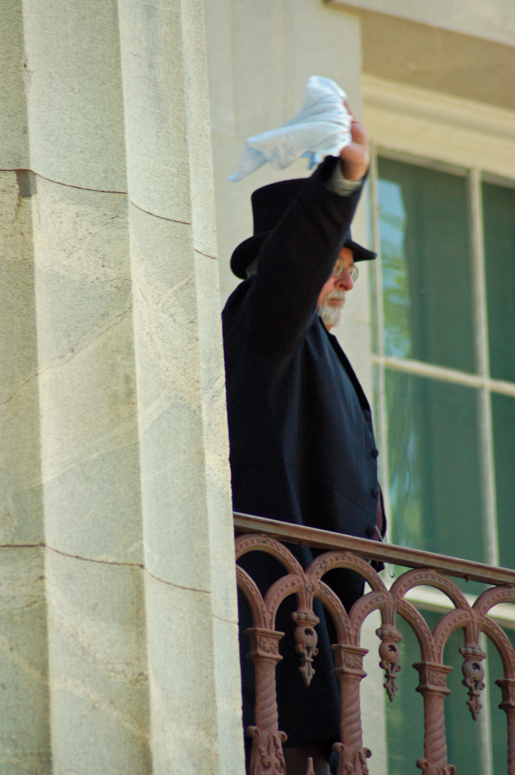 Saturday morning found us still in Raleigh. Except this time, we spent a large portion of time at the State Capital. At 11:00 am, there was a re-enactment of the passage of the secession act in the House Chamber (or was it the Senate Chamber?). This was followed by the dropping of a white handkerchief out on the balcony, signifying to the soldiers below to fire volleys. In May 1861, these volleys were fired by artillery, and, according to local accounts, the concussion shattered windows in businesses in town. So artillery fire was replaced by three well-timed volleys from the rifled-muskets of the 26th North Carolina Troops, Reactivated. For the next several hours, members of the 26th NCT delivered lectures on various subjects, including flags, uniforms, and North Carolina’s war record.


This was followed by another trip to the auditorium. The North Carolina Division of the Sons of Confederate Veterans recently raised over $8,000 to conserve the Gettysburg-captured flag of the 23rd North Carolina Troops. Henry Mintz did a great job of giving a history of the regiment and its role at Gettysburg. This was followed by a gathering of descendants of the 23rd NCT on the stage, and then the unveiling of the flag. That is always a special treat.
Then it was time to head home. A great weekend and it was a pleasure to meet so many of you. If you are interested in the War, and did not attend, you really missed out on a great weekend commemorating the War in North Carolina.
Thursday, May 19, 2011
Off to Raleigh
 Well folks, I am off to Raleigh for the weekend. I’ll be speaking tomorrow at the Civil War Symposium at the Museum of History. The title of my talk: “’A People Without Monuments is a People without Heroes’: Remembering the Civil War in Appalachian North Carolina.”
On Saturday, I’ll be hanging with friends from the 26th North Carolina Troops, Reactivated, as they conduct a living history on the grounds of the capital. Then at 2:00 pm on Saturday, I’ll be attending the dedication of the conserved flag of the 23rd North Carolina Troops at the Museum.
Remember the American Soldier at Bennett Place Program on May 28
DURHAM – After the Civil War, Confederate and Union veterans and their families visited the graves of those who had made the ultimate sacrifice. Gen. John A. Logan had been at the surrender negotiations at Bennett Place in April 1865, and upon becoming a congressman he was instrumental in the establishment of Memorial Day to honor the U.S. military.
On Saturday, May 28, 10 a.m-4p.m., Bennett Place State Historic Site will continue the tradition.
Soldiers from many time periods will be available at the living history event. Re-enactors representing the American Revolution, Union and Confederate Civil War, Rough Riders from the Spanish American War, World Wars I and II, and other periods will participate.
“In special recognition of recent events in our United States military history we are especially proud to honor American soldiers with this particular Memorial Day event,” shares Site Manager John Guss. “We hope everyone everywhere will say a special thanks to our military and remember those who gave their all throughout our history.”
The evolution of weaponry and uniforms also will be apparent, from a flintlock musket to an M-1 Garand, or the hunter frock preferred by George Washington for his soldiers to the field uniform of World War II. The program is free, but donations are greatly appreciated.
The Historic Bennett Farm grounds, nature trails and picnic area will be available, and the Visitor Center will be open. Many exclusive Civil War artifacts in the museum gallery interpret the lives of the Bennett family, and Union and Confederate soldiers also. Visitors can purchase Bennett Place and Civil War-related collectibles that will benefit preservation of this historic landmark.
Once the home of James and Nancy Bennett, the farm became the site of the largest troop surrender of the American Civil War in April 1865, involving nearly 90,000 soldiers from North and South Carolina , Georgia , and Florida . The mission of Bennett Place State Historic Site is to preserve and interpret the surrender and the lives of 19th-century yeomen farmers such as the Bennetts.
Bennett Place is located at 4409 Bennett Memorial Road , Durham , NC , 27705 . It is within the Division of State Historic Sites in the N.C. Department of Cultural Resources, the state agency with the mission to enrich lives and communities, and the vision to harness the state’s cultural resources to build North Carolina ’s social, cultural and economic future. For more info rmation on Cultural Resources, visit http://www.ncculture.com/.
Wednesday, May 18, 2011
Thoughts on Secession
We have arrived at secession week here in North Carolina. On May 20, North Carolina left the Union. But alas, I get ahead of myself and my story.
South Carolina seceded on December 20, 1860, and was quickly followed by Florida, Alabama, Mississippi, and Georgia. North Carolina could not really decide what do, but managed to put together a call for a convention to consider the question and to elect delegates. The call for a convention was barely defeated. It is interesting how past historians put a spin on this – often writing how the majority of people in North Carolina were pro-Union. Well, that majority was extremely slim. Just 650 votes, less than one percent of the votes cast, kept North Carolina from holding a convention to consider secession.
So North Carolina settled into a wait-and-see stance for about six week or seven weeks.
That changed in April. Abraham Lincoln sent reinforcements to Fort Sumter, and before they could arrived, Confederate forces opened fire on the South Carolina fortification, compelling the garrison to surrender on April 13. Lincoln then issued his famous call for 75,000 militia to go into the Deep South states to deal with the rebellion. North Carolina Governor John W. Ellis denied Lincoln the use of North Carolina Troops, and ordered the Federal fortifications at Wilmington and Morehead City seized, along with the arsenal at Fayetteville. Ellis then called the general assembly into special session on April 17. On May 1, the General Assembly issued a call for a convention and the election of delegates. Some members also attempted to pass legislation that would require any act of the Convention to be ratified by the people, but this failed.
The General Assembly Act called for men to go to the polls on May 13 to elect 120 delegates, to meet in Raleigh on May 20. Those that met in Raleigh on May 20 fell into two categories: secessionists, who believed in the idea that a state could secede from the Union; and revolutionaries, those who denied the right of secession and believed that a state could only leave the Union by resorting to revolution.
Burton Craige, convention delegate from Rowan County, introduced the secession ordinance, which was unanimously adopted. The convention then adopted the Constitution of the Confederate States. On May 21, the delegates gathered and signed North Carolina’s ordinance of secession.
So, my question to you is this: was North Carolina the last state to secede from the Union? Here is the dilemma.
Virginia left the Union on April 17.
Arkansas on May 6.
Tennessee on May 7, and,
North Carolina on May 20.
However, both Virginia’s and Tennessee’s secession ordinances had to be ratified by the people (white male voters). Virginia’s secession ordinance was ratified on May 23, and Tennessee’s on June 8.
John G. Barrett and W. Buck Yearns wrote in North Carolina Civil War Documentary that “the Tar Heel State was the last to secede from the Union…” (xi)
A recent piece on DocSouth from the University of North Carolina at Chapel Hill proclaims that “North Carolina was the last Southern State to join the Confederacy.” (http://docsouth.unc.edu/highlights/secession.html)
I could go on and on with these sources. Tennessee and Arkansas claim the same thing.
What do you think? Was North Carolina the last state to secede, or do the public ratifications of the secession ordinances from Virginia and Tennessee bump us up the list?
Tuesday, May 17, 2011
WEEKEND EVENTS COMMEMORATE 150TH ANNIVERSARY OF NORTH CAROLINA'S SECESSION VOTE
WEEKEND EVENTS COMMEMORATE 150TH ANNIVERSARY OF NORTH CAROLINA'S SECESSION VOTE
On May 20, 1861, North Carolina seceded from the Union to join the Confederate States of America. Thus began the state's involvement in the American Civil War.
This weekend the N.C. Museum of History and the State Capitol in Raleigh will commemorate the 150th anniversary of North Carolina's secession vote. On Friday, May 20, the Museum of History will open the small exhibit North Carolina and the Civil War: The Breaking Storm, 1861-1862, which is located within the museum's military history gallery A Call to Arms. On Saturday, May 21, the State Capitol will present North Carolina Secedes, a living history program that includes a re-enactment, period music, a drill and dress parade, lectures and more.
Details about the exhibit and the program follow. Both are free and open to the public.
North Carolina and the Civil War: The Breaking Storm, 1861-1862
North Carolina and the Civil War: The Breaking Storm, 1861-1862 highlights the events leading up to the outbreak of the Civil War and the early battles. On view from May 20, 2011, through Oct. 29, 2012, the exhibit features artifacts related to the state's role in the War of 1812, the Mexican-American War, the nation's western expansion, and the Civil War. Civil War artifacts include the Confederate first national flag of the 33rd Regiment N.C. Volunteers, 1861-1862; and an M1833 dragoon saber and scabbard (1861-1862) used by Zebulon B. Vance, colonel of the 26th Regiment N.C. Troops and later the state's wartime governor. A bugle, snare drum, banjo and flugelhorn are among the musical instruments on exhibit.
North Carolina and the Civil War: The Breaking Storm, 1861-1862 is the first exhibit in a three-part series that explores the four-year conflict that changed the state and nation. The exhibit series, titled North Carolina and the Civil War: 1861-1865, tells the story of North Carolinians who lived, served and sacrificed during the nation's bloodiest conflict.
The series' second exhibit, debuting in 2013, will focus on the year 1863. The final installation, opening in 2014, highlights the last engagements of 1864-1865 and postwar consequences.
North Carolina Secedes: Living History Program at State Capitol
North Carolina Secedes, a living history program at the State Capitol, takes place Saturday, May 21, from 10 a.m. to 4 p.m. The event will commemorate the state's historic vote and look at North Carolina's early wartime preparations.
At 11 a.m. in the historic House Chamber, hear readings from Secession Convention speeches. Contemporary accounts of May 20, 1861, recount that after the unanimous vote, someone dropped a handkerchief from the Capitol's west portico to signal to the crowd below that North Carolina had seceded and joined the Confederacy. Maj. Stephen Dodson Ramseur's artillery unit, which was posted on the grounds for the occasion, announced the historic moment by firing its cannons.
During the May 21 program, approximately 100 re-enactors from the 26th Regiment N.C. Troops will portray Maj. Ramseur's battery and re-enact an infantry drill and rifle-fire during the war. In the afternoon watch the drill and dress parade, and hear a field music concert. Lectures will focus on the state's military organization, war flags, and the early uniforms and equipment of both North Carolina and Union soldiers. Additionally, a facsimile of North Carolina's Ordinance of Secession will be on display inside the Capitol.
The exhibit and the living history program are presented as part of the N.C. Civil War Sesquicentennial, a statewide initiative organized by the N.C. Department of Cultural Resources in commemoration of the 150th anniversary of the Civil War in North Carolina. For more information go to www.nccivilwar150.com.
To learn more about the Museum of History, call 919-807-7900 or access www.ncmuseumofhistory.org or Facebook. For details about the State Capitol program, call 919-733-4994 or visit www.nchistoricsites.org/capitol/default.htm.
# # #
The N.C. Museum of History is located at 5 E. Edenton St. Hours are Monday through Saturday, 9 a.m. to 5 p.m., and Sunday, noon to 5 p.m. The Museum of History, within the Division of State History Museums, is part of the N.C. Department of Cultural Resources, the state agency with the mission to enrich lives and communities, and the vision to harness the state's cultural resources to build North Carolina's social, cultural and economic future. Information is available 24/7 at www.ncculture.com.
On May 20, 1861, North Carolina seceded from the Union to join the Confederate States of America. Thus began the state's involvement in the American Civil War.
This weekend the N.C. Museum of History and the State Capitol in Raleigh will commemorate the 150th anniversary of North Carolina's secession vote. On Friday, May 20, the Museum of History will open the small exhibit North Carolina and the Civil War: The Breaking Storm, 1861-1862, which is located within the museum's military history gallery A Call to Arms. On Saturday, May 21, the State Capitol will present North Carolina Secedes, a living history program that includes a re-enactment, period music, a drill and dress parade, lectures and more.
Details about the exhibit and the program follow. Both are free and open to the public.
North Carolina and the Civil War: The Breaking Storm, 1861-1862
North Carolina and the Civil War: The Breaking Storm, 1861-1862 highlights the events leading up to the outbreak of the Civil War and the early battles. On view from May 20, 2011, through Oct. 29, 2012, the exhibit features artifacts related to the state's role in the War of 1812, the Mexican-American War, the nation's western expansion, and the Civil War. Civil War artifacts include the Confederate first national flag of the 33rd Regiment N.C. Volunteers, 1861-1862; and an M1833 dragoon saber and scabbard (1861-1862) used by Zebulon B. Vance, colonel of the 26th Regiment N.C. Troops and later the state's wartime governor. A bugle, snare drum, banjo and flugelhorn are among the musical instruments on exhibit.
North Carolina and the Civil War: The Breaking Storm, 1861-1862 is the first exhibit in a three-part series that explores the four-year conflict that changed the state and nation. The exhibit series, titled North Carolina and the Civil War: 1861-1865, tells the story of North Carolinians who lived, served and sacrificed during the nation's bloodiest conflict.
The series' second exhibit, debuting in 2013, will focus on the year 1863. The final installation, opening in 2014, highlights the last engagements of 1864-1865 and postwar consequences.
North Carolina Secedes: Living History Program at State Capitol
North Carolina Secedes, a living history program at the State Capitol, takes place Saturday, May 21, from 10 a.m. to 4 p.m. The event will commemorate the state's historic vote and look at North Carolina's early wartime preparations.
At 11 a.m. in the historic House Chamber, hear readings from Secession Convention speeches. Contemporary accounts of May 20, 1861, recount that after the unanimous vote, someone dropped a handkerchief from the Capitol's west portico to signal to the crowd below that North Carolina had seceded and joined the Confederacy. Maj. Stephen Dodson Ramseur's artillery unit, which was posted on the grounds for the occasion, announced the historic moment by firing its cannons.
During the May 21 program, approximately 100 re-enactors from the 26th Regiment N.C. Troops will portray Maj. Ramseur's battery and re-enact an infantry drill and rifle-fire during the war. In the afternoon watch the drill and dress parade, and hear a field music concert. Lectures will focus on the state's military organization, war flags, and the early uniforms and equipment of both North Carolina and Union soldiers. Additionally, a facsimile of North Carolina's Ordinance of Secession will be on display inside the Capitol.
The exhibit and the living history program are presented as part of the N.C. Civil War Sesquicentennial, a statewide initiative organized by the N.C. Department of Cultural Resources in commemoration of the 150th anniversary of the Civil War in North Carolina. For more information go to www.nccivilwar150.com
To learn more about the Museum of History, call 919-807-7900 or access www.ncmuseumofhistory.org
# # #
The N.C. Museum of History is located at 5 E. Edenton St. Hours are Monday through Saturday, 9 a.m. to 5 p.m., and Sunday, noon to 5 p.m. The Museum of History, within the Division of State History Museums, is part of the N.C. Department of Cultural Resources, the state agency with the mission to enrich lives and communities, and the vision to harness the state's cultural resources to build North Carolina's social, cultural and economic future. Information is available 24/7 at www.ncculture.com
Monday, May 16, 2011
Pvt. Hamilton Bare - 37th NCT
If you have hung out on the blog for any time, you have probably figured out that I have a strange passion for cemeteries. I’m one of those folks who believe they every soldier, whether Confederate or Union, deserves to have his grave marked in some fashion. This past Saturday, I had the honor of the traveling to Ashe County to participate in the dedication of a stone to Pvt. Hamilton Bare of the 37th North Carolina Troops. Bare’s grave was marked only with a field rock until a 90+ year old descendant informed fellow historian Tar Heel Clint Johnson just who was buried there. Johnson took the lead, and procured a VA stone for Bare.
Hamilton Bare was conscripted into service on August 15, 1862. He was just 18 years old. He served throughout the war, save for a period between May and September 1863 when he was absent without leave. Bare was captured on April 2, 1865, and spent three months as a prisoner of war at Point Lookout, Maryland.

Hamilton Bare had a brother in the 37th North Carolina Troops, Farrow Bare. His final resting place is still unknown, and might be at the same cemetery that Hamilton is interred in. If you have any information, please drop me a line.
Hamilton Bare was conscripted into service on August 15, 1862. He was just 18 years old. He served throughout the war, save for a period between May and September 1863 when he was absent without leave. Bare was captured on April 2, 1865, and spent three months as a prisoner of war at Point Lookout, Maryland.

Saturday’s service included a biography on Hamilton Bare, made by one of his many present descendants. I gave a talk on the history of the 37th NCT, and then reenactors from the 26th North Carolina Troops and the 37th North Carolina Troops fired three volleys over the grave. Just one more of North Carolina’s 125,000 Confederate graves is now marked.
Many thanks to Clint Johnson for making this happen, and for his invitation to speak.
Friday, May 13, 2011
North Carolina Remembers Gettysburg
“The last two weeks are big events of the greatest importance…” - 4th NCST.
“This day none will forget that participated in the fight. It was truly awful.” – 53rd NCT
 “The battle was grand, sublime, awful.” – 26th NCT
Folks, it is with great pleasure that I announce the release of North Carolina Remembers Gettysburg. This book is a collection of 77 first-person accounts of the battle of Gettysburg written by North Carolina soldiers.
“This day none will forget that participated in the fight. It was truly awful.” – 53rd NCT
“In this fatal charge our losses were very heavy.” – 52nd NCT
 “The battle was grand, sublime, awful.” – 26th NCT
Folks, it is with great pleasure that I announce the release of North Carolina Remembers Gettysburg. This book is a collection of 77 first-person accounts of the battle of Gettysburg written by North Carolina soldiers.
This new volume is loaded with details of the battle: what the men experienced, written just days or weeks after the battle; the great debate of 1877 on who went the furthest, Pickett or Pettigrew; and, how their views on the battle changed toward the close of the nineteenth century.
These letters first appeared in newspapers just days after the battle, and continued into the twentieth century. The letters were written by the men who participated in the battle, men who had witnessed the death of Col. Henry K. Burgwyn, Jr., of the 26th North Caroline Troops on July 1; the twilight struggle of the 6th North Carolina State Troops on July 2; and, the charge of Lane’s Bigade on July 3.
Many of these letters have not been read since their original publication decades ago. But you can read what they wrote, what they experienced, and in their own words. It is what the soldiers wanted you to read, the stories that they wanted you to remember.
Orders for signed copies are now being accepted. The cost is $20, shipping and handling included. Please include to whom you would like the book inscribed. Please visit my web site, http://www.michaelchardy.com/books.html to order today.
Tuesday, May 10, 2011
Confederate Memorial Day

Today is Confederate Memorial Day, or Decoration Day, in North Carolina. Let me encourage you to get out to a local cemetery and think about what the common Tar Heel Confederate soldiers did, 1861-1865.
Monday, May 09, 2011
Wilmington Event
Dr. Chris Fonvielle
Occupied Wilmington: A Tale of Two Wars
Explore Wilmington’s role in two great American conflicts with historian Dr. Chris E. Fonvielle, Jr., author and associate professor of history at UNC Wilmington.
Tuesday, May 10 – 7:00 PM
Revolutionary War Wilmington
Discover how and why Wilmington was occupied by British forces in 1781 and the role the town played in the Southern Campaign.
Cape Fear Museum, 814 Market Street.
Saturday, May 14th, 10:30am
Brunswick Town & Fort Anderson Tour
A walking tour focused on the Revolutionary War & Civil War history of the Brunswick Town-Fort Anderson State Historic Site.
8884 St. Philip's Rd. SE, Winnabow, NC.
Attendees will meet at the site at 10:30am.
Tuesday, May 17th, 7:00pm
Wilmington Falls to the Union
Discover what life was like in Wilmington under Union control in the closing months of the Civil War in 1865.
Cape Fear Museum, 814 Market Street.
All 3 Events $25.00 • Individual Events $10.00
For reservations contact Historic Wilmington Foundation at 910.762.2511 or edwards@historicwilmington.org
Friday, May 06, 2011
In the Toe River Valley Saturday
Has five days come and gone? Still trying to get the manuscript off – all this "editing and writing captions for pictures and editing and picture placement and editing and indexing and editing" is taking a considerable amount of time.
This Saturday, I’ll be helping with the Confederate Memorial Day activities in the Toe River Valley. We’ll be reading the names of men who died in Yancey County and firing a salute on the grounds of the courthouse in Burnsville at 9:00 am on Saturday. Saturday, about dusk, I will be participating in the candlelight memorial service at the old Bakersville Cemetery in Mitchell County. Everyone is encouraged to join us and bring a friend.
This Saturday, I’ll be helping with the Confederate Memorial Day activities in the Toe River Valley. We’ll be reading the names of men who died in Yancey County and firing a salute on the grounds of the courthouse in Burnsville at 9:00 am on Saturday. Saturday, about dusk, I will be participating in the candlelight memorial service at the old Bakersville Cemetery in Mitchell County. Everyone is encouraged to join us and bring a friend.
Monday, May 02, 2011
Civil War North Carolina
Whew… what a writing marathon. I finished the draft for Civil War North Carolina this past Saturday. For those of you who don’t know, Civil War North Carolina is a concise, well-illustrated history of North Carolina and the war. The first five chapters cover events in North Carolina from 1860 to 1865. Chapter 6 looks at Tar Heel soldiers who marched away. Chapter 7 examines reconstruction, Chapter 8 the memorialization process (monuments, cemeteries, veterans groups like the UCV, UDC, and GAR), and chapter 9 is a “looking for the war today” examination of museums and historic sites.
While this book does not present anything new, per se, it is the first time that you will be able to read about the war, reconstruction, and the reunion process all in one place. Well to be honest, there is really no other place to read about the memorialization process. If there is, I’ve not found it.
So what where my primary resources? Period newspapers, bios on Vance, Worth, Woods, and Stanly. I used histories by Powell, Barrett, Trotter, Meekins, Bradley, and Inscoe. And I used three dissertations – Wood’s Port Town at War: Wilmington; McGee’s On the Edge of the Crater (Raleigh); and Auman’s Neighbor against Neighbor. Of course, there were a hundred more other books and articles that I consulted.
Civil War North Carolina is being published by the History Press out of Charleston, South Carolina. I look forward to telling you more about it in the fall when it is released.
Thursday, April 28, 2011
Confederate Cemetery To Be Dedicated at Bentonville, Site of Bloodiest Battle
FOUR OAKS – Grave markers honoring 20 Confederate soldiers who died during the three-day Battle of Bentonville, which caused nearly 4,200 Union and Confederate casualties, will be dedicated at the site on June 11. The ceremony is part of the N.C. Department of Cultural Resources’ 2nd Saturdays summer series combining arts and history, and is also the site’s annual June Summer Seasonal Living History Program.
Starting at 10 a.m., visitors will hear artillery and musket fire such as split the air in March 1865. The permanent marker dedication ceremony will be at 2 p.m.
The farm home of John and Amy Harper became the Union Army XIV field hospital during the battle, where nearly 600 Union soldiers and an unknown number of Confederates were treated. After the battle the Union army marched on to Goldsboro , paroling at least 45 wounded Confederates left in the care of the Harpers. In spite of the Harpers’ best efforts, 23 of the soldiers died and 20 were buried on the farm.
Over the years the exact location of the Confederate graves was lost. Thanks to 21st-century technology and discovery of a late 19th-century photograph, the cemetery was found. The picture shows 20 headstones and footstones just south of the Harper family cemetery. Assistant State Archaeologist John Mintz and Wake Forest University Director of Public Archaeology Kenneth Robinson led a team of archaeologists who confirmed the graves’ location using ground-penetrating radar.
The Harper House Chapter of the United Daughters of the Confederacy, a Bentonville Battlefield support group, is raising funds to purchase headstones for the graves. To contribute, contact the site at (910) 594-0789.
During the dedication, research historian Michael Hill from the N.C. Office of Archives and History will present a talk about the care of a fallen Confederate soldier at one of the war’s first battles. Archaeologist John Mintz will speak on archaeological discoveries at Bentonville and on the treatment of the dead in the last days of the war. A musket and artillery salute by Civil War re-enactors will follow.
Bentonville Battlefield is located at 5466 Harper House Road , Four Oaks, N.C. 27524, three miles north of Newton Grove on S.R. 1008; it is about one hour from Raleigh and about 45 minutes from Fayetteville . For more info rmation, visit http://www.nchistoricsites.org/bentonvi/ or call (910) 594-0789.
Bentonville Battlefield State Historic Site in the Division of State Historic Sites is part of the N.C. Department of Cultural Resources, the state agency with the mission to enrich lives and communities, and the vision to harness the state’s cultural resources to build North Carolina ’s social, cultural and economic future. For more info rmation on Cultural Resources, visit http://www.ncculture.com/.
Wednesday, April 20, 2011
Alleghany County Public Library Honors “Freedom, Sacrifice, Memory”
Alleghany County Public Library Honors “Freedom, Sacrifice, Memory”
With Civil War Photography Exhibit on Display May 2-28
RALEIGH – Since the beginning of the Civil War (1861-1865) 150 years have passed, but its widespread impact and defining characteristics remain vivid. These can especially be seen in North Carolina due to the state’s role in the war as illustrated by the Freedom, Sacrifice, Memory: Civil War Sesquicentennial Photography Exhibit (www.nccivilwar150.com). The exhibit will be hosted by Alleghany County Public Library from May 2-28, honoring North Carolinians in the Civil War with a variety of images.
“The Civil War was the first war widely covered with photography,” explains Deputy Secretary Dr. Jeffrey Crow of the N.C. Department of Cultural Resources. “The Freedom, Sacrifice, Memory exhibit provides images of historic figures, artifacts, and documents that brought the reality of the war from the battlefront to the home front, then and now.”
The exhibit will travel the state from April 2011 through May 2013, visiting 50 libraries and several museums with its showcase of 24 images. The N.C. Department of Cultural Resources (www.ncculture.com) commemorates the 150th anniversary of the Civil War with images gathered from the State Archives (www.archives.ncdcr.gov), the N.C. Museum of History (www.ncmuseumofhistory.org) and State Historic Sites (www.nchistoricsites.org). A notebook will accompany the exhibit with further info rmation and seeking viewer comments.
Among the various pictures is an image of a mourning ring crafted by a North Carolina Confederate soldier. The ring, made out of a type of easily-carved rubber called guttapercha, contains mother-of-pearl and gold inlay. Mourning rings were used to buy various items in prison like socks and were also fashionably worn by Southern women as a symbol for loved ones fighting or fallen in the war.
Call the Alleghany Public Library (336) 372-5573 for more info rmation on the exhibit. Contact the Department of Cultural Resources (919) 807-7389 for tour info rmation.
The N.C. Department of Cultural Resources is the state agency with the mission to enrich lives and communities, and the vision to harness the state’s cultural resources to build North Carolina ’s social, cultural and economic future. Information on Cultural Resources is available 24/7 at www.ncculture.com.
Tuesday, April 19, 2011
North Carolina Monument at Allatoona
A week and a half ago (Yes, I really am that far behind), I had the opportunity to venture to North Georgia, to one of those battlefields where Tar Heels bled and died. The occasion was the dedication of a monument to the 29th and 39th NCT regiments, and I was blessed with being able to present the keynote address.
Here are a few excerpts from my talk.
The 29th and 39th Regiment were often in the thick of things during the Atlanta campaign of the spring and summer of 1864. They were engaged at New Hope Church, Picket’s Mill, Smyrna, Peachtree Creek, the battles for Atlanta, Ezra Church, and the evacuation of Atlanta in September 1864. As Hood moved north toward Tennessee, his goal was to draw out Sherman and look for an advantageous position to attack. Hood also planned to cut Sherman’s supply line coming from Tennessee, making the Federal position in Atlanta untenable. Hood’s men struck the railroad at Acworth and Big Shanty. Next lay Allatoona, with its large storehouse of provisions. Capturing Allatoona was assigned to French’s division, containing Ector’s brigade and the 29th and 39th Regiments. The three redoubts protected about 2,000 Federals. The Confederates captured the railroad and its protecting blockhouse, before demanding the Federals surrender. They declined, and the Confederates attacked. The 39th Regiment did not actively participate in the attack, being sent to serve as supports for Confederate artillery and skirmishers. The rest of Ector’s brigade were placed in support during the initial attack. During the attack, the 29th Regiment advanced under fire through some thick woods, before discovering that they had lost contact with the rest of the brigade. Major Ezekial Hampton ordered the regiment to advance at the double quick. They stopped just short of the Federal works, dropped to the ground, and reloaded. Soon Hampton ordered his men up and advanced over the works. Three color bearers were struck before the flag of the 29th Regiment was planted on the Federal works. According to one historian, “the 29th ran into the Federal trench and fought ‘hand-to-hand with swords, bayonets, rifle butts, and rocks.’ The Confederates killed many of the enemy and captured 25 or 30 prisoners… no sooner had they taken the Federal works than Major Hampton ordered his men forward again. The 29th got within 20 yards of the Star Fort before their charge was stopped.” Before French could order his men to attack the final Federal position, he received word that the Federals were coming up in his rear. Fearing the he would be cut off, French ordered his men to retreat. Hampton, in his official report, stated that the 29th North Carolina took 138 men into action, losing 12 killed, 39 wounded, and 3 missing. Colonel David Coleman of the 39th North Carolina reported that his regiment lost only two men wounded.

Saturday, April 16, 2011
Conference in Raleigh May 20 Examines Civil War Memories
RALEIGH -- As it has for generations, the Civil War engages and fascinates students of history like almost no other topic. A keynote address by David Blight of Yale University titled “Race and Reunion : Has Civil War Memory United or Divided America?” will kick off an all-day conference at the N.C. Museum of History on Friday, May 20.
The conference, “Contested Past: Memories and Legacies of the Civil War,” is being held on the 150th anniversary of North Carolina ’s secession from the Union . It is the first of three sesquicentennial symposiums the N.C. Office of Archives and History will sponsor around the state between 2011 and 2015.
Following Blight’s address, other experts in the field of Civil War history will examine aspects of memory and the war in breakout sessions with topics that include literature, historiography, statuary, monuments, race, women, heritage organizations, and other legacies.
A registration fee of $25 covers all lectures, morning refreshments, a boxed lunch and a reception late Friday afternoon. To register, send a check made payable to the North Carolina Literary and Historical Association (NCLHA) by May 10 to Parker Backstrom, 4610 Mail Service Center , Raleigh , NC 27699-4610 . For more information, call the N.C. Office of Archives & History at (919) 807-7280, or go to www.nccivilwar150.com.
Sponsors include the North Caroliniana Society, the North Carolina African American Heritage Commission, the North Carolina Civil War Tourism Council, and the North Carolina Literary and Historical Association
On May 20, 1861, delegates meeting in the State Capitol voted to take North Carolina out of the Union and align with the Confederate States of America . For the next four years North Carolinians , other Southerners and those in the North engaged in a protracted war touching every part of society.
A team of North Carolina Department of Cultural Resources staff, operating with an advisory panel of leading historians, has planned more than 200 events, lectures and exhibits across the state to commemorate the 150th anniversary of the Civil War.
The North Carolina Department of Cultural Resources (www.ncculture.com) is the state agency with the mission to enrich lives and communities, and the vision to harness the state’s cultural resources to build North Carolina ’s social, cultural and economic future.
Presenters
David W. Blight, Class of 1954 Professor of History at Yale University , is the author of “Race and Reunion : The Civil War in American Memory,” for which he received the Bancroft, Lincoln, and Frederick Douglass Prizes.
John Coffey is the deputy director for art at the North Carolina Museum of Art where, since 1989, he also has been the Curator of American and Modern Art.
Adam H. Domby is a graduate student at the University of North Carolina at Chapel Hill . His current research explores the memory of dissent and intra-community violence in North Carolina .
Mark Elliott is associate professor of history at the University of North Carolina at Greensboro . Along with John David Smith, he co-edited Undaunted Radical: The Selected Writings and Speeches of Albion W. Tourgee.
James Gillispie teaches history at Sampson Community College in Clinton . He is the author of Andersonvilles of the North: The Myths and Realities of the Northern Treatment of Civil War Confederate Prisoners.
John Haley is a retired professor of history at the University of North Carolina at Wilmington . The study of race relations and the Civil War and Reconstruction are his areas of specialty.
Michael C. Hardy maintains the blog “ North Carolina and the Civil War.” In 2010 he was named North Carolina Historian of the Year by the North Carolina Society of Historians.
John C. Inscoe, University Professor and Albert B. Saye Professor of History at the University of Georgia , is author of “Race, War, and Remembrance in the Appalachian South” and “Writing the South through the Self.”
Elizabeth C. King is a survey specialist in the Eastern Office of the State Historic Preservation Office. She is completing a comprehensive survey of historic architectural resources in Beaufort County .
Leonard Lanier is a graduate student at Louisiana State University . His research interests include post-Civil War political violence in eastern North Carolina .
David Madden, the Robert Penn Warren Professor Emeritus at Louisiana State University and founding director of the United States Civil War Center, recently retired to Black Mountain .
Jaime Martinez is an assistant professor of history at the University of North Carolina at Pembroke, where her primary teaching area is 19th-century U.S. history.
Chris Meekins is correspondence archivist at the North Carolina State Archives and serves as chairman of the symposium subcommittee of the North Carolina Civil War Sesquicentennial Committee.
Barton A. Myers, assistant professor of history at Texas Tech University , received the Jules and Frances Landry Award for “Executing Daniel Bright: Race, Loyalty and Guerrilla Violence in a Coastal Carolina Community, 1861-1865.”
Erica St. Lawrence is a Master’s degree candidate in public history at North Carolina State University . Her interests include myth and memory-making in public history and early modern European history.
Shannon SanCartier is an archivist for the Historical Society of the Lower Cape Fear. Her thesis about Fort Fisher was selected best history thesis ( University of North Carolina at Wilmington ) in 2010.
David Silkenat is an assistant professor of history and education at North Dakota State University . He is the author of “Moments of Despair: Suicide, Divorce, and Debt in Civil War Era North Carolina.”
Tom Vincent is a local records management analyst for the North Carolina State Archives. He maintains the Web site “North Carolina Civil War Monuments Survey” (http://ncmonuments.ncdcr.gov/).
Thursday, April 14, 2011
A Tar Heel's view on Fort Sumter, pt. 2
A fleet of steamers arrived off the bar early in the day and came to anchor. The number was afterwards increased, for on Sunday, when we went down the harbor, we saw seven.
We were told by gentlemen from Morris Island that Anderson had signal lights burning constantly, and that his flag was at half-mast a part of the time. The vessels did not seem to take any notice of him.
The conduct of this fleet is enough to bury the stars and stripes forever in infamy. They had witnessed the fight all day, riding quietly at anchor in sight of the wharves and not more than three miles from Fort Sumter. When night came every one confidently expected the attempt would be made to come it, or land troops, and if they had their own time to choose out to five years, they could not have been favored with so many advantages. There was a splendid tide, the wind was in their favor, it was as dark as pitch, rainy and misty and there were no lights burning on the old hulks in the harbor as there had been the night before. Their attempt was regarded as so certain that preparations were redoubled at every point. Every one looked to see a general engagement—Thus the night wore away.
Early Saturday morning the fire was resumed, and in a very short while the cry went through the city, “Fort Sumter is on fire,” and so it was. A dense volume of smoke rose from the fort, and lurid flames leaped up visible to the naked eye.—Anderson still kept up his fire on the Floating Battery and Fort Moultrie, but it evidently became slower and weaker. The boys on Morris Island gave him three cheers for every gun he fired. And now there comes a tremendous explosion in the fort, resembling the blowing up of a house, and throwing smoke and flame high in the air. Some said the magazine had exploded; others that he was blowing up the barracks to stop the flame; but the truth was that a shell or hot shot had struck some hand-grenades and loose ammunition, causing the explosion. Anderson’s fire ceased altogether, as the devouring element enveloped the fort; but the shell from his enemies burst around him with increased rapidity and fury as he endeavored to extinguish the flames. At last, a yell from the whole line of spectators along the wharves and battery announced the fall of the flag which had been defiantly floating throughout the engagement, but which had been shot away. It was so long before the flag was raised again that the opinion became general that his men were exhausted or smothered with smoke, or killed, and that he could not raise the flag again, and accordingly, Col. Wigfall started in a small boat from Morris Island, bearing a white flag for Fort Sumter. Before he reached the fort, however, Maj. Anderson had showed the stars and stripes again, together with a white flag; but the firing continued at the sight of the former, and Col. Wigfall entered the fort through a storm of shell and shot, and asked for Major Anderson. – When he made his appearance, Col. Wigfall said that seeing his distress, his utter inability to hold out, and the his flag was not raised, he, as aid to Gen. Beauregard, claimed a surrender. Major Anderson wish to know upon what terms he was expected to surrender, to which Col. Wigfall gracefully replied, that Gen. Beauregard was a gentleman and a soldier, and know how to treat as brave an enemy as Major Anderson; whereupon an unconditional surrender was made to Gen. Beauregard in behalf of the Confederate State. The stars and stripes were then hauled downed and the batteries on Sullivan’s Island ceased their fire.
At the first appearance of the white flag, the enthusiasm and excitement became very great all over the city and among the troops, and when the Palmetto and Confederate flags were raised on the parapet, the ordnance from all points of the harbor pealed forth their joyful thunder. The water was alive with craft of all sorts. The details of surrender were made. Major Anderson was allowed to carry out his property and side arms and to salute his flag. The Isabel went down from the city, at his own request, to take him to New York.
And we would be glad to close this brief narrative here—but the worst and the best thing connected with the battle of Fort Sumter, happened subsequently. The hand of Providence seemed to be in this flight. History records no where the fact that skilful artillerist on both sides have fired for 33 hours without killing, or seriously wounding a man. Major. Anderson’s men were so small in number that, notwithstanding the fort is a scene of desolation inside, they could all be safely stowed away in the casemates and thus escape the iron hail. The sand batteries and iron batteries protected the South Carolinians wonderfully. The only loss of life was experiences occurred when Major Anderson’s men were saluting his flag immediately previous to leaving the fort. In firing one of the guns, some shells of loose ammunition lying on the parapets caught and exploded, killing one man instantly, and mortally wounding three or four others, two of whom have since died. Gen. Beauregard ordered that the one that was killed should be buried with military honors, which was done.
From the Wilmington Herald
Reprinted The Daily Register, April 20, 1861.
Tuesday, April 12, 2011
A Tar Heel’s views of Fort Sumter
What We Saw in Charleston
We left Wilmington on Thursday night last to witness, and, if allowed to participate in the bombardment of Fort Sumter. Our journey was full of excitement which one might expect to realize when on his way to the field of battle for the first time. On Friday morning, when about twenty-five miles from Charleston, we heard the heavy ordnance of Sumter and the different batteries on the islands, and as the jarring thunder steadily and a regular intervals broke upon the early morning air. The excitement on the cars increased to fever heat and the passengers could scarcely restrain their impatience at one or two very brief stoppages of the train to take up several South Carolinians who were hurrying to the scene of action. As the train approached the city, the dull, heavy explosions shook the air in rapid succession like thunder-claps, and at last the clouds of smoke from the different batteries became visible, and the smell of burnt powder was wafted pleasantly on the breeze. We found the streets comparatively quiet--the citizens and strangers of both sexes having crowded down to the Battery—and, eating a hurried break fast, we ascended to the roof of the Mills House, with a friend, to take a view. And such a view!
There lay the waters of the beautiful harbor, sparkling and heaving gently to the kiss of the morning breeze. Directly before us arose out of the deep the beleaguered fortress, all its angles softened by the distance—the once glorious ensign of a once glorious republic floating proudly over its walls, and the whole scene looking as peaceful and beautiful as God intended it should be. But see! from a point on the right a white puff of smoke is sent, and, ere the report reaches us, a red flame burst over the flag-staff of Fort Sumter and the dreadful bomb scatters its fragments over the doomed fort and comes to the ear with a report almost equal to that of the mortar from which it proceeded. Another puff from the opposite wise where the floating battery and Fort Moultrie are located, an answer from Maj. Anderson, a round shot hurtles through the air from Cumings Point; and so it goes. We hurry down, passing the bulletin boards of the Mercury and Courier offices, and learning there that, as yet, “nobody is hurt.” Arrived at the Battery… we find several thousand ladies and gentlemen, citizens and strangers gazing at the conflict and all impressed with the character of the drama which was being enacted. Soldiers on horback and on foot, messengers and aids hurry to and fro. There was no weeping—no apparent distress—but upon the faces of all,--men, women and children, Determination was stamped in unmistakeable characters. We took our stand and watched every shot from every battery on each of the islands and from Fort Sumter. “There goes Stevens’ Battery,” ‘There goes Anderson,” “Look at that shell,” “now for the Floating Battery,” “Ripley keeps up the fire from Fort Moultrie gloriously,” “I’d give $100 to be there,” and a thousand other similar expressions constantly greeted the ear, while every time a should would explode over Sumter, leaving its little cloud of white smoke, a cheer would go up from the large concourse of spectators. Major Anderson generally alternated his shots with the different batteries (five or six in number) that were playing on him; but sometimes he would open fire from both sides at once.—He seemed about 9 o’clock on Friday to be paying his particular respects to Fort Moultrie, and a rumor reached the city that 30 or 40 men had been killed there, and that the battery was terribly exposed; but a short time proved these and various other rumors to be false. Moultrie kept pegging away slowly and steadily, as did the others. Fort Sumer replied briskly. Dispatches now came that the iron battery (Stevens) on Cummings’ Point, was rapidly making a breach in the Southwest wall of Sumter, and we think Major Anderson did not fire at Cummings’ Point after 2 o’clock on Friday. Cheering news arrived from all quarters, of the harmlessness of Anderson’s shots and the good spirits of the “boys.” The firing was kept up under dark, which there seemed to be only one gun about every ten or fifteen minutes, as it intended to keep Major Anderson awake.
To be continued….
Friday, April 08, 2011
State Capitol Commemorates 150th Anniversary of North Carolina ’s Secession Vote
RALEIGH – On May 20, 1861, delegates from across the state met in the House Chamber of the State Capitol and voted to sever North Carolina ’s ties with the Union . On Saturday, May 21, 2011, the Capitol will present “North Carolina Secedes,” a living history program commemorating the historic vote and a look at the state’s early wartime preparations.
The free event will take place from 10 a.m.-4 p.m. and is open to the public. It is part of the North Carolina Civil War Sesquicentennial, a commemoration of the 150th anniversary of the Civil War in North Carolina (www.nccivilwar150.com).
The re-enactment of the Secession Convention’s vote will take place in the historic House Chamber at 11 a.m. Contemporary accounts of the day recall that following the unanimous vote, a handkerchief was dropped from the west portico as a signal to the crowd below that North Carolina had seceded and joined the Confederacy. Stephen Dodson Ramseur’s artillery unit was posted on the grounds for the occasion and announced the historic moment by firing its cannons and infantry. Approximately 100 re-enactors from the 26th North Carolina Regiment will portray Ramseur’s battery and re-enact the infantry firing on the southwest grounds.
In the afternoon, the event will feature a drill and dress parade, a field music concert and lectures on the state’s military organization, war flags, and the early uniforms and equipment of both North Carolina and Union soldiers. Additionally, a facsimile of North Carolina ’s Ordinance of Secession will be on display inside the Capitol.
For those hoping to get a glimpse of Confederate camp life, the 26th NC (http://www.26nc.org/) will be encamped at Historic Oak View County Park on the east side of Raleigh . On Sunday, the group will present “Preparing for War: The 26th NC in 1861” at the park from 10 a.m.-2 p.m. Visit http://www.wakegov.com/parks/oakview for details.
The State Capitol’s mission is to preserve and interpret the history, architecture and functions of the 1840 building and Union Square . The Capitol is bounded by Edenton, Salisbury , Morgan and Wilmington streets. For more info rmation, visit www.nchistoricsites.org/capitol/default.htm or call (919) 733-4994.
Administered by the Division of State Historic Sites, the State Capitol is part of the N.C. Department of Cultural Resources, the state agency with the mission to enrich lives and communities, and the vision to harness the state’s cultural resources to build North Carolina ’s social, cultural and economic future. Information on Cultural Resources is available 24/7 at http://www.ncculture.com/.
Tuesday, April 05, 2011
A look around the Old North State…
You can find some real interesting figures about women in Raleigh in 1860 by visiting the CivilWarTime blog. I wonder how those numbers had changed by 1865?
Josh Howard’s quest to find how many Tar Heel soldiers died during the War continues to make headlines, including this post on Fox News and the Wall Street Journal.
The Asheville Citizen Times is trying to help people find their Civil War ancestors. Check it out here.
More information about Civil War/family research can be found here.
The Battle of Big Bethel get’s an early reenactment this year. Learn more here.
Dr. Judkin Browning is going to be speaking at the Western North Carolina Civil War Round Table in Sylva next Monday – you can learn more here.
An interesting story about a Yankee who dig relics off the Bentonville Battlefield can be found here.
An article on the Tweets of a member of the 30th NCT can be here in the Raleigh News and Observer.
And,
The Burlington Times-News has an article on the Kirk-Holden War. Check it out here.
Monday, April 04, 2011
Allatoona Battlefield this Saturday.
Having a job as a full-time Civil War historian has its perks – ok, it has a lot of them, like working with original sources, handling original artifacts, unveiling conserved flags, and talking to scores of great folks. One those many perks is getting to spend time on original battlefields.
This Saturday, at 11:00 am, I get to speak on one of those battlefields. The Georgia Division and the North Carolina Division, Sons of Confederate Veterans, are unveiling a monument to two North Carolina regiments that fought at the battle of Allatoona Pass. And yours truly gets to spend fifteen or twenty minutes talking about those two regiments and what they did during the battle. Everyone is invited. If you have ancestors who served in one of those two regiments, the event organizers would like you to help unveil the monument. This Saturday, April 9, 2011, looks to be a great day! I hope you can join me on the Allatoona Pass Battlefield.
This Saturday, at 11:00 am, I get to speak on one of those battlefields. The Georgia Division and the North Carolina Division, Sons of Confederate Veterans, are unveiling a monument to two North Carolina regiments that fought at the battle of Allatoona Pass. And yours truly gets to spend fifteen or twenty minutes talking about those two regiments and what they did during the battle. Everyone is invited. If you have ancestors who served in one of those two regiments, the event organizers would like you to help unveil the monument. This Saturday, April 9, 2011, looks to be a great day! I hope you can join me on the Allatoona Pass Battlefield.
Saturday, April 02, 2011
Volume XVIII: Junior Reserves and Detailed Men in the North Carolina Troops, 1861-1865: A Roster series is now available for ordering!!!
Volume XVIII contains the history and rosters of the North Carolina Senior Reserves. The Senior Reserves were men between the ages of 45 and 50, drafted in the last year of the war, as the Confederacy faced a disastrous shortfall in manpower. Between the spring and fall of 1864, North Carolina raised five regiments, four battalions, and two independent companies of Senior Reserves. These men guarded bridges and depots, rounded up deserters, and guarded prisoners at Salisbury and elsewhere. The exigencies of the war drew them into active service, some in South Carolina with General Hardee as he attempted to hold off the Federal advance to North Carolina; some in defense of Fort Fisher, south of Wilmington; and some at Bentonville, the last major battle of the war.
Also in the last year of the war, the Confederate government decided that it could no longer afford to have white men working “on detail” in ordnance works, quartermaster service, recruiting service, or other non-combat operations. In the fall of 1864, North Carolina began organizing its detailed men into military units. Eventually, three regiments, two battalions, and an independent company were organized from the detailed men in the state, but the war ended before they had an opportunity to participate in combat.
An authoritative 114-page history of the Senior Reserves begins the volume. The history is followed by a complete roster and service records of the officers and men that served in the Senior Reserves. The service records include important information such as full name, rank, county of birth and residence, occupation, place and date of enlistment, age, whether the individual was wounded, captured, hospitalized, paroled, transferred, or promoted and whether or not he died during the war or survived. A 19-page history of the Detailed Men is followed by a complete roster and service records of the officers and men that served in those units. A detailed index completes the volume.
To learn more about this important, new contribution to Civil War scholarship (and to order a copy), please visit:
http://nc-historical-publications.stores.yahoo.net/3499.html
Friday, April 01, 2011
In Old Wilkes
Last night, I had the opportunity to speak at the opening of the new Civil War exhibit at the Wilkes County Heritage Museum. Not only did I speak, but so did Gary Coffey, commander of the James B. Gordon Camp, Sons of Confederate Veterans, who sponsored the event; Skip Smith, Colonel of the 26th North Carolina Troops, Reactivated; and Chris Hartley, author of the new book on Stoneman’s Raid.
If you get a chance, stop by the Old Wilkes Court House and check out the exhibit – it includes weapons, flags, and uniforms, and is well worth the ride. Thanks again to the Wilkes Museum for allowing me to come and speak for a few minutes. I look forward to working with them in the future.

If you get a chance, stop by the Old Wilkes Court House and check out the exhibit – it includes weapons, flags, and uniforms, and is well worth the ride. Thanks again to the Wilkes Museum for allowing me to come and speak for a few minutes. I look forward to working with them in the future.

Michael C. Hardy, Chris Hartley, and Skip Smith.
Subscribe to:
Posts (Atom)