Showing posts with label Joseph E. Johnston. Show all posts

Monday, August 03, 2026

The Three Trials of William Holland Thomas

   Thomas’s Legion is one of those Confederate infantry organizations with almost mythical status. In a day and time when Native Americans in the United States had been maligned and unfairly treated, a group of Cherokee joined the Confederate cause. They were led into the fray by their white chief, William Holland Thomas. Yet Thomas was a poor military leader. Three times during the war, he was court martialed by his superiors for various offenses.

   Thomas was born in 1805 near Waynesville, North Carolina. He was raised by his widowed mother, was running a store by the age of thirteen, and later, dealt in real-estate.  Thomas also read law. In 1848, he won a seat in the state senate and held that seat until 1861, an unusual feat for a Democrat in the Whigish mountain counties. His political fortunes were tied to internal improvements, largely the railroad. Most Democrats were not in favor of internal improvements unless they benefited the eastern counties. Thomas owned thirty-nine slaves according to the 1860 census, was married, and had three small children at home.[1] 

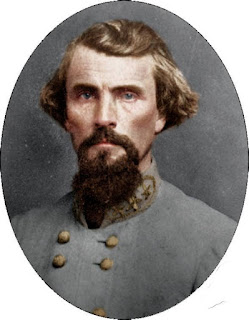
Col. William H. Thomas, from Clark's.

      Thomas had a long and complex history with some of his neighbors, the Cherokee. He ran a store in Qualla Town in Haywood County, and was adopted by Yonaguska, one of the Cherokee chiefs. Some of the Cherokee had agreed to an 1819 treaty in which they accepted land outside of what was considered tribal lands.  Worried that they would be forced west like other Cherokee, this group chose Thomas as their agent in dealing with the Federal government.  Throughout the 1830s and 1840s, Thomas fought for the rights of this small group, going as far as to buy thousands of acres of land for what became known as the Lufty Cherokee. After Yonaguska died, Thomas was elected their chief.[2]

   Because of his role with the Lufty Cherokee, Thomas had the idea of raising a company or battalion of Cherokee warriors to fight for the South. His first attempt, a company called the “Junaluska Zouaves,” really did not go anyplace. Thomas was busy in Raleigh with the secession convention and did not appear to do much recruiting.

   In November 1861, a group of Unionist burned bridges in east Tennessee. Some of the arsonists were caught and imprisoned in Tuscaloosa (read more here). Others were caught and executed, while the majority escaped, some fleeing to western North Carolina. Alarmed at the influx of malcontents, Governor Henry Clark organized ranger companies along the North Carolina-Tennessee boarder. Thomas was slow in organizing his rangers. It was not until April 1862 that the Highland Rangers were mustered into service. Thomas’s command was ordered to East Tennessee to guard railroad bridges. He continued to  recruit, eventually having an infantry regiment, usually under the command of Lt. Col. James R. Love, Jr.; Walker’s battalion, under the command of Lt. Col. William C. Walker;  Levi’s battery, under the command of Capt. John T. Levi; and the Indian Battalion, usually under Thomas.[3]

   It was while in East Tennessee that Thomas first ran into trouble. Thomas’s Legion, because of the rate of desertion, was put under the command of Brig. Gen. Alfred E. Jackson. The two clashed. In August 15, 1863, Jackson placed Thomas under arrest for disobedience of orders. Thomas was sent to Knoxville for trial, and either the trial was interrupted by the arrival of Federals under Ambrose Burnside, or the charges were dismissed.[4]

   In September 1863, as the Confederates abandoned much of east Tennessee, Thomas had orders to join Jackson at Bristol, Tennessee. Instead, Thomas took his Indian battalion and headed for North Carolina. Thomas claimed he had orders to do so, but those don’t seem to survive.[5]

   In December 1863, Thomas moved his command into east Tennessee, possibly planning to spend the winter near Gatlinburg, or possibly in support (and under orders) of Longstreet. Thomas’s command was caught unaware by Federals at Gatlinburg, and after an hour-long fight, retreated back into North Carolina. Soon thereafter, Brig. Gen. Robert B. Vance headed into Tennessee where he was captured on January 14, 1864. New departmental commander Joseph E. Johnston ordered Thomas arrested. The court martial was held in Asheville on February 23, 1864. Once again, the outcome is not known, but Thomas retained his command.[6]

   Thomas continued to try to hold the mountain passes in the Great Smoky Mountains. He struggled to keep not only his men fed, but their families as well. Desertions were rampant, leaving Thomas with too few men. Federals frequently rode into the area, striking at places in Thomas’s rear. Thomas continued to try and recruit, leading to his third arrest and courts martial. The commanding officer of the 6th North Carolina Cavalry charged Thomas on May 11, 1864, for “[k]knowingly entertaining and receiving for his command” over twenty deserters from that regiment. He was charged with both conduct unbecoming an officer and gentleman and for conduct to the prejudice of good order and military discipline. The trial was held in Goldsboro, North Carolina, October 22, 1864. Thomas was probably found guilty of all charges. In all likelihood, Thomas, who immediately went to Richmond, got Jefferson Davis to drop all but one of the guilty verdicts.[7]

   Thomas and his legion are kind of heroes in Confederate service. His Legion, composed of both Whites and Cherokees, does lend even more credence to the idea of a more diversified Confederate army (you can check out more here and here). But Thomas had many detractors during the war. Congressman A.T. Davidson wrote the Secetarty of War that month asking that Thomas’s command be disbanded. Davidson believed that Thomas had “greatly transcended his authority to the prejudice of the service…Thomas’s Indians are worthless and never will do any good.” In March 1863, Col. Benjamin S. Ewell, assistant adjutant general to Joseph E. Johnston, believed that Legions, including Thomas’s, should be broken apart, formed into traditional regiments in regulation brigades. “In their present condition they are inefficient,” he wrote. Another North Carolinian wrote in 1864: “One North Carolinian wrote to Governor Vance: “It is true, W H Thomas is in Jackson [County]. But what does he do? No order ever reaches him or if it does, his own way is the best.”[8]

      Thomas was paroled in Waynesville on May 9, 1865. He was forced to resign as chief of the Eastern Band of Cherokee, and then was sued by them, some say reluctantly, in an effort to gain possession of some of their lands. Thomas suffered with mental issues and died at the mental hospital in Morganton in 1893.[9]


[1] McKinney, “William Holland Thomas,” Dictionary of North Carolina Biography, 6:25.

[2] McKinney, “William Holland Thomas,” Dictionary of North Carolina Biography, 6:25.

[3] Brown and Coffey, North Carolina Troops, 16:31; Crow, Storm in the Mountains, 151.

[4] Brown and Coffey, North Carolina Troops, 16:72.

[5] Brown and Coffey, North Carolina Troops, 16:75.

[6] Brown and Coffey, North Carolina Troops, 16:128.

[7] Brown and Coffey, North Carolina Troops, 16:213.

[8] Brown and Coffey, North Carolina Troops, 16:213.

[9] McKinney, “William Holland Thomas,” Dictionary of North Carolina Biography, 6:25.

Wednesday, January 07, 2026

Longstreet's other plan

Lt. Gen. James Longstreet

A lot of ink has been spilt over the decades on Gen. James Longstreet and the Gettysburg campaign. Believing that they were just fighting defensive battles, Longstreet was opposed to the attacks on July 2 and 3. He wanted to find a defensive position and let the Federals attack them. Frequently lost in the discussion is the fact that Longstreet did not even really want to be on this campaign.

Following Chancellorsville, Confederate Army of Northern Virginia commander Robert E. Lee sought to once again invade the North. He had many reasons, including a dwindling supply of foodstuffs and wanting to pull the enemy army out of Virginia. A Confederate victory on Northern soil might just galvanize the beginning peace party in the North to press for an end to the war. Elsewhere in the Confederacy, the primary Confederate army of the western theater was locked in a siege at Vicksburg, Mississippi. There were some who believed that a portion of the Army of Northern Virginia should be detached and sent to help defeat the Federal forces.

Longstreet was one of those who wanted to ship a portion of the Virginia army west. Writing in the Philadelphia Weekly Times in 1897, Longstreet recalled visiting the Secretary of War James Seddon as he passed through Richmond following his assignment in the Suffolk area. Seddon asked Longstreet his views on the matter of sending part of the ANV west. “I replied that there was a better plan, in my judgement, for relieving Vicksburg than by direct assault upon Grant. I proposed that the army then concentrating at Jackson, Mississippi, be moved swiftly to Tullahoma, where General Bragg was located with a fine army, confronting an army of about equal strength under General Rosecrans, and that at the same time two divisions of my corps be hurried forward to the same point. The simultaneous arrival of these reinforcements would give us a grand army at Tullahoma. With this army General Johnston might speedily crush Rosecrans, and that he should then turn his force towards the north, and with his splendid army march through Tennessee and Kentucky, and threaten the invasion of Ohio.”

When Longstreet met with Lee, “I laid it before him with the freedom justified by our close personal and official relations. . . . We discussed it over and over, and I discovered that his main objection to it was that it would, if adopted, force him to divide his army. He left no room to doubt, however, that he believed the idea of an offensive campaign was not only important, but necessary.”[1]

Longstreet brings up the same argument in 1896 when he pens his autobiography, From Manassas to Appomattox.[2]

Why not reinforce Pemberton in Vicksburg? “Grant seems to be a fighting man, and seems to be determined to fight. Pemberton seems not to be a fighting man. . . the fewer troops he has the better,” Longstreet wrote Wigfall on May 13, 1863.[3]

Historians are mixed on Longstreet’s motivation. Freeman speculates that “It is impossible to say how far his ambition influenced his proposal or to what extent his plan stirred his ambition. Perhaps he dreamed of supplanting Bragg and of winning the decisive victory.”[4] Piston found Longstreet’s proposal “strategically sound,” but questioned his motives. Did Longstreet wish to replace Bragg? Johnston out-ranked Bragg. Maybe Longstreet still preferred serving under Joseph E. Johnston. Piston goes on to agree with Jones and Connelly who wrote that Longstreet was a part of the “western concentration bloc.” This group of men feared that the industries in East Tennessee, Georgia, and Alabama were susceptible to Federal attacks and Bragg should be reinforced by portions of Lee’s army. Longstreet actually wrote Texas Senator Louis T. Wigfall about such a proposal in February 1863 concerning this concentration of troops.[5] Wert argues that Longstreet was not a member of that “western concentration bloc.” He bases this assertion on the letter that Longstreet wrote Wigfall on May 13, 1863. Longstreet told the senator that if a forward movement was ordered, “we can spare nothing from this army to re-enforce in the West.” Instead, the Army of Northern Virginia should be reinforced. “If we could cross the Potomac with one hundred & fifty thousand men, I think we could demand Lincoln to declare his purpose. . . . When I agreed with the Secy & yourself about sending troops west I was under the impression that we would be obliged to remain on the defensive here. But the prospect of an advance changes the aspect of affairs to us entirely.”[6]

Would the proposal of a combination of men and commanders in central Tennessee have reaped the benefits that Longstreet proposed? Maybe. The plan of Lee moving north certainly did not work to the best advantage of the Confederates.


[1] The Annals of War written by Leading Participants North and South, 416-17.

[2] 330-31.

[3] Wert, General James Longstreet, 245.

[4] Freeman, R.E. Lee, 3:20.

[5] Piston, Lee’s Tarnished Lieutenant, 42, 44.

[6] Wert, General James Longstreet, 244-45.


Tuesday, September 30, 2025

Robert E. Lee’s Compiled Service Record

    For anyone wishing to research a person, regiment, or just about anything else connected to the War, the first place to stop is the Compiled Service Records. At the very end of the war, scores of boxes from the Confederate War Department were turned over to Federal officials in Charlotte (you can learn more about this here). These papers were transported to Washington, D.C., where they were gone through by officials, trying to tie Jefferson Davis to the assassination of Abraham Lincoln.

   Part of the War Department papers were the muster roll sheets for the various regiments in Confederate service. These muster rolls were completed once every two months and were used to pay the individual troops. Other correspondence was also included. All of this wound up in Washington, D.C.

   After the war, there were various pension acts passed. For Federal soldiers, the pensions came from the US Congress. For Confederate soldiers, pensions came from their various states. The validity of each claim had to be verified. Were they good soldiers who were honorably discharged versus not-so-good soldiers: men who had deserted or been dishonorably discharged. Beginning in the 1890s, the War Department began creating the Compiled Service Records. The muster roll sheets, regimental returns, descriptive books, information from hospitals, and any other materials the clerks could find were copied onto various cards (usually one for each surviving muster). With other surviving documents, these cards were placed in envelopes and filed away by states and regiments. When a pension applicant or state official wrote the War Department inquiring about a veteran’s service, it was (usually) easy to pull those records, summarize the information, and send a letter with the necessary details.

   Robert E. Lee never served in a regiment. He, along with thousands of others who were staff officers, had a special category  (now known as “Confederate officers). Although Lee served as a military advisor to Jefferson Davis, as commander of the Army of Northern Virginia, and then, toward the end of the conflict, as overall Confederate commander, his folder only contains 66 pieces.

   Several of the cards refer to letters found in other places. For example, there is a card for a letter that Lee wrote to Jefferson Davis on February 19 and February 23, 1865. They are in the file of Charles E. Jones. Both letters deal with correspondence from Beauregard. Another refers to a special order issued on June 2, 1862, assigning Lee to command the army in Virginia.

   One card outlines Lee’s service as commander of the department of South Carolina, Georgia, and East Florida, including a list of his staff; his promotion to brigadier general in the regular Confederate Army; and his parole at Appomattox on April 9, 1865.

   And then there are more mundane things, like a requisition for forage for the third quarter of 1864. Lee had two horses (Traveler and Lucy) and asked for eight pounds of corn and eight pounds of oats, daily. It is interesting that in August 1864, the voucher listed four horses.

   There are pay vouchers for his thirty years of service. It is interesting to note that Lee was paid $301 a month, plus an additional $100 a month for commanding an army, plus an extra $54 a month for his thirty years of service. There are several official letters that Lee wrote. One is dated March 26, 1863, and addressed to Maj. A. H. Cole. His total pay for the months of April, May, June, and July, 1863, was $1,820.00.

   Included is a telegram from Lee to Secretary of War James Seddon, written December 4, 1862, regarding corn in the upper Rappahannock valley; a note from Secretary of War Seddon regarding the nomination of Lee for Commander in Chief; and various other letters while Lee was serving as military advisor to Davis in the spring of 1862.  These include notes to Beauregard, E. Kirby Smith, Lovill, and Josiah Gorgas.

   Also included are a handful of letters from twentieth-century people, including Douglas Southall Freeman, asking for details on Lee’s military service. Writing on August 15, 1925, Freeman was interested in any correspondence from Lee between April 1 and April 10, 1865. Freeman was advised to consult on the Official Records.

   I was curious about how Lee’s Compiled Military Service Record, at 67 pages, stacked up against some of the other Confederate commanders: P.G.T. Beauregard comes in at 170 pages; E. Kirby Smith, 81 pages; and Joseph E. Johnston, 129 pages.

   Once again, if you are going to research a person or regiment/brigade, etc., the Compiled Military Service Records, now housed at the National Archives and available online at fold3.com, is the place to start. You might find nothing, and you might discover a gold mine!

Monday, March 25, 2024

Breckinridge, Lee, Johnston, and the end of the War.


   When the surrender of the two principal Confederate armies is discussed, those conversations focus on two sets of interactions: Robert E. Lee and U.S. Grant at Appomattox and Joseph E. Johnston and William T. Sherman at the Bennett Place. Hovering around the periphery of those discussions is John C. Breckinridge. In the final days, he counselled both Lee and Johnston.

   John C. Breckinridge kind of slips through the cracks of history. While there are scores of biographies on Lee and Johnston, there are only three on Breckinridge. Born in Kentucky, he graduated from Transylvania University, practiced law, and served as an officer in the 3rd Kentucky Volunteers during the war with Mexico. Breckinridge served two terms as a Kentucky legislator, two terms in the U.S. House, as Vice President of the United States under President James Buchanan, and was serving in the U.S. Senate after his term as Vice President expired. Described as not being a “proponent of secession or of extreme state rights views,” he did run against the Lincoln-Hamlin ticket as a Democrat in 1860.[1]

   Breckinridge might just be the most widely-traveled of Confederate generals. Commissioned as brigadier general in November 1861, he saw service in Kentucky, fought at Shiloh, was promoted to major general in April 1862, was in Vicksburg, Baton Rouge, Port Hudson, and at Murfreesboro. In 1863, he led a division at Jackson, Chickamauga, and a corps at Chattanooga. Breckinridge then moved east, leading the Confederate forces at New Market in May 1864, Cold Harbor, and then back to the Shenandoah Valley to defend it against attacks by Federals, eventually leading a corps under Early’s command during the march on Washington, D.C. In January 1865, Breckinridge became the sixth and last Confederate Secretary of War.

Breckinridge, Lee, and Johnston. (LOC)

   Following the breakthrough of Confederate lines below Petersburg on the morning of April 2, 1865, Richmond was abandoned. Jefferson Davis and the Confederate Cabinet boarded the last train out of Richmond that night, leaving the city a blaze. Breckinridge was not with the group. He rode out of the city early on the morning of April 3. Breckinridge took command of a wagon train moving toward Amelia Court House, having at least one brush with Federal cavalry. In Farmville on the night of April 6 or morning of April 7, Breckinridge found Lee and discussed events, with Lee wishing Breckinridge to deliver a message to President Davis.[2]

   While it is not known what all they discussed, Breckinridge does write Davis on April 8. Amelia Court House was occupied by the Federals on April 5; some 800 Federals had been captured near Rice’s Station on April 6; serious Confederate losses had been sustained-- “High Bridge and other points.” It was Lee’s plan to try and get to North Carolina, Breckinridge wrote. He then outlines the disposition of a few other Confederate commands, like Lomax and Echols. “The straggling has been great, and the situation is not favorable,” Breckinridge concluded. Was surrender something that the two had discussed?[3]

   Breckinridge rode toward the south, escaping Federal troops encircling Lee and the Army of Northern Virginia. Lee surrendered on April 9 at Appomattox Court House. On April 11, the day after Davis moved south to North Carolina, Breckinridge arrived in Danville. He set out the following day and reached Davis, meeting with the president at the home of John Wood. It was Breckinridge that brought the official word of Lee’s surrender. That night, Breckinridge met with Joseph E. Johnston.[4]

   According to Johnston, it was his opinion, along with that of P.G.T. Beauregard, that the “Southern Confederacy was overthrown.” Johnston told Breckinridge this and believed that it was Davis’s responsibility to exercise this “power . . . without more delay.” Breckinridge promised to give Johnston the floor to express this view. Johnston was given the opportunity and told the president “that under such circumstances it would be the greatest of human crimes for us to attempt to continue the war.” Davis asked for the views of his cabinet, with Breckinridge, Stephen Mallory, Secretary of the Navy, and John H. Reagan, Postmaster General, concurring. Only Secretary of State Judah P. Benjamin held out hope. Davis agreed to allow Johnston to begin talks with Sherman.[5]

   Davis, with the Confederate cabinet, including Breckinridge, set out from Greensboro, heading to Charlotte, on April 15. Breckinridge was with Davis, and, on the following day, learned that Johnston and Sherman had opened talks. Johnston and Sherman began meeting at the Bennett Farm near Durham, and Johnston wanted Breckinridge to help with the negotiations. It was Johnston’s plan (and Davis’s) that the civil departments be surrendered as well. Not reaching a conclusion at the end of the first day, Johnston requested that Breckinridge join him. Breckinridge arrived, along with Reagan, and joined Johnston in drafting a surrender proposal. When Johnston returned to the Bennett Farm, Breckinridge was also there, and it was Johnston’s idea that Breckinridge join the negotiations. Sherman demurred. Breckinridge was one of those civil officials. Johnston reminded Sherman that Breckinridge was also a major general in the Confederate army, and Breckinridge joined in the debate. Eventually, terms were reached on April 18 and sent to various presidents.[6]

   While standing in the yard of the Bennett farm, waiting for copies of the documents to be made, Sherman took Breckinridge aide. Sherman told Breckinridge that “he had better get away, as the feeling of our people, who had as such announced Mr. Lincoln,  of Illinois, duly and properly elected the President of the United States, and yet that he afterward openly rebelled and taken up arms against the Government. He answered me that he surely would give us no more trouble, and intimated that he would speedily leave the country forever.”[7] Of course, Breckinridge would leave the country, heading to Cuba first, then Great Britian and Canada, before a tour through Europe. Upon being assured that he was covered under President Andrew Johnson’s Amnesty Proclamation of December 1868, Breckinridge returned to Kentucky. He died in Kentucky in 1875.

   Breckinridge’s council with Joseph E. Johnston is well documented. While what Breckinridge and Lee discussed in Farmville on April 7 is seemingly lost to history, the pair had met frequently after Breckinridge assumed the office of Secretary of War, including a three-day stint after Breckinridge failed to get the Confederate senate to pass a resolution demanding Davis open negotiations with Lincoln. Historian William C. Davis, in an essay on the roles of Breckinridge, Lee, and John A. Campbell, believes that, at that Farmville meeting,  Breckinridge and Lee possibly outlined what Lee could do if he was cornered and forced to surrender.[8]  


[1] Davis, The Confederate General, 1:127.

[2] Knight, From Arlington to Appomattox, 494; Davis, Breckinridge, 507.

[3] OR, Vol. 46, pt. 3, 1389.

[4] Davis, Breckinridge, 509.

[5] Johnston, Narrative of Military Operations, 397-99.

[6] Johnston, Narrative of Military Operations, 400-405.

[7] Sherman, Personal memoirs, 2:353-54.

[8] Davis, “Lee, Breckinridge, and Campbell,” in Janney, Petersburg to Appomattox, 155.

Friday, February 25, 2022

George Washington and Jefferson Davis

   There is no doubt that George Washington, the “Father of His Country,” was an inspiration to many in the Southern Confederacy. Washington appeared in the center of the Confederate seal, the $50 note (first series and second series), and on some Confederate bonds. Jefferson Davis used Washington’s birthday – February 22 – when he was inaugurated as the first permanent president of the Confederate in Richmond in 1862.


   While Washington, who died in 1799, and Davis, born in 1808, never met, Davis was well aware of the legacy that Washington left behind. Davis spent many years while serving in the U.S. House, as Secretary of War, and in the US Senate, living in the city named for the first president. How frequently did Davis pass by Greenough’s sculpture of George Washington as Davis passed through the Capitol Rotunda? Davis actually attended the unveiling of the Washington statue in 1856.[1]

   It is not really clear when and to what extent Davis studied the life of Washington. It is clear that it was something he did throughout his life. On June 28, 1845, Davis took to the stage in Vicksburg, Mississippi, to eulogize the recently deceased Andrew Jackson. Davis compared the character of Jackson to that of “the wisest, greatest of them all, the immortal Washington.”[2] In a letter to Malcolm D. Hayes, August 18, 1849, Davis told Malcolm the “Fanatics and demagogues have inflamed popular passion; it has been fed by sectional pride, and we have to meet the evil which Washington deprecated…”[3] Of course, Washington had spoken against political parties in his Farewell Address in 1796.

   Debate arose in the U.S. Senate in January 1850 regarding buying a corrected copy of Washington’s Farewell Address. While Davis had supported the purchase of two other manuscript collections, he was not in favor of this purchase. In his opinion, the “value of the Farewell Address is twofold: first, for the opinions contained in it; and next, the authority from which they are derived.”[4]

   In a campaign speech in Fayette, Mississippi, July 11, 1851, Davis broached the subject of Washington and the right of secession. Davis, according to a newspaper editor, believed that the “Declaration of Independence recognized the right of secession under circumstances of oppression and injustice. [Davis] wanted to see the man who would come forward with arguments to show that if a country has a right to secede from an oppressive government, as did the United States did from Great Britain, why States had no right to secede from the federal government under similar circumstances. How could the colonies have greater power than the States?” Washington was a Federalist in line with Alexander Hamilton and John Adams. He supposedly told Edmund Randolph in 1795 that if the United States dissolved, he would join the North. [5] “Whilst that great and good man who always opposed State coercion, Gen. Washington,” Davis continued, “in his farewell address discountenanced the perversion of power in the sovereign acts of a State, but he left it to this degenerate race to discover that treason could be committed by a sovereignty.” Davis then explored the threat of Kentucky to secede over free navigation of the Mississippi in 1795. “Did President Washington seek to turn the sword against Kentucky[?]  No, he had used the sword on the battle field. . . He knew its value-its uses and its abuses. . . Did he. . . threaten to coerce, and to force into submission? No, he called upon a friend, Col. Ellis, and proceeded at once to give Kentucky her request, by a negotiation with Spain, which secured to Kentucky, that which made peace and gave satisfaction.”[6]

   In a report to President Franklin Pierce, regarding the condition of the various militia regiments in the various states, Davis, advocating militia reform, actually quoted Washington, who believed that militia reform was “abundantly urged by its own importance.”[7] In June of 1860 Davis learned that several Mississippians in Washington, D.C. were in the process of having a cane made from wood at Mount Vernon to present to Davis.[8] Once the Southern states broke from the Union, there were comparisons made by many people, comparing Davis to Washington. One such comparison came from Florida’s David Yulee on February 13, 1861.[9] Another came from Gen. Joseph E. Johnston, who wrote on June 26, 1861, “We require now. . . that you should appear in the position Genl. Washington occupied during the revolution.”[10] This opinion would continue through 1863. Henry S. Foote wrote Davis in August 1863 that Southern people considered Davis “a second Washington.”[11] In December 1862, Sarah E. Yancey, the wife of William L. Yancey, sent Davis George Washington’s spyglass as a gift.[12] In October 1864, as Davis was passing through Columbia, South Carolina, a group of young boys serenaded Davis with “May you live long Sir an honor to your Country and bright example to the world like Washington was.”[13]

   Davis and Alexander Stephens used the George Washington equestrian statue in Richmond as the site of their inauguration in February 1862. Since so many compared Davis to Washington, the pageantry was obvious.[14] It would be natural for Confederate leaders to adopt George Washington. He was a son of Virginia, and almost ninety years earlier, had led a group of thirteen independent colonies towards victory over the most powerful nation in the world. Henry “Light Horse” Lee, another famous Virginian, had declared Washington “First in War, First in Peace, and First in the Hearts of His Countrymen” at his death. Davis undoubtedly knew that story and wanted to follow in the steps of Washington.


[1] Jefferson Davis Papers, 6:liii

[2] Jefferson Davis Papers, 2:272.

[3] Jefferson Davis Papers, 4:28

[4] Jefferson Davis Papers, 4:60.

[5] Wood, Revolutionary Founders, 59.

[6] Jefferson Davis Papers, 4:207-09.

[7] Jefferson Davis Papers, 6:90.

[8] Jefferson Davis Papers, 6:665

[9] Jefferson Davis Papers, 7:40.

[10] Jefferson Davis Papers, 7:213.

[11] Jefferson Davis Papers, 9:356.

[12] Jefferson Davis Papers, 10:112.

[13] Jefferson Davis Papers, 11:81.

[14] Richmond Dispatch, February 22, 1862.

Thursday, February 10, 2022

Confederate Escort Companies


   At first glance, the title, “Confederate Escort Company,” might seem suggestive. But in reality, the escort companies that hovered around the headquarters of various generals probably served more of a utilitarian service than one providing comforts. Yet the role of Confederate escort companies is a topic that seems to slip through the cracks of Confederate history.

   What exactly would an escort company be? Where they simply there to ride around with a general, keeping him safe, or did they perform some function? Escort Companies likely served as scouts, guides, and couriers for their commanding officers. Probably the most famous two, or at least the two most documented, are the 39th Battalion Virginia Cavalry, who served in the Army of Northern Virginia, and Forrest’s Escort Company, under the command of Nathan Bedford Forrest.

   The men of the 39th Battalion Virginia Cavalry, also known as Lee’s Body Guard, were recruited in the last half of 1862. Some members of the battalion were conscripts. Prior to that date, various cavalry companies were dispatched to headquarters to serve as couriers and guides. Cavalry commanders complained that their regiments were operating with fewer and fewer men. Richard Ewell had a company in mid-1862 known as Ewell’s Body Guard. This was the core unit of what became the 39th Battalion, which eventually numbered four companies. These men did just about everything. They escorted prisoners to Richmond, escorted new conscripts to their regiments, relayed messages between telegraph stations and headquarters, drove headquarters wagons, and delivered messages. You can learn more by checking out my book, Lee’s Body Guard, here

Nathan Bedford Forrest

   Forrest’s Escort Company was made up of men recruited by Nathan Bedford Forrest. Much of this company came from Bedford County, Tennessee, and was likewise recruited in mid-1862. Montgomery Little, who raised the company, was the first captain. Unlike the 39th Battalion Virginia Cavalry, Forrest’s Escort Company was a front-line fighting unit and was engaged with Forrest at places like Trenton, Tennessee, in December 1862. The Escort Company, like their command, was often in the thick of the fighting. At least 25 members of the company were killed during the war. A great resource on this command is Michael Bradley’s Nathan Bedford Forrest’s Escort and Staff.

   Another escort company with perhaps less information available is Shockley’s Escort Company, formed from students at the University of Alabama in 1864. The company numbered over 100 students and was created in mid-1864. They originally served as the escort company for General Gideon J. Pillow, but after the battle of LaFayette, Georgia, they transferred and served as an escort company under Brig. Gen. Daniel W. Adams, in the command of Nathan Bedford Forrest. Most of the company was captured on April 1, 1865. The rest surrendered on May 10, 1865, at Gainesville, Alabama. William Hoole wrote History of Shockley’s Alabama Escort Company in 1983.

    There are other commands that served as escorts throughout the war. Detailed histories of these groups seem to be lacking. In January 1863, Bolen’s (Kentucky) cavalry company was listed as an escort company to Brig. Gen. John Adams, Fourth Military District, in the Department of Mississippi and East Louisiana. (OR, vol. 24, pt 3, 613)

Company A, 7th Tennessee Cavalry, under Capt. W.F. Taylor, was listed as Maj. Gen. Stephen D. Lee’s escort on August 20, 1863 – Department of Mississippi and East Louisiana. (OR, Vol. 30, pt. 4, 515.)

On December 31, 1863, the Army of Tennessee, Joseph E. Johnston commanding, listed the following escorts: (OR, Vol. 31, pt. 3, 889

1st Louisiana Cavalry – army headquarters

Raum’s (Mississippi) Cavalry Company – Hardee’s Corps

Merritt’s (Georgia) Cavalry Company – Cheatham’s division

Vandyke’s (Tennessee) Cavalry Company – Stevenson’s Division

Sanders’s (Tennessee) Cavalry Company – Cleburne’s division

Boydstum’s (Georgia) Cavalry Company – Walker’s Division

Lenoir’s (Alabama) Cavalry Company – Hindman’s division

Foules’s (Mississippi) Cavalry Company – Breckinridge’s division 

This is a topic that deserves much more research, especially in the Army of Tennessee and the Trans-Mississippi Department.